

By Kingsley Webora TANKEH
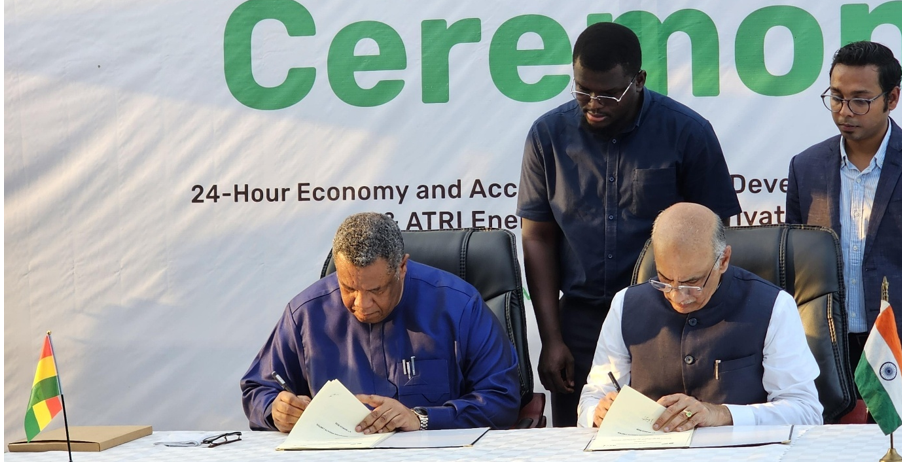
The 24-Hour Economy Authority has signed a memorandum of understanding (MoU) with ATRI Energy, an Indian renewable energy company, to provide affordable and sustainable industrial power along the Volta Economic Corridor and develop agro-ecological parks in the country.
The deal was signed in Accra on Friday, March 5, 2026. The framework outlined several projects spanning solar power generation, oil palm plantations, agro-processing and a personal rapid transport system from Oyarifa to the central business district of Accra in collaboration with the Ghana Railway Authority to reduce reliance on private vehicles and cut travel times.
Speaking to the media after the signing, the Presidential Advisor on the 24-Hour Economy and Accelerated Export Development, Augustus Goosie Tanoh, said the combined initiatives would create several employment opportunities, particularly for young people along the northern corridor. He noted the projects will generate over 165,000 direct and indirect jobs.
“What is important for us is that at the end of the day, these projects will create jobs for the teeming number of unemployed Ghanaians,” he said.
Under the terms of the MoU, ATRI Energy is committing to a 15-year investment plan involving US$10 billion between 2026 and 2031, with the first set of eight binding joint development agreements to be signed in the coming days.
These include a 1,500 megawatt solar farm in Buipe, a 40,000-hectare oil palm plantation in Nkwanta North, napier grass production across Nkwanta North and the Savannah Region, and the development of agro-ecological parks in the Sanga-Kumbungu-Savlugu belt to supply fresh produce to the Tamale Cargo Hub for export.
Mr Tanoh explained that the MoU with ATRI Energy aligns with the government’s commitment to providing affordable power for industry. He revealed that the government intends to establish a special purpose vehicle, PAX Energy, to attract private sector investment for power distribution and the upgrading of transmission infrastructure.
He emphasised that electricity injected into the national grid under the 24-Hour Economy programme must remain within a cap of US$0.07 per kilowatt-hour when supported by battery storage, or between US$0.04 and US$0.05 per kilowatt-hour for generation without storage.
“We will sell to ECG and so on, but we’ll also insist that they cap how they sell it finally to retail consumers and wholesale consumers,” Mr Tanoh explained, comparing Ghana to neighbouring countries that are already selling cheaper power to industry.
“Countries around us are offering cheaper energy. Benin is offering US$0.07 per kilowatt-hour, and we have to also move in tandem,” he noted.
Mr. Tanoh indicated that the initiative aims to inject 2,000 megawatts into the grid over the next five years to serve the Volta Economic Corridor and sell the excess to licensed participants.
The Founder and Promoter of ATRI Energy Transition Private Limited, S. Kishore, pledged that the projects will be executed timely, saying some of them may even be delivered within 24 months.
Mr. Kishore indicated that the company views congestion as an opportunity rather than a problem. “When people complain of congestion, we find it as an opportunity because we will give you something by which you can decongest,” he said.
He revealed that the company is planning to launch three pilot projects immediately: a 20-tonnes-per-day biofuel plant, a 100 megawatt solar project, and the 18-kilometre personal rapid transport in Accra.
He said the company already has about 1,000 buses, which are expected to be converted to electric vehicles over the next two years, either through retrofit or new bus acquisition.
Mr. Tanoh confirmed that the secretariat is working with the Council for Scientific and Industrial Research (CSIR) and the Kwame Nkrumah University of Science and Technology (KNUST) to ensure technology transfer and the incorporation of local innovation.
He noted that the agriculture component of the deal will be facilitated by what he described as a ‘participatory land access model’. This approach seeks to circumvent the land litigation that has historically plagued large-scale agriculture projects in the country.
Chief of Staff, Julius Debrah, who witnessed the signing on behalf of President Mahama, said the partnership falls within government’s vision for the Volta Economic Corridor.
“Government alone cannot deliver this transformation. Our responsibility is to provide the enabling environment—clear policy, regulatory certainty, and the infrastructure that supports your investment,” he said.
Post Views: 18
Discover more from The Business & Financial Times
Subscribe to get the latest posts sent to your email.