
The oppressive heat and its twin, humidity, stick around even after my departure from Abidjan. My mind is yet to ease on involuntary aerobics: converting the CFA to South African rand. My destination, Yamoussoukro, replaced Abidjan as the capital city decades ago.
But, Babi, as locals refer to their city, remains the heart and soul of Côte d’Ivoire. It is, second to Lagos, West Africa’s second-largest city. Skyscrapers speak of economic growth. Expensive apartments chime in. Ébrié lagoon, on which the sun glistens now, stretches way too far but does nothing to calm the heat. The nightlife is great: even the fashion and the food.
For the city’s residents, Abidjan is the capital of coolness. As they say here: Babi est zoo (zoh). Babi’s cool.
Yamoussoukro, a city of low-rise buildings, is synonymous with the concept of liberalised African skies – five freedoms in the aviation parlance. Decades later, that concept remains in a hangar. To switch lanes, cooperation in arts and culture has been alive for eons. Years ago it was Brenda Fassie and Magic System. Davido and Nasty C as well as Tyla and Tems are doing it. Politically-inspired Fela Kuti, Harry Belafonte and then-exiled Hugh Masekela did it. Southern African filmmakers tend to look beyond the continent.

I am getting ahead of myself. The receding sights – as our orange bus slugs A3 to the north this morning, the road that scythes the land for 700-km – are tracks of verdant land. Beyond savannah, the eclectic terrain includes many plains, rolling hills and craggy grounds. The south is dotted by lagoons and hemmed by a coastline of 600-km. Contrast that to desert-like north where Sudanese-style mosques are. In the mountainous northwest, where the country meets Guinea and Liberia, sits a pretty Mount Nimba Integral Nature Reserve – declared a world heritage site in 1982. Mt Nimba resembles the equally stunning Maloti and uKhahlamba as well as Makhonjwa back in Southern Africa.
On either side of A3, palm and coconut trees salute passers-by as if to say Akwaaba. Also in the mix are cashew, cocoa and coffee plantations. Cocoa, Côte d’Ivoire’s top export, is at the heart of the country’s economy. Alas, as the world’s leading producer, the nation missed opportunities by exporting raw cocoa but is now set to leverage on its gift and earn forex and bolster its skills base through initiatives such as the recently-launched 21-hectare cocoa processing complex that cost $230 million.

Beyond cocoa, the story of Abidjan’s texture and rhythm, partly captured in surreal Marabout Cheri, for one, is incomplete without a mention of a maquis, a lively open-air eatery. One September evening, on my second visit to a maquis in Babi, great company made the ambience even tastier. Delectable. So was the food. Two women in smart-casual African print approach from a yellow taxi painted Glorie a Dieu (Glory unto God). Inshallah, Shalom, declare others. Many other vehicles, including trucks, bear religious messages. Others praise Didier Drogba, Kolo Touré and their fellow top male footballers. Over there, waves’ whispers grow louder by the hour. Menus brim with tasty juices and hearty meals: alloco, chicken, garba, goat meat, jollof rice and attiéké (pronounced acheke). Unesco now lauds attiéké a must-eat cassava-based staple, often enjoyed with fish, gravy and fried onions, for its import to humanity. In 2024 the organisation added the dish to the world’s list of intangible cultural heritage.
A few male patrons, in Afro-chic suits, nostalgically sing along to Premier Gaou by the iconic Magic System. By the way, that band had a track with Brenda Fassie – a rare fusion of genres and regional tastes, with traces of five languages. This evening, club DJs serve genres like Afrobeats, coupé-décalé and infectious zouglou. On the playlist of a club – at Babi’s upmarket Cocody (near must-see Banco park) – is a chart-topping Serge Beynaud once crowned, by the Kundé, as the Best Artist in West Africa. Awesome.
Despite the country ticking the right boxes when it comes to culture, infrastructure, air connectivity, and, generally, sights that would make photographers swoon, it is doing poorly in inbound tourist traffic. On the other hand, beyond filmmakers from Francophone nations, few creatives consider these climes as film location. The mix of sea views, world heritage sites (now totalling five, West Africa’s second highest behind Senegal), rainforests, undulating mountains, a surfer’s paradise in Assinie, lagoons and other gifts from Mother Nature seem to count for little. To be fair, the region is an “unchartered territory for most English-speaking Africans,” asserted author Sihle Khumalo on his maiden visit to West Africa.
While taking in the beauty also seen in locally-produced films, like Bal Poussière, I’m reminded of the nation’s push to be a movie hub. It’s a tall order given Nigeria’s dominance. However, despite downsides – including lazy location scouts or limited tourist traffic – early signs show that the cocoa-producing nation can do it.
But, pity, even classics like award-winning Bal Poussière, which has had plenty runs and re-runs in Côte d’Ivoire, and made it to Cannes Classic, rarely make it to Southern Africa. “Bal Poussiere is a hugely entertaining film about the love-games men and women play, while Hynes is a masterpiece of symbolism and cinematic intrigue as it explores the dynamism of history and tradition. Neither is to be missed,” wrote the Mail & Guardian in 1997. That was then with the country keen to culturally reintegrate with the rest of Africa. These days, TV chiefs play Eurocentric. Likewise, the Durban International Film Festival puts European projects on a pedestal and treats the Global South and Africa poorly. No surprise then that southerners – cinephiles and average consumers – miss out on, for instance, Les coups de la vie, Ivanna and Dans la pleau d’un caïd among other old and new Ivorian films that I got introduced to before and after my visit to the country.
In film, continental collaborations remain rare. “We are not seeing many co-productions, but we, first as individuals, must change this. When we network let us be mindful of fostering relations,” Durban-based industry expert Sakhile Gumede said, decrying missed opportunities. “(Tourism) and film are interlinked. Look at location. Filmmaking is huge, but it’s often underrated. When some leaders think tourism, they think of aspects such as game parks but hardly consider film.”
On the upside, the Ivorian film sector is relishing what’s widely dubbed a historic double victory: Éve Guehi and Akakpo Massé Fortuné, thespians in Les Nounous, are the reigning Best African Actress and Best African Actor after their respective wins at Sotigui Awards (TV series). “[The accolades] confirm the rise of Ivorian cinema on the African scene,” wrote Fratmat, adding that the Franck Vléhi-produced series is now one of the most-watched in Côte d’Ivoire and neighbouring countries.
Expanding its scope of productions, beyond Francophone movies, could boost tourist traffic. Abroad, The White Lotus boosted hotel bookings in Hawaii and Sicily. Thai tourism chiefs later hailed the series for bristling reservations in Phuket and Samui. Prior to that, and closer to home, Umkhokha, then South Africa’s most-watched DStv show, reportedly accounted for a thick slice of the 1.3 million people who visited Durban one December. Overall, the visitors sustained 11,500 jobs having injected billions of South African rand in revenues.

On the downside, South Africa and its neighbours barely bring any slices of the rest of Africa to these shores. When watching TV in the south, you’re ten times likely to see a film from Britain or Australia that you would a West African production. Radio listeners across the spectrum – from 947 to Lesedi, RSG and even Kaya, which formerly posed as home to Afropolitans – barely hear music from Algeria, Ethiopia, Madagascar, Zambia or elsewhere on the continent. In contrast, TV productions from the south and music of AKA, Uncle Waffles and others get a share of the airwaves and dancefloors in West Africa.
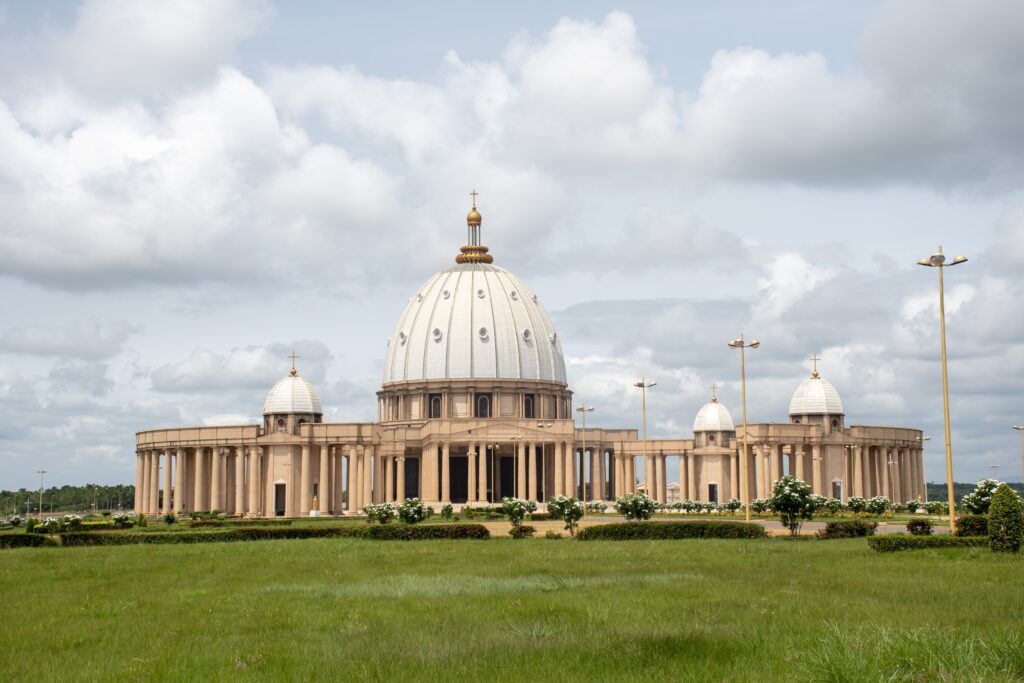
Trees hug Yamoussoukro’s wide roads, quietly watching as people come and go. Tourists trickle to see the world’s largest basilica and the crocodile lake. For me, it’ll just be Notre-Dame de la Paix, thanks. The basilica was built as a tribute to peace, hence the name. Well, it is not as gigantic as I’d imagined but bewilderingly staggering! The basilica has three grand sections. One of those is a cathedral that holds up to 18,000 souls, nearly three times the capacity of Regina Mundi’s, Soweto, Southern Africa’s largest cathedral. Overall, Notre-Dame’s premises can accommodate north of 200,000 people outdoors. Massive.
Next on my journey is Abidjan, en route to the picturesque Grand-Bassam, declared a world heritage site in 2012. The trip to Bassam is a shorter and the mood more relaxed as the sun takes a bow. Outside my window, palm trees heave and sway. Shades of green offer the background with Ébrié lagoon giving the area an island feel. Bassam is slow-paced but soulful. Horses gallop on the beach where young and old chill, and others play volleyball. Pretty sights. And, they linger. Just like the taste of attiéké and zouglou.
By Shoks Mnisi Mzolo