

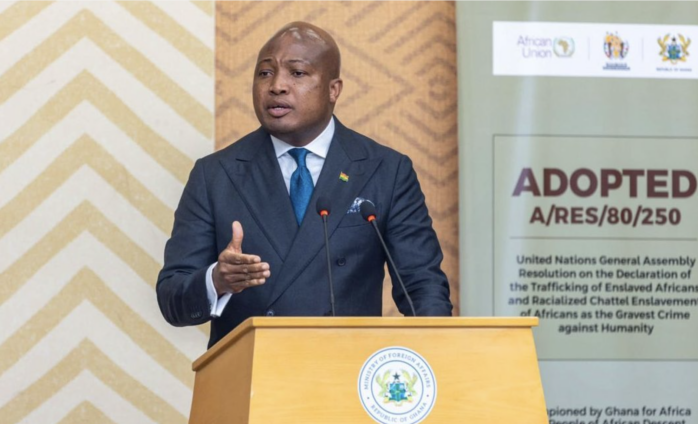
Minister for Foreign Affairs, Samuel Okudzeto Ablakwa, has provided detailed clarification on the government’s newly announced free visa policy for African citizens.
In a post shared on X to address public expectations and underline key safeguards embedded in the initiative.
The policy, unveiled by President John Mahama, is due to take effect on Africa Day, 2026. It will allow travellers from across the continent to apply for Ghanaian visas without paying any fees, marking a significant step towards easing movement within Africa.
However, Mr Ablakwa’s post sought to dispel what he described as widespread misconceptions, stressing that “free visa” does not translate into unrestricted or automatic entry.
“Gratis, but not without scrutiny”
Central to the Minister’s explanation is the distinction between cost and process. While African applicants will no longer pay visa fees, they will still be subject to the same application procedures and screening requirements as other travellers.
“All applicants including Africans will have to apply for visas,” he noted, adding that the only difference is that their applications will be processed free of charge.
This means prospective visitors must complete an online application via a soon-to-be-launched e-visa platform, which will become the exclusive channel for all visa requests into Ghana.
E-visa system at the heart of reform
Mr. Ablakwa emphasised that the free visa policy is not a standalone measure but a component of a broader digital transformation in Ghana’s immigration system.
The government is introducing an electronic visa regime next month, designed to streamline applications while strengthening border controls.
The new system will be integrated with Ghana’s API-PNR (Advance Passenger Information and Passenger Name Record) infrastructure, as well as international crime databases.
According to the Minister, this will enable consular officials to conduct thorough background checks before granting entry.
“The novel e-visa system shall allow our officers to check the background of applicants and provide appropriate vetting to ensure Ghana’s security is not compromised,” he explained.
Facts about Ghana’s new Free Visas for Africans Policy as announced by President Mahama:
1) Africans will not pay visa fees;
2) Not paying visa fees does not mean you will not go through visa screening. Africans will still have to go through a visa application process like…
— Sam Okudzeto Ablakwa (@S_OkudzetoAblak) April 3, 2026
No automatic entry
A key point repeatedly highlighted in the Minister’s post is that the removal of visa fees does not equate to automatic admission into the country. Individuals with criminal records or those deemed to pose a risk will be refused entry.
“There shall be no automatic and unvetted entries,” Mr Ablakwa stressed, reinforcing the government’s position that national security remains paramount.
This clarification appears aimed at addressing concerns that the policy could expose the country to security threats or irregular migration.
Backed by investment and infrastructure
The Minister also revealed that significant investments have been made by the Ministries of Foreign Affairs, Interior and Transport to support the rollout.
These investments, he said, have resulted in a “robust and technologically advanced architecture” capable of handling both the e-visa system and the free visa initiative.
The integration of modern technology is expected to improve efficiency in visa processing while maintaining rigorous screening standards.
Learning from past delays
In his post, Mr Ablakwa also addressed the history of the policy, noting that a similar घोषणा had been made in 2024 by former President Nana Akufo-Addo.
However, that earlier initiative could not be implemented due to the absence of the necessary security and operational frameworks.
He indicated that the current administration has now resolved those challenges, making it possible to proceed with both the e-visa platform and the free visa regime.
“For clarity, though former President Nana Akufo-Addo announced a Free Visa for Africans policy in 2024, that could not commence because the mechanisms and security safeguards had not yet been put in place,” the post read.
The announcement of the policy itself followed bilateral talks between President Mahama and Emmerson Mnangagwa during an African Union summit, highlighting its broader continental significance.
DISCLAIMER: The Views, Comments, Opinions, Contributions and Statements made by Readers and Contributors on this platform do not necessarily represent the views or policy of Multimedia Group Limited.
DISCLAIMER: The Views, Comments, Opinions, Contributions and Statements made by Readers and Contributors on this platform do not necessarily represent the views or policy of Multimedia Group Limited.
Source link