
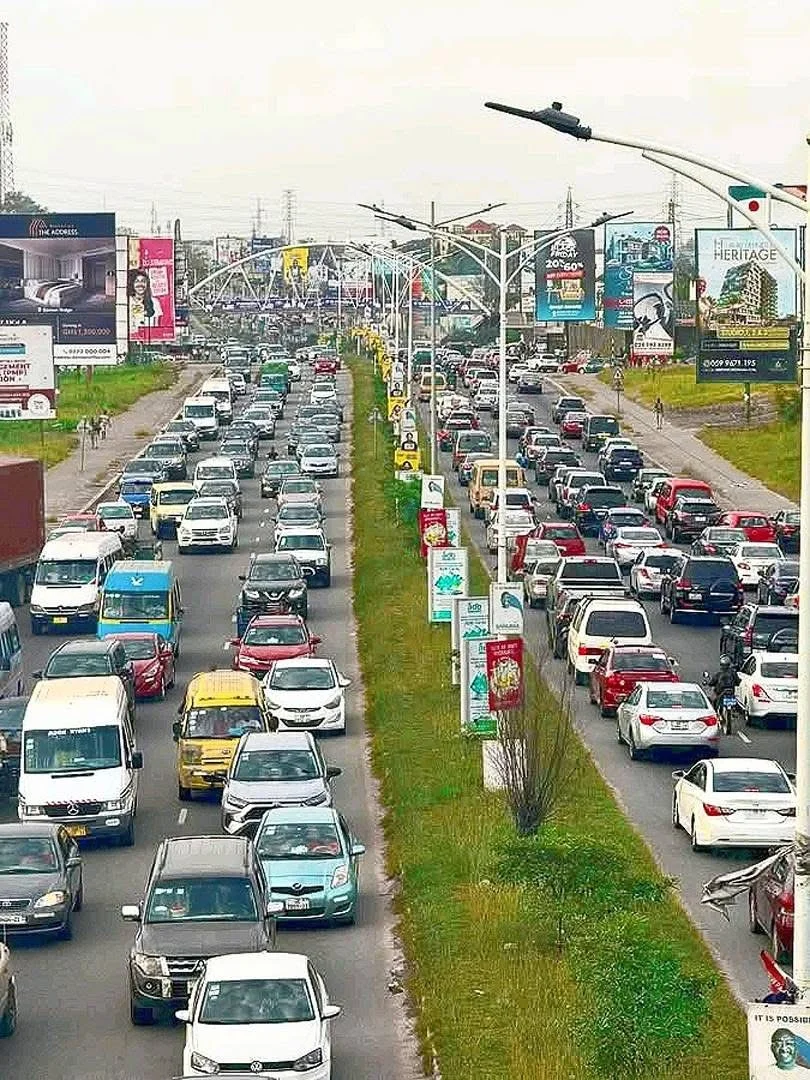
Traffic gridlock in Ghana’s capital is costing the national economy an estimated GH¢4.5 billion every year, according to a new policy brief by Glima Research, a Ghana-based consulting firm.
The report, titled “The cost of gridlock: a policy brief on Ghana’s Urban Traffic Crisis,” highlights how long hours spent in traffic during peak periods are severely undermining worker productivity, draining household incomes, and diminishing quality of life in Accra and other urban centres.
Lead research analyst Andy Sevordzi and geodetic engineer Franklin Owusu-Kwakye co-authored the study, with contributions from statistician Yusif Mohammed and biochemist Rudolph Djirackor.
The breakdown of the annual economic losses shows that time wasted in traffic accounts for the largest share at approximately GH¢3.2 billion, or 71% of the total cost.
Fuel wastage from vehicles idling in congestion contributes GH¢434 million (about 10%), while productivity losses due to stress and fatigue add another GH¢815 million (18%).
Researchers used the heavily congested Madina–37 corridor in Accra as a primary case study. Through data modelling, they quantified time losses, fuel consumption, and productivity impacts on that route before applying Glima’s traffic multiplier model to estimate the nationwide economic burden.
“Traffic congestion, particularly in Accra, is more than just a nuisance; it is a massive economic sinkhole quietly draining productivity, income, and quality of life,” a GNA report quoted the report. “This crisis is far from static — it is escalating. As Ghana’s urban population continues to rise, especially in key growth areas, so will the number of vehicles, the hours lost to traffic, and the economic damage caused by traffic paralysis.”
The environmental consequences are equally concerning. The study estimates that excess fuel consumption from idling vehicles generates around 73,000 metric tons of additional carbon dioxide emissions annually — an impact equivalent to neutralising the carbon sequestration benefit of roughly 3 million trees each year.
On the Madina–37 corridor alone, congestion-induced stress and fatigue reduce effective daily work output by about 30 minutes per commuter, resulting in an annual productivity loss of GH¢72.8 million.
Other major routes such as Spintex Road, Mallam–Kasoa, and Circle–Achimota experience similar or worse bottlenecks during rush hours, while several regional capitals also face growing traffic challenges that compound the national economic toll.
To tackle the crisis, the report recommends urgent and multi-pronged interventions. These include widening critical road segments, upgrading feeder and inner roads to ease pressure on arterial highways, installing smart traffic management systems, and deploying intelligent traffic lights.
It also calls for graveling or concreting alternative routes in residential areas, as well as decentralising government offices and commercial hubs to reduce travel demand in the capital.
“Urban mobility investments are no longer optional but urgent, high-return economic priorities essential to safeguarding Ghana’s productivity, environmental sustainability, and long-term development,” the researchers emphasised.
While road widening can deliver quick relief, the report stresses that lasting solutions must be forward-looking, anticipating future population and vehicle growth rather than simply reacting to present congestion levels.