
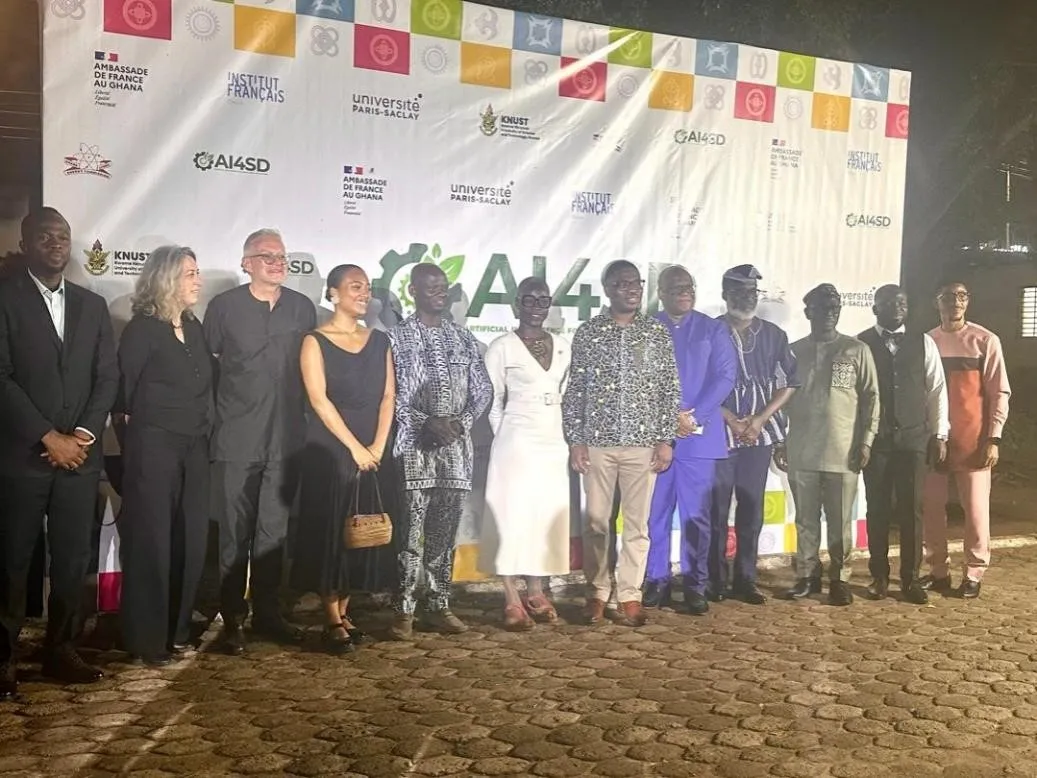

The Artificial Intelligence for Sustainable Development (AI4SD) project, spearheaded by the Kwame Nkrumah University of Science and Technology (KNUST) and funded by the French Embassy in Ghana, has developed a robust home-grown ecosystem where technology serves the people.

The AI4SD, a multi-partner initiative, is positioning Ghana at the forefront of the technological revolution in West Africa, harnessing the power of Artificial Intelligence (AI) to tackle the nation’s most pressing challenges in agriculture, health and education.
Research Engineer – Université Paris-Saclay, Dr. Daniel Adjei, speaking at a first anniversary commemoration event for AI4SD in Accra, highlighted the relevance of the initiative. He noted that African countries must build their own AI infrastructure to solve their unique and dynamic needs.
He emphasised that the initiative focuses on applied research tailored to Ghana’s specific needs in agriculture, health and education.
“AI is no longer a distant technology; it is already shaping our world, and Ghana and Africa as a whole cannot be left out.
“Through collaboration, innovation and knowledge sharing, we can build our own AI systems. We must reinforce the inclusivity and diversity of AI systems, strengthen human capacity and close gaps to enhance productivity and skills development,” he said.
Championing this development in Ghana is the KNUST and it has presented that in just a year, the initiative is yielding tangible results across multiple sectors.

Professor John Jerry Kponyo, Director of the Responsible AI Lab (RAIL) at KNUST, highlighted that in agriculture, his team has developed a crop disease detection toolbox that analyses the colour and damage of a crop leaf to accurately diagnose the disease, offering low-cost support to smallholder farmers. A smart, indigenous weather app is also in development to provide localised climate data.
In the energy sector, solutions have been co-created with the Ghana Grid Company (GRIDCo) to predict damage to machines and transformers, allowing for preemptive maintenance.
The initiative has also broken ground in healthcare, with projects focused on diagnosing rare diseases in infants and using AI for clean water, and developing methods to remove heavy metals from water bodies polluted by illegal mining activities.
The human element of this technological push is just as critical as the code. The project is deeply invested in cultivating the next generation of Ghanaian innovators.
Prof. Kponyo highlighted the establishment of 15 Robotics clubs in Senior High Schools across the country, equipped with 45 laptops and robotics kits to foster hands-on learning.
Furthermore, the SheCodes Clubs have been created to support and encourage young women in universities, directly addressing the gender gap in the tech industry.
Director-General, Ghana Atomic Energy Commission (GAEC), Professor Samuel Boakye Dampare, expressed the institution’s gratitude to the French Government for its support.
He emphasised that as the chief advisor to the government on energy, nuclear energy and the green transition, GAEC is leveraging the AI4SD framework to develop its own systems.
“Under the AI4SD initiative, GAEC is developing systems for agriculture and health, including machine learning models, predictive tools and dashboards for weather prediction,” he revealed.
French Ambassador to Ghana, Diarra Dimé-Labille, expressed profound admiration for the programme’s impact in just the first year of roll-out.
She underscored that AI transcends being a mere technological issue, positioning it firmly within the realms of social and human development.
“Ghana benefits from a thriving AI ecosystem and with support from development partners, the AI4SD project is investing in long-term partnerships and development to create opportunities for the younger generation.” She specifically praised the SheCodes programme as a vital tool for bridging the gender gap where women remain underrepresented, reinforcing the commitment to an inclusive digital future.
Through this culture of collaboration and knowledge sharing between Ghana and France, led by KNUST and Université Paris-Saclay, the AI4SD project is ensuring that the builders of Ghana’s future AI systems are being trained in the very schools and labs the project supports today.
Post Views: 3
Discover more from The Business & Financial Times
Subscribe to get the latest posts sent to your email.