
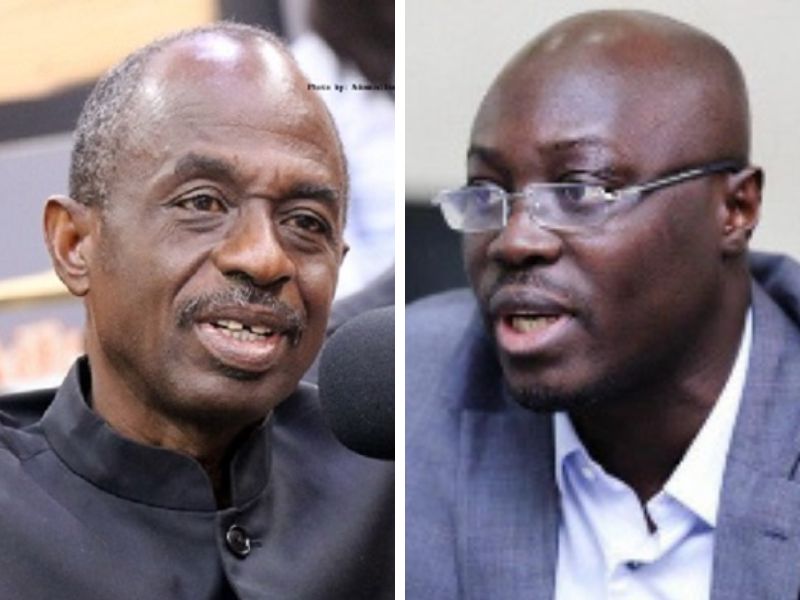
The National Democratic Congress’s party chairman, Johnson Asiedu Nketia, maintains his lead in the race to become the party’s next presidential flagbearer, polling at 29% among delegates.
But a fresh tracking poll suggests his position is under growing pressure as Finance Minister Ato Forson’s support surges, narrowing what was once a commanding 16-point advantage to just 10 points in less than two weeks.
The findings come from a Global InfoAnalytics poll conducted between March 31 and April 9, which surveyed nearly 10,400 NDC delegates across all 16 regions using telephone interviews.
It represents the first public measurement of delegate sentiment since the contest to succeed President John Mahama began to take shape.
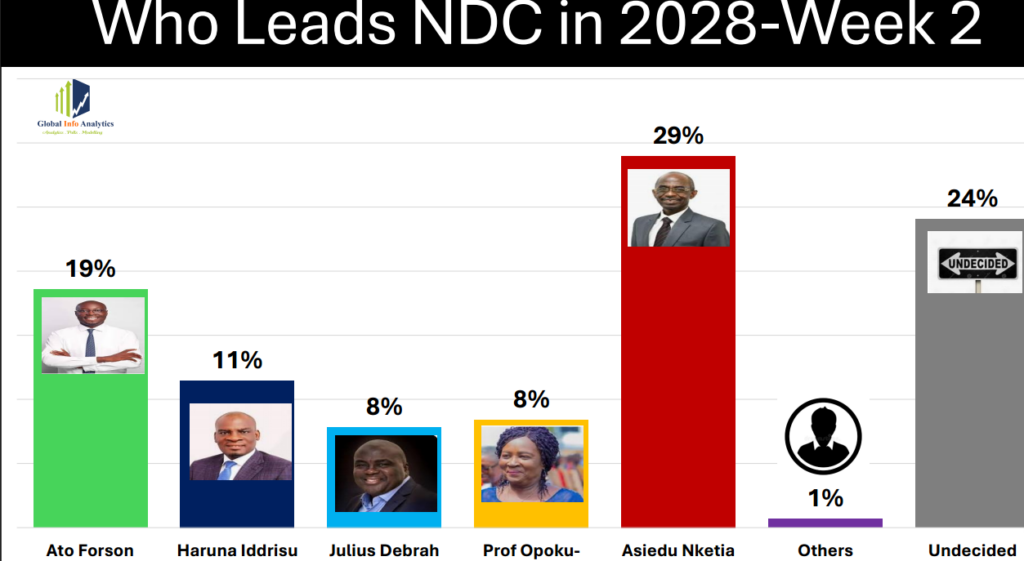
Nketia, who has been criss-crossing the country on a “thank you” tour, leads with 29% support in the second poll round. Ato Forson stands at 19%, followed by Haruna Iddrisu at 11%, Julius Debrah and Prof Jane Naana Opoku-Agyemang tied at 8%, with 1% supporting others and 24% still undecided.
In the first poll a week earlier, Nketia had led Forson 28% to 12%—a gap that has tightened as undecided delegates have broken toward the finance minister.
Pollsters at Global InfoAnalytics noted that “all the major candidates make significant gains except the party chairman, even as his tour gathers pace.”
For Forson, who has made no public declaration of intent to run, the data presents a paradox: he is rapidly becoming a serious contender without formally entering the race.
Political observers say that 19% support from an undeclared candidate signals a genuine grassroots appetite.
In one-on-one matchups, Nketia leads Forson 37% to 32%, but that five-point margin is significantly tighter than his leads over other rivals.
Regional dynamics reveal another vulnerability for the chairman.
Haruna Iddrisu commands 35% support in the Northern Region—his home base—while Nketia slips to just 26% there. In the Swing Region (Greater Accra, Central, Eastern, Western), where delegates are less ethnically or regionally bound, Nketia recovers strength, polling at 28% compared to Forson’s 28%.
The broader contest remains fluid. About 24% of delegates remain undecided, a pool large enough to reshape the race.
Nketia’s one-point gain from the first poll suggests his nationwide tour, while keeping him in the lead, has not solidified support or meaningfully converted undecided voters.
Among delegates’ priorities, 74% prioritize performance, 53% want a visionary leader, and 35% value government service. Only 8% think youth matters, and just 1% cite gender—signals that the party is focused on competence and track record rather than demographic representation.
DISCLAIMER: The Views, Comments, Opinions, Contributions and Statements made by Readers and Contributors on this platform do not necessarily represent the views or policy of Multimedia Group Limited.
DISCLAIMER: The Views, Comments, Opinions, Contributions and Statements made by Readers and Contributors on this platform do not necessarily represent the views or policy of Multimedia Group Limited.
Source link