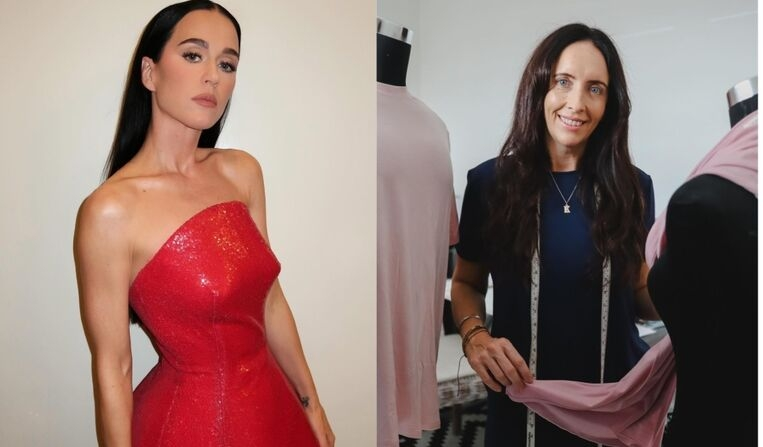
An Australian fashion designer selling clothes under the name “Katie Perry” has won an epic legal fight against pop star Katy Perry after the High Court ruled that the singer had persistently infringed her trademark.
On Wednesday, the country’s highest court upheld an earlier decision that found that the Firework singer had engaged in a “calculated disregard” of designer Katie Taylor’s (nee Perry) trademark rights, marking the end of a dispute that has gone on for nearly 17 years.
Taylor, the owner of a small business selling lifestyle basics, first applied to register the “Katie Perry” trademark in September 2008 after she began selling her clothes at Paddington Markets in Sydney. Months earlier, Katheryn Elizabeth Hudson, performing under the stage name Katy Perry, released her first hit single, I Kissed a Girl, spawning a career that has included more than 150 million record sales.
For Taylor, it would mark the beginning of a lengthy David and Goliath battle with a global megastar.
In 2009, Perry’s management first sent cease and desist letters to Taylor over the Katie Perry name.
During evidence, the court heard that Perry’s manager, Steven Jensen, had become aware of Taylor’s trademark in 2009 and tried to convince the artist to put out a statement on the matter.
“As is common in Australia, the tabloids have picked this up and made it into a ‘story’,” he said in emails cited in the judgment.
But Perry had responded that she wanted to “keep me outta it entirely”.
READ ALSO: Katy Perry and former Canadian Prime Minister Justin Trudeau officially confirm romance
“Stupid b*tches. I wouldn’t have even bothered with this [if] mtv hadn’t picked up this silliness. Dumb bitch! Rawr!” she said in response.
Taylor later rejected an agreement proposed by Perry’s team for the two trademarks to co-exist, and in 2019, commenced legal action against the singer.
She succeeded before the Federal Court in 2023, when Justice Brigitte Markovic ruled that the singer had infringed her trademark. That decision was overturned on appeal by the Full Federal Court in 2024, with the judges ordering the cancelling of Taylor’s trademark.
But on Wednesday, three High Court justices – Jayne Jagot, Simon Steward and Jacqueline Gleeson – sided with Taylor, while two of their colleagues dissented. Perry’s team argued that because the singer already had a reputation in September 2008, Taylor’s trademark was likely to deceive or cause confusion. But the High Court rejected this argument, ruling that Perry did not have a reputation in Australia regarding clothing. Despite her career beginning to take off, not a single piece of Katy Perry-branded clothing had been sold in Australia by the relevant date.
Instead, the court ruled that Perry had failed to prove that there was any real confusion over the trademark. Perry, the star with a $US360 million ($505 million) net worth, will be on the hook for Taylor’s costs. The exact figure is to be determined by the Federal Court.
Gilbert + Tobin partner Michael Williams, who leads the firm’s technology and intellectual property group, told this masthead that the High Court’s close decision would have a significant knock-on effect.
“I think it will reinforce the basic principles [around trademark law], and I think it would probably be seen as a pretty logical result … that you have an Australian trademark owner whose rights aren’t easily swamped by an international celebrity,” he said.
Williams told this masthead that the High Court’s majority judgments also expressed disapproval of Perry’s conduct towards Taylor.
“There is also a theme that runs through the judgments of the majority, and that is really a disapproval of the dismissive way in which the singer and her management approached the Taylor trademark application,” he said.
A representative for Perry said: “Katy Perry has never sought to close down Ms. Taylor’s business or stop her selling clothes under the KATIE PERRY label. Today, by a 3:2 decision, the High Court determined that Ms. Taylor’s trademark can remain on the register.”
In a statement, Taylor said the decision was a victory for small business.
“As a small business owner and a mother of two young children, this process has been incredibly demanding,” she said.
“There were moments that were emotionally exhausting, but I believed in standing up for my business and for justice.”