

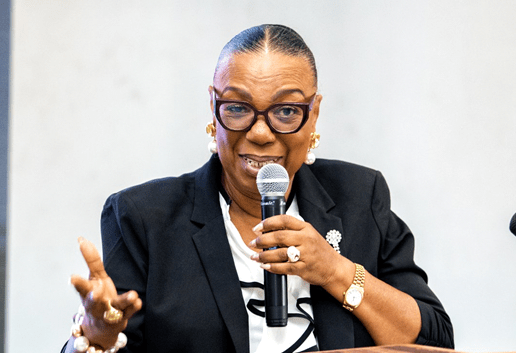

Former Attorney General and Minister of Justice Betty Mould-Iddrisu has urged aspiring lawyers to treat statutes as only a starting point, warning that the realities of legal practice often lie in interpretation, negotiation and evolving social norms.
Speaking at the Ghana School of Law during SRC Week in Kumasi, the former Attorney-General said the most significant developments in Ghana’s family and succession law have come not from parliament but the courts.
“The law is rarely complete,” she told students. “Statutes are drafted in a particular moment in time, but society evolves much faster.”
Courts filling the gaps
Mrs. Mould-Iddrisu pointed to family and succession law as a clear example of this gap, where Ghana’s plural legal system – combining customary law, statute and constitutional principles – often produces tensions.
Key rulings by the Supreme Court of Ghana – including Mensah v Mensah and Arthur v Arthur – have reshaped how marital property is treated, recognising non-financial contributions such as childcare and domestic work.
More recent decisions, such as Sarpong v Sarpong, suggest a shift toward stricter interpretation of ownership and contribution, highlighting what she described as the uncertainty created by absence of comprehensive legislation.
At the centre of this evolving framework is PNDCL 111, which sought to protect spouses and children but continues to generate disputes – particularly over shared ownership of matrimonial homes.
A system under strain
In practice, she noted, succession disputes often begin not in courtrooms but during funeral arrangements, where questions of legitimacy, inheritance and control quickly surface.
The challenge is compounded by:
Multiple forms of marriage (customary, statutory and foreign)
Undocumented relationships
Expanding family structures
These realities, she argued, expose a widening gap between Ghana’s legal framework and modern social life.
Economic and social implications
While often viewed as private matters, family and succession disputes carry wider economic consequences.
Unclear property rights and prolonged litigation can:
Delay asset transfers and reduce economic productivity
Discourage investment in jointly acquired property
Increase legal costs for families already under financial strain
At a broader level, uncertainty in inheritance systems can weaken confidence in property ownership – an issue with implications for credit access, housing and wealth accumulation.
For women in particular, evolving judicial interpretations have had mixed effects: while earlier rulings expanded access to marital property, recent decisions suggest a more cautious approach…. potentially reintroducing vulnerability in certain cases.
Call for skills beyond the courtroom
Against this backdrop, Mrs. Mould-Iddrisu urged students to develop skills beyond litigation.
“Many family disputes are resolved not by court judgments but by carefully negotiated settlements,” she said.
She emphasised negotiation and mediation as essential tools, noting that lawyers often operate in emotionally charged environments where legal strategy must be balanced with sensitivity.
The case for reform
Her lecture also renewed calls for the long-delayed Property Rights of Spouses legislation, which is expected to bring greater clarity and consistency to marital property disputes
Until then, she said, Ghana’s legal system will continue to rely heavily on judicial interpretation – what she described as the “living law”.
A human-centred profession
Her closing message was simple: law is ultimately about people.
“Behind every succession case lies a family navigating grief, loss and uncertainty.”
For Ghana’s next generation of lawyers, she suggested, the real challenge will not just be knowing the law – but applying it in a way that reflects realities of the society it serves.
Post Views: 6
Discover more from The Business & Financial Times
Subscribe to get the latest posts sent to your email.