
A research study led by environmental sustainability expert Dr. John Boakye-Danquah and climate scientist Dr. Yaw Agyemang Boafo has recommended a more decentralised approach to combating illegal mining in Ghana.
During a policy dialogue dubbed “Beyond the Crackdown: A Policy Dialogue on Strengthening District-Level Mining Governance in Ghana”, held at the Fiesta Royal Hotel in Accra on Thursday, March 26, 2026, the researchers emphasised that district assemblies are best positioned to handle monitoring and enforcement at the local level. They cited the Atiwa East District Assembly as a successful case study.
Speaking to the media, Dr. John Boakye-Danquah of the University of Saskatchewan said the approach adopted by the Atiwa East District Assembly, under the leadership of District Chief Executive Ernest Owusu Ntim, represents an ideal model for addressing a critical gap in Ghana’s mining governance.
“Today, what we witnessed here is a very innovative approach to understanding how a critical gap in Ghana’s governance of the mining sector can be addressed. We see that many national agencies such as NAIMOS, the EPA, and the Minerals Commission are working quite well. However, there is a clear gap in monitoring and enforcement at the local level. We are making the case that district assemblies, which are permanently located in these communities, can provide the solution.
“What we demonstrated today is what effective local governance could look like, using the Atiwa East case study,” he added.
Dr. Boakye-Danquah explained that the purpose of the dialogue is to replicate the Atiwa East model across other districts in the country to make national efforts against illegal mining more effective.
“The goal is to scale this approach nationally. We are not suggesting that national agencies should stop working. What we want to see is stronger collaboration between national and local agencies so that the existing gaps can be closed. NAIMOS cannot be present everywhere.
“Even when they conduct operations in mining communities, they eventually leave. Who then holds the fort to prevent miners from re-entering the forests? What happens to the degraded land? The government is currently seeking funding for reclamation, but if we hold miners more accountable, they can take responsibility for reclaiming the land. This is exactly what the Atiwa East District Assembly is demonstrating,” he said.
He further noted that the Atiwa model aligns with a global shift in environmental management.
“It is not just the Atiwa model. Across many parts of the world, there is a clear shift away from centralized approaches to environmental management. Doing everything from the centre is too expensive and often inefficient. Localities must be actively involved. What the Atiwa East District Assembly is doing is essentially a community-based approach — a method that is tried and tested worldwide for addressing systemic environmental challenges. While it is not foolproof and requires strong reporting mechanisms and accountability systems, it remains one of the most effective strategies,” he added.
Addressing the event, the District Chief Executive for Atiwa East, Ernest Owusu Ntim, shared his experiences in achieving significant progress against illegal mining in the constituency.
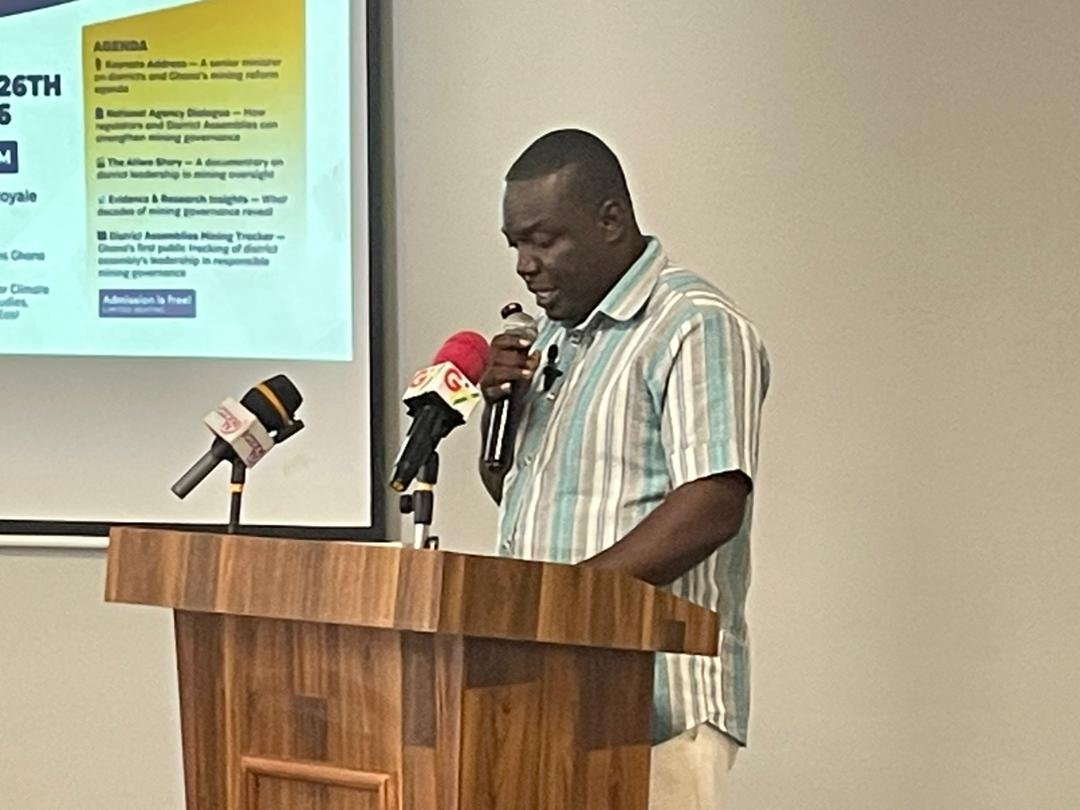
He acknowledged that while the Assembly’s proximity to the communities gives it an advantage in monitoring illegal mining, it also comes with serious challenges, including impacts on local livelihoods, competing interests, and even threats to personal safety.
“We have had to operate under very difficult conditions. There have been accusations of complicity, public criticism, and in some cases, personal threats. This is the reality of local leadership in the fight against galamsey. It requires not only commitment but also adequate support and protection,” he said.
He however stressed the importance of collaboration and commended chiefs, traditional leaders, and national agencies for their support in the fight against galamsey.
The research was conducted with support from Globe and Systems, JPRS Consulting, and the University of Ghana.