

By Joshua Worlasi AMLANU
The Bank of Ghana cut its benchmark interest rate by 150 basis points to 14 percent from 15.5 percent, citing sustained disinflation, improving domestic macroeconomic conditions and elevated real interest rates.
Nonetheless, the bank warns that rising oil prices and geopolitical tensions could pose risks to the inflation outlook.
The decision, taken at the 129th Monetary Policy Committee (MPC) meeting held from March 16–18, signals a calibrated shift toward easing after a prolonged period of tight monetary policy. Policymakers said the balance of risks now allows for a reduction in the policy rate, even as external uncertainties intensify.
Inflation dynamics were central to the decision. Headline inflation declined to 3.3 percent in February 2026 from 5.4 percent in December 2025, driven by easing food and non-food prices. Core inflation also moderated, pointing to subdued underlying price pressures.
The committee noted that inflation expectations across consumers, businesses and the financial sector remain broadly anchored.
The MPC attributed the disinflation trend to tight policy conditions over the past 14 months, relative currency stability and improved food supply.
Monetary aggregates also reflected the restrictive stance, with reserve money contracting by 0.5 percent year-on-year in February compared with a sharp expansion of 68.8 percent a year earlier. Broad money growth slowed to 16 percent from 33.1 percent over the same period.
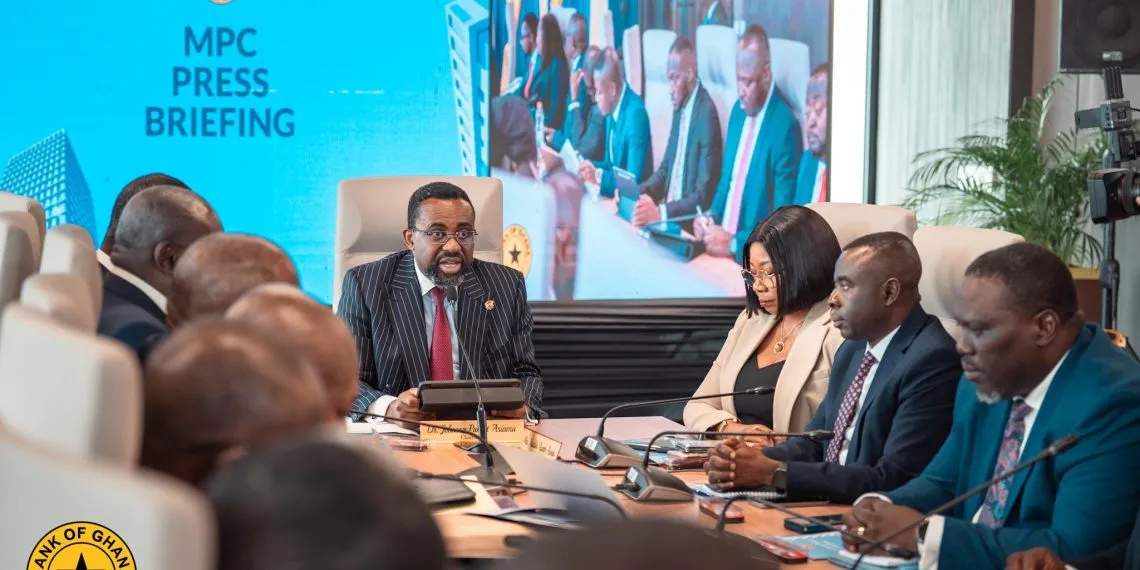
“The favourable domestic macroeconomic conditions, and also the high prevailing real interest rates, provide scope to ease the policy rate further,” central bank Governor, Dr. Johnson Pandit Asiama said at the MPC press briefing.
Domestic economic activity has strengthened alongside the disinflation trend. Provisional data from the Ghana Statistical Service show real GDP grew by 6 percent in 2025, up from 5.8 percent in 2024, with non-oil GDP accelerating to 7.6 percent from 6.1 percent, supported by services and agriculture.
Fourth-quarter data also pointed to improving momentum, with year-on-year growth of 5.8 percent and stronger expansion in non-oil sectors.
High-frequency indicators reinforce the recovery. The Bank of Ghana’s Composite Index of Economic Activity recorded annual growth of 8.4 percent in January 2026, compared with 6 percent a year earlier.
The pickup has been supported by increased private sector credit, higher industrial output, expanding trade activity and stronger household consumption.
Confidence indicators also improved. Consumer sentiment strengthened on easing inflation and improved expectations, while business confidence rose on the back of improved operating conditions and optimism about industry prospects.
Financial conditions have eased in line with declining inflation. Yields on short-term government securities, including the 91-day Treasury bill, fell sharply in the first two months of 2026. Average bank lending rates declined to 19.2 percent in February from 30.1 percent a year earlier, contributing to a gradual recovery in private sector credit.
Fiscal consolidation has reinforced the macroeconomic adjustment. Provisional data show the overall fiscal deficit on a commitment basis narrowed to 1 percent of GDP in 2025, below the budget target of 2.8 percent. The primary balance recorded a surplus of 2.6 percent of GDP, exceeding the 1.5 percent target. Public debt declined to 45.3 percent of GDP at end-2025, from 61.8 percent a year earlier.
The banking sector has shown signs of recovery, with total assets increasing, supported by deposits, borrowings and capital. Investment growth accelerated sharply, while key financial soundness indicators—including profitability, liquidity and solvency—improved.
Non-performing loans ratio declined to 18.7 percent in February 2026 from 22.6 percent a year earlier, although the MPC flagged asset quality risks as still elevated.
Externally, the country’s position remains supportive. Trade surplus widened to US$3.7 billion in the first two months of 2026 from US$2.1 billion a year earlier, driven by higher gold export earnings and modest import growth. Gross international reserves rose to US$14.8 billion, equivalent to 5.8 months of import cover, up from US$13.8 billion at end-2025.
The central bank expects further reserve accumulation under the Ghana Accelerated National Reserve Accumulation Programme, which targets import cover of 15 months by 2028. The stronger external position has contributed to relative currency stability.
Despite the improving domestic outlook, policymakers highlighted growing external risks. Escalating geopolitical tensions in the Middle East have disrupted supply chains, increased crude oil price volatility and heightened global uncertainty.
These developments could tighten global financing conditions and reintroduce inflationary pressures.
The MPC said its latest forecasts indicate inflation will remain within the medium-term target but identified upside risks from potential pass-through effects of higher crude oil prices.
“The committee will continue to closely monitor developments, especially in the Middle East, and its potential implications on the inflation outlook,” the Governor said, adding that it “stands ready to take appropriate policy actions as needed to safeguard price stability.”
The next MPC meeting is scheduled for May 18–20, 2026, where policymakers are expected to reassess the balance between supporting growth and containing emerging inflation risks.
Post Views: 2
Discover more from The Business & Financial Times
Subscribe to get the latest posts sent to your email.