


By Joshua Worlasi AMLANU & Ebenezer Chike Adjei NJOKU,
[email protected] / [email protected]
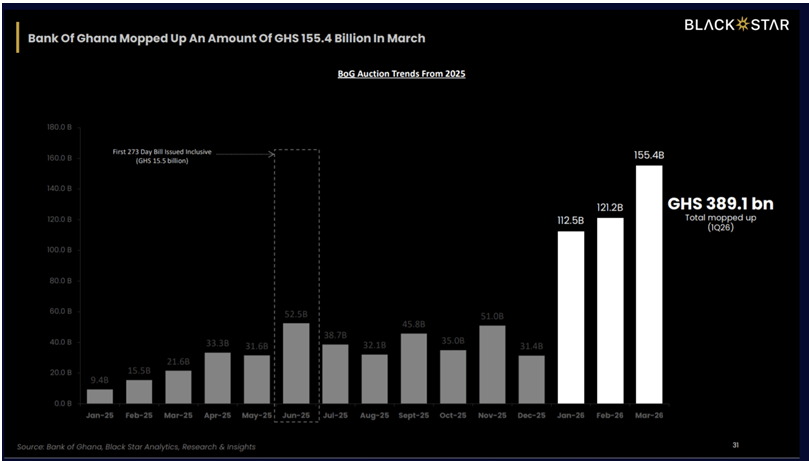
The Bank of Ghana (BoG) absorbed a record GH¢389.1billion of excess liquidity in the first quarter (Q1) of 2026, the highest for at least six years and pointing to rising liquidity pressures as declining yields and selective borrowing left cash in the system, a Black Star Brokerage insight of the period has shown.
Monthly data show the pace of liquidity absorption accelerated into the year. The central bank drained GH¢112.5billion in January, GH¢121.2billion in February and GH¢155.4billion in March alone, indicating that liquidity pressures intensified as the quarter progressed. The March figure represents the single largest monthly mop-up over the period reviewed.
The liquidity surge coincides with a rapid compression in domestic yields, as monetary easing and government borrowing strategy pushed rates lower across the curve. Treasury bill yields declined into single digits for the first time since the debt crisis, with the 91-day bill falling to about 4.8 percent, the 182-day to 6.6 percent and the 364-day to 9.8 percent. The broader government bond market also recorded sharp repricing, with yields dropping from above 22 percent in March 2025 to a range of roughly 10 percent to 13 percent for March 2026.
The decline of yields has been driven in part by policy. Government rejected approximately GH¢59.97billion in bids during primary auctions during the first quarter, accepting GH¢104.1billion out of GH¢164.1billion tendered. By limiting acceptance at higher rates, the Treasury effectively compressed borrowing costs – reinforcing the downward trend in yields.
This approach has had a direct impact on liquidity conditions as funds that would typically be absorbed through primary issuance remained in the system, contributing to the build-up of excess liquidity.
The central bank’s increased reliance on sterilisation operations reflects an effort to manage these spillovers and maintain monetary stability.
“Government acceptance hit a three-month low as weak yields dampened investor participation in March, on account of the growing mismatch between investor expectations and pricing levels in the domestic debt market,” the report noted.
Investor behaviour has begun to adjust in response to the lower-rate environment. Demand has shifted toward longer-dated instruments, with accepted volumes for 364-day bills rising to GH¢36.6billion in the first quarter compared with GH¢23.9billion for 182-day bills. This trend suggests investors are seeking to lock-in yields ahead of further declines, as they anticipate continued easing or sustained low interest rates.

At the same time, participation has shown signs of weakening as yields fall. Monthly primary auction acceptance dropped to about GH¢20.6billion in March from higher levels earlier in the quarter, indicating that some investors are becoming less willing to allocate funds at compressed rates. This dynamic has contributed to the accumulation of liquidity, as funds remain unplaced in government securities.
Secondary market activity has absorbed part of this excess liquidity. Trading volumes in bills and other fixed-income instruments increased to approximately GH¢35.8billion in March, up from GH¢20.2billion for the same period a year earlier. The rise in activity points to stronger market participation and increased circulation of funds, even as primary market dynamics remain constrained.
The combination of lower yields, rising liquidity and increased trading volumes highlights a broader shift in the domestic financial system. Monetary easing has reduced the return on government securities while fiscal strategy has limited the supply of investable instruments at higher rates. Together, these forces have altered the balance between liquidity and absorption, requiring more active intervention by the central bank.
The macroeconomic backdrop has supported this transition. Inflation fell sharply to 3.2 percent in March 2026, providing the BoG with scope to reduce its benchmark policy rate by 400 basis points to 14 percent. The decline in inflation has been driven by easing food prices, lower imported inflation and improved supply conditions, creating a more accommodative environment for monetary policy.
However, the structure of inflation suggests that some pressures remain. Services inflation stood at about 7.2 percent while housing-related costs remained elevated, indicating that underlying price dynamics are not fully aligned with the headline disinflation trend. This divergence introduces uncertainty around the sustainability of low inflation and pace of further policy easing.
Growth conditions remain relatively stable but are showing signs of moderation. Ghana’s economy is projected to expand by 5.5 percent in 2026, down slightly from 5.8 percent in 2025. The services sector continues to lead growth – supported by information and communication activities, while agriculture and industry remain more subdued.
In the foreign exchange market, the cedi depreciated by about 4.4 percent against the US dollar in the first quarter, an improvement compared with previous years but still indicative of underlying external pressures.
The currency weakened against major trading currencies despite improving macroeconomic conditions, as global factors and capital flows continue to influence exchange rate dynamics.
The interaction between liquidity conditions and exchange rate stability will be a key area to monitor. Excess liquidity, if not effectively managed, could spill over into the foreign exchange market… putting additional pressure on the cedi. The central bank’s sterilisation operations have so far contained these risks, but the scale of intervention required points to underlying imbalances.
The current environment also has implications for financial markets beyond fixed income. Lower yields have reduced the attractiveness of government securities, encouraging a reallocation of capital toward other asset classes. The equity market has benefitted from this shift, with the Ghana Stock Exchange Composite Index posting strong gains in the first quarter.
However, the extent to which these gains are driven by fundamentals versus liquidity conditions remains an open question. The rise in asset prices in a low-rate environment is consistent with global trends, but it also raises the possibility of mispricing if underlying economic conditions do not improve in line with market valuations.
From a policy perspective, the central bank faces a complex balancing act. On one hand lower inflation and stable growth provide a basis for continued easing, while on the other rising liquidity and shifting investor behaviour require careful management to prevent instability. The record level of liquidity mop-up in the first quarter highlights the scale of this challenge.
Government’s borrowing strategy will also play a critical role. Continued rejection of bids at higher yields may help contain borrowing costs, but it could also sustain liquidity pressures and limit effective market clearing. Over time, this approach may require adjustment to align supply and demand more closely.
The outlook suggests a period of normalisation rather than continued rapid adjustment. Inflation is projected to rise modestly to between 7.5 percent and 8.5 percent by the end of 2026, while the policy rate is expected to remain within a range of 10 percent to 14 percent. The exchange rate is forecast to weaken further and yield levels may stabilise as market conditions adjust.
The trajectory of liquidity will depend on how these factors evolve. If yields stabilise and investor participation improves, the need for large-scale sterilisation may diminish. However, if current dynamics persist, the central bank may need to maintain an active role in managing liquidity.
Post Views: 1
Discover more from The Business & Financial Times
Subscribe to get the latest posts sent to your email.