


By Edward Twum ANANE
Regional economic transformation in Ghana increasingly depends on the development of secondary growth poles capable of supporting agro-industrialization, trade integration and domestic value addition.
While national attention has historically concentrated on Accra, Tema and Kumasi, emerging regions such as Bono East exhibit structural characteristics that position them for accelerated investment-driven growth.
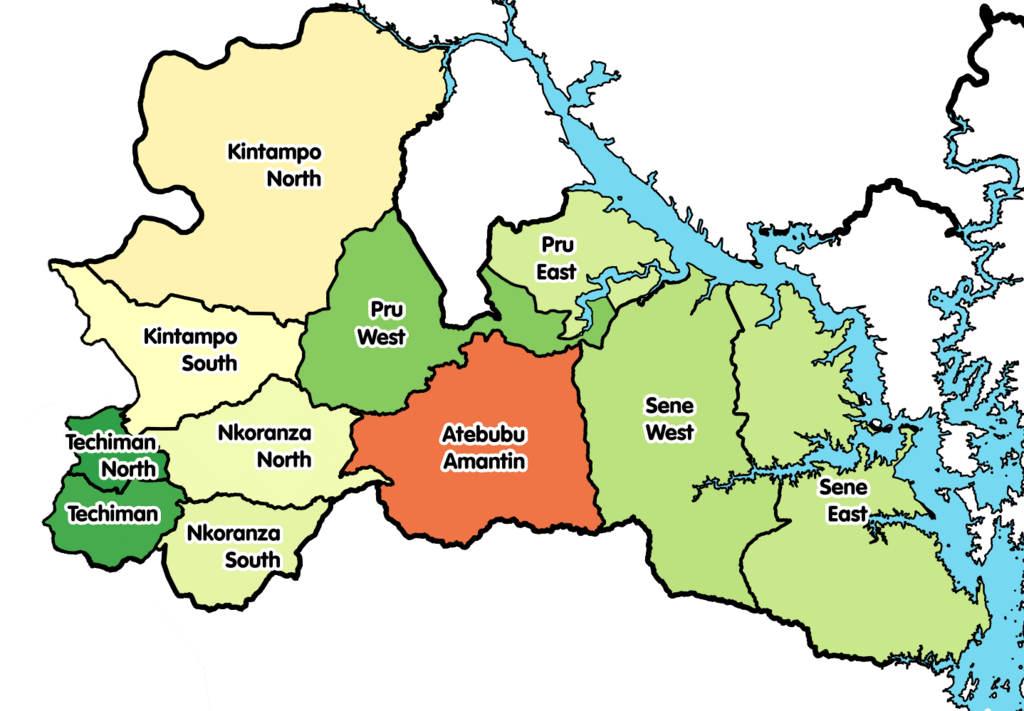
Created in 2019, Bono East covers approximately 22,952 square kilometres—about 9.5 percent of Ghana’s total land area—and hosts a population exceeding 1.2 million people according to the 2021 Population and Housing Census.
Its capital, Techiman, functions as one of West Africa’s most significant agricultural commodity markets, linking production zones in northern Ghana to urban consumption centres in the south. This strategic geography, combined with abundant arable land and active commercial networks, forms the basis of the region’s investment appeal.
Geographic Centrality and Market Integration
Bono East occupies a pivotal location within Ghana’s internal trade architecture. Positioned along major road corridors connecting Kumasi, Tamale, Sunyani and Accra, the region serves as a natural transit and aggregation hub. Techiman’s central market exemplifies this connectivity, attracting traders from across Ghana and neighbouring countries such as Burkina Faso, Togo and Côte d’Ivoire.
The spatial logic of the region enhances its competitiveness. Agricultural produce from northern savannah zones is aggregated and redistributed through Techiman to southern
markets, while manufactured goods flow in reverse direction. This bidirectional trade dynamic reduces logistical fragmentation and lowers transaction costs for firms operating within the region.
For investors in warehousing, commodity exchanges, cold-chain systems and transport services, the region’s geographic advantage provides a ready-made commercial ecosystem rather than a speculative frontier.
Agricultural Production and Resource Endowment
Agriculture constitutes the backbone of Bono East’s economy. The region benefits from over 1.2 million hectares of arable land and an estimated 44,000 hectares of low-lying valleys suitable for irrigated rice production.
The forest–savannah transition ecology allows for cultivation of diverse crops, including maize, rice, soya beans, cassava, yam, groundnuts, tomatoes, onions, mango and cashew. In many districts, bimodal rainfall patterns permit two cropping seasons annually, enhancing yield potential and income stability.
This production diversity aligns closely with Ghana’s import substitution priorities. The country continues to import substantial quantities of rice, processed tomato products, vegetable oils and poultry feed inputs.
Bono East’s established maize and soya production base positions it as a natural supplier to Ghana’s expanding poultry sector, while its rice valleys offer capacity for scaled domestic production. Similarly, cassava cultivation presents opportunities in starch, ethanol and high-quality flour manufacturing, reducing reliance on imported industrial inputs.
Importantly, the region’s agricultural strength is not confined to subsistence farming. Commercial production already feeds large wholesale markets, indicating the existence of functional value chains. What remains underdeveloped is the industrial layer capable of converting raw output into higher-value processed goods.
Agro-Industrialization and Value Addition
The most significant investment opportunity in Bono East lies in agro-processing. Despite strong primary production, value addition remains comparatively limited. This structural gap creates space for rice milling complexes, soya oil extraction plants, feed mills, cassava processing facilities, fruit drying and juice production plants, and tomato processing factories.
The economic rationale for agro-industrial investment in the region rests on proximity to raw materials. Reduced transportation distances lower input costs and post-harvest losses, improving profit margins. Moreover, Ghana’s participation in the African Continental Free Trade Area (AfCFTA) expands market access beyond domestic consumption. Firms located in Bono East can potentially serve regional markets across West Africa under preferential trade frameworks.
Agro-processing also produces multiplier effects. It stimulates demand for packaging, storage, transport, finance and technical services, thereby deepening regional economic complexity. The region’s relatively youthful population offers labour supply that can be upskilled through vocational and technical training aligned with industrial needs.
Livestock, Aquaculture and Integrated Agribusiness
Beyond crop production, Bono East’s ecology supports livestock rearing and aquaculture. The savannah transition landscape is suitable for cattle, poultry and small ruminants, while proximity to water bodies within the broader Volta basin system supports fish farming initiatives. Ghana remains a net importer of fish and dairy products, indicating unmet domestic demand.
Integrated agribusiness models—combining feed production, livestock rearing and meat processing—could therefore generate significant returns. The availability of maize and soya for feed reduces input costs for poultry and livestock enterprises. Such vertical integration enhances competitiveness and reduces exposure to external supply shocks.
Urbanization, Services and Real Estate
Urban centres within the region, particularly Techiman, Kintampo and Nkoranza, are experiencing steady growth driven by trade and administrative expansion. Rising commercial activity increases demand for real estate development, hospitality services, financial intermediation and retail infrastructure.
As wholesale trade volumes expand, so does the need for modern storage facilities, commodity warehouses and logistics terminals. Investment in structured warehousing and digital commodity trading platforms could transform Techiman into a fully integrated inland commercial hub. Real estate development, including residential estates and commercial complexes, similarly benefits from demographic growth and business migration into the region.
Tourism and Renewable Energy Potential
The region’s natural assets, including Kintampo Waterfalls, Fuller Falls and the Boabeng-Fiema Monkey Sanctuary, offer scope for eco-tourism development. While tourism remains secondary to agriculture in economic weight, targeted hospitality investments could diversify income streams and stimulate local employment.
Additionally, strong solar radiation patterns across the savannah transition zone make distributed solar energy systems viable for agro-processing clusters and irrigation schemes. Renewable energy integration reduces operational costs and enhances environmental sustainability, factors increasingly important to institutional investors.
Conclusion
The Bono East Region embodies the structural ingredients of a viable growth pole: geographic centrality, agricultural abundance, commercial vibrancy and demographic momentum.
Unlike speculative investment destinations, the region’s economy is already active, with established commodity flows and functioning markets. What is required is the infusion of capital, technology and industrial organization to elevate existing production systems into integrated value chains.
For investors seeking opportunities in import substitution, agro-industrialization, commodity logistics and regional trade integration, Bono East presents a compelling and data-grounded proposition. Its development aligns not only with regional prosperity but also with Ghana’s broader economic transformation agenda.
In this context, Bono East should be understood not as a peripheral territory, but as Ghana’s emerging inland engine of agricultural and commercial growth.
About the Author
Edward Twum Anane is a development researcher, educator and founder of the Anane Institute, a private research and training organization based in Techiman, Bono East Region, Ghana. Established in 2013, the Institute promotes science, research, innovation, and socio-economic development through evidence-based research, publications, training and consultancy services focused on agriculture, business, environment and sustainable development. Through his work, Anane has been actively engaged in regional development research, investment promotion initiatives and policy-oriented studies that aim to unlock economic potential in Ghana’s interior regions. The Anane Institute also collaborates with local and international partners to support community development, entrepreneurship and skills training aligned with national growth priorities.
Email: [email protected]
Post Views: 18
Discover more from The Business & Financial Times
Subscribe to get the latest posts sent to your email.