
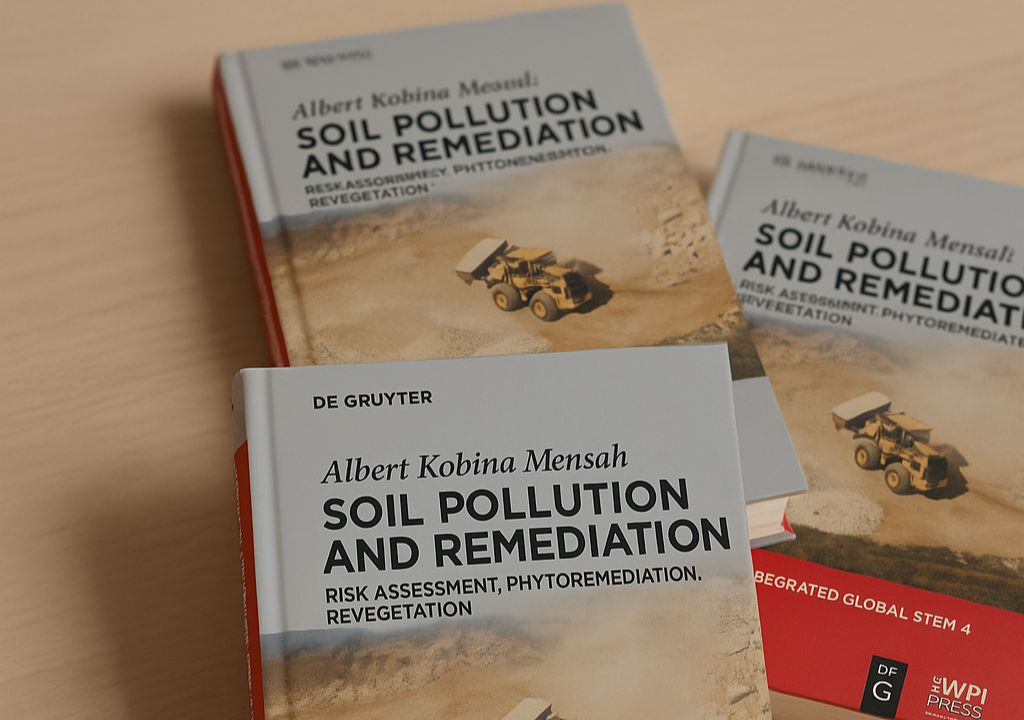
This book is a novel deep dive into the subject matter of soil pollution and remediation. The straight-forward title: Soil Pollution and Remediation does not leave the reader with any ambiguity. The authors are clear in their mission of tackling the complex but important subject with clarity with the intention to inform, educate and equip their readers with knowledge – and these include students, scholars, researchers and policymakers.
In this over 400-page book, Dr Mensah and his co-authors deliver an engaging, poignant and timely in-depth examination of how mining; even though a crucial economic activity, has made environmental impacts that have negatively affected the land, especially the soil in Ghana.
The book goes to lengths to offer a comprehensive and multidisciplinary inquiry and critical examination of the environmental challenges associated with soil degradation, particularly in mining areas. It also focuses on the strategies that can be practically applied to restore ecological balance.
The book’s clear central argument goes into the heart of soil pollution resulting from mining and tackles the reality of sustainable development in mining-dependent economies like Ghana, which requires a deliberate integration of scientific, social, and policy-driven reclamation approaches.
The book deeply looks at the true cost of mining showing that it extends far beyond the immediate economic gains. It further brings to the fore that years of inadequate environmental oversight, weak enforcement of reclamation laws, policies and programmes, and the marginalization of local communities have resulted in widespread soil degradation, water contamination, and biodiversity loss, with the resultant economic impact on local people.
It focuses on soil pollution within the broader environmental and economic systems, emphasizing that remediation is not merely a technical exercise but a complex socio-ecological process, with social and economic consequences. It further highlights how historical neglect of environmental concerns in mining and mining communities has led to widespread environmental strain.
The book in an uncompromising way, stand by its insistence that remediation is not merely a technical process but a broader socio-economic and political challenge.
Structure and thematic strengths of the book
The book is structured into thematic chapters that progressively develop from conceptual models to examples of practical implementation. It combines theoretical frameworks (e.g., sustainability, remediation science), historical evolution of land reclamation, technical methods (physical, chemical, biological remediation), and case studies, particularly from Ghana.
Strengths of the book
One of the book’s strengths shines through the anchoring on historical perspective, as it traces the evolution of land reclamation from a neglected aspect of mining to a regulated and scientifically grounded practice, influenced by global environmental movements and thinking.
The grounding in historical antecedents is important because it shows that current environmental challenges are not accidental – they are the result of policy and institutional failures over time.
Another strength of the book is that it goes to lengths to explain technical remediation methods such as phytoremediation; soil amendment; erosion control and revegetation strategies.
It goes even further by detailing practical steps on how to implement the processes, throws light on the planning stages, environmental impact assessments, and monitoring systems. These detailed practical steps make the book valuable not only for academics, but also for practitioners, activists and policymakers.
Strong emphasis on sustainability
A recurring theme in the book are the three pillars of sustainable development—environmental, economic, and social.
The authors argue convincingly that remediation efforts must restore ecological systems, support livelihoods and ensure long-term economic viability. Its holistic framing and thoroughness elevates the book beyond a technical manual into a policy-relevant text.
Focus on Ghana and policy gaps
The book’s contextual grounding in Ghana’s mining sector makes it highly relevant for African policymakers, researchers and environmental practitioners. The authors do a great job in identifying critical weaknesses in Ghana’s mining and reclamation framework, including the lack of detailed and enforceable reclamation policies, insufficient capacity building and training, weak enforcement mechanisms and limited stakeholder coordination.
It also argues that existing policies “fall behind global best practices,” particularly in areas such as community involvement and water management.
Institutional and stakeholder challenges
Analysing stakeholder dynamics, the book highlights how fragmented institutional responsibilities, poor coordination among regulators, communities, and mining firms and exclusion of key actors like traditional leaders and local communities are, touching on broader governance challenge, and not just a technical one.
 Knowledge and data gaps
Another critical issue raised by the book, is the lack of documentation and knowledge transfer on reclamation efforts in Ghana, and that effectively limits policy learning, replication of successful practices and development of national restoration programmes.
The book makes a unique contribution to knowledge in the designated field, and it’s importance cannot be discussed without due reference to one of the most compelling contributions. The book’s emphasis on indigenous knowledge systems makes it outstanding. It argues that local communities possess valuable ecological insights that can enhance restoration outcomes when tapped. This perspective challenges purely technocratic approaches and promotes inclusive, community-driven perspective to development.
The book employs a multidisciplinary approach that makes it remarkable, as it effectively integrates environmental science, sociology, economics and policy analysis by demonstrating that successful land restoration requires collaboration across disciplines and stakeholders.
A critical evaluation
Despite its strengths, the book has some limitations. While the Ghanaian focus is valuable, the book would benefit from more comparative analysis with other countries, as that would strengthen its policy relevance and provide broader more deeper lessons.
Some sections of the book are highly technical and repetitive, particularly in discussions of remediation methods. This may reduce accessibility for non-specialist readers.
While the book identifies policy gaps, it sometimes stops short of offering clear, actionable policy recommendations. Readers are left to infer solutions rather than being presented with structured clear and practical reform strategies.
Relevance
The book however is highly relevant for policymakers in mining economies, environmental scientists, development practitioners and activists, and academic researchers.
The valuable insights are of great importance for especially Ghana, where mining remains a key economic driver but also a major environmental challenge.
Conclusion
In conclusion, the book, Soil Pollution and Remediation is a rigorous, well-researched, and contextually grounded work that makes a significant contribution to the conversation on environmental sustainability in mining areas.
The core message it exudes is both urgent and practical. Without effective reclamation and sustainable practices, the economic benefits of mining will be outweighed by long-term environmental and social costs.
By combining scientific depth with policy relevance, the book provides a strong foundation for rethinking how resource-rich countries manage land degradation and environmental restoration.
At a time when climate change and environmental sustainability dominate global conversations, this book serves as both a wake-up call and a guide. It doesn’t only challenge governments and actors in the mining industry, it also calls on communities to participate in the rethinking of how natural resources are managed, and crucially, how damaged ecosystems can be restored.
This book is a must own, for policymakers, researchers, and anyone concerned about the future of Africa’s environment.
By Emmanuel K Dogbevi
About the Author: Albert Kobina Mensah (Ph.D.)

Dr. Albert Kobina Mensah is a research scientist at the Council for Scientific and Industrial Research (CSIR) – Soil Research Institute. His research interests include soil science, soil contamination and pollution, soil trace elements, soil potentially toxic elements, remediation, phytoremediation, environmental risk assessment, redox chemistry of potentially toxic elements (PTEs), and artisanal and small-scale mining sustainability.
He has conducted numerous laboratory investigations and field experiments to find sustainable solutions to soil contamination problems from gold mining.
Born in a mining community in Ghana’s Western Region, where he also grew up and went to school, his life’s experience growing up drew him closer to the impact of mining on the environment and human life.
As a result, he developed interest in the environment, an interest that was further deepened when he studied General Agriculture at the University of Cape Coast in Ghana, for his bachelor’s degree. He took courses in soil science, agriculture engineering, agriculture economics and forestry, among other courses.
Dr. Mensah holds a PhD in the natural sciences from the Ruhr-Universität Bochum in Germany, a Master of Science in water resources/watershed management from the Kenyatta University in Nairobi-Kenya.
His works have been published in peer-reviewed publications, focusing on the performance of the mining sector in Ghana, factors affecting adoption of mulching in Kibaale sub-catchment, South Central Uganda, and the role of revegetation in restoring fertility of degraded mined soils in Ghana. He has also been involved in discussing the institutionalizing community participation in watershed management and policy interventions in watershed management. Dr. Mensah’s doctoral dissertation focused on arsenic contamination from gold mining and remediation of active and abandoned mining spoils in Ghana, while his master’s thesis focused on the effects of Eucalyptus sp. plantation on soil physico-chemical properties in Thiririka Sub-catchment, Kiambu County, Kenya, and his bachelor’s thesis was on the restoration of fertility of degraded mined soils through revegetation.
Dr. Mensah provides a comprehensive analysis of the mining sector sustainability in Ghana, emphasizing the need for a more sustainable approach to combating illegal mining. He has received numerous awards and scholarships for his contributions to the environmental and science research.
He has made presentations on his specialization at conferences around the world, and he continues to train young scientists in different universities.