


By Sandra Agyeiwaa OTOO
The Civil and Local Government Staff Association of Ghana (CLOGSAG) has cautioned that aspects of the Constitutional Review Committee’s (CRC) final report could weaken institutional coherence and disrupt the established administrative framework of the country’s public service.
In its review of the CRC report titled “Transforming Ghana: From Electoral Democracy to Developmental Democracy,” the association limited its assessment to reforms that directly affect the architecture of the public service.
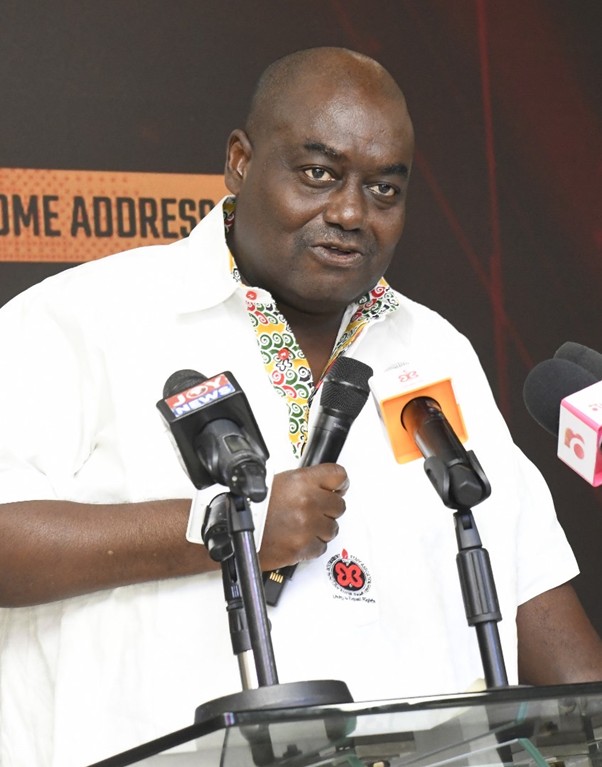
Executive Secretary Isaac Bampoe Addo said the association’s priority is to safeguard merit-based administration and maintain clear lines of regulatory authority.
“Our review focused on areas where modifications may be necessary to protect merit-based administration, clear regulatory authority and the long-term integrity of Ghana’s public service,” he said.
According to Mr. Addo, a key concern for CLOGSAG is the proposal to grant independent constitutional status to the Controller and Accountant-General’s Department (CAGD). The association insists that the department’s operational mandate firmly rests within the Ministry of Finance.
“We disagree with the proposal to establish the Controller and Accountant-General as an independent or hybrid-independent constitutional office. The mandate of the Controller and Accountant-General’s Department falls squarely within the functional oversight and responsibilities of the Ministry of Finance,” he noted.
He explained that the CAGD operates as an implementation agency of the ministry, executing government accounting, ensuring payment control and performing treasury management functions.
As part of the executive machinery responsible for implementing fiscal policy, he said the department should remain administratively within the Ministry of Finance rather than be structurally separated into an independent constitutional body.
He warned that granting the department independent status could lead to institutional ambiguity, undermine fiscal coordination, create overlapping bureaucratic structures and hinder the efficient management of public finances.
“Elevating the department to an independent status could create institutional confusion, weaken fiscal coordination, introduce bureaucratic duplication and complicate efficient financial administration,” he said.
Mr. Addo also objected to proposals to empower the Council of State to recruit, vet and make binding nominations to the President for the appointment of the Controller and Accountant-General.
He argued that such a move departs from the association’s long-standing position that departmental appointments should be handled by governing councils, which possess the institutional memory and expertise to select qualified leaders on merit.
He emphasised that like all public institutions in Ghana, parliamentary oversight of the Controller and Accountant-General’s Department through the appropriate committees in accordance with the law, is welcome.
However, he maintained that the Ministry of Finance must remain the legitimate authority responsible for ministerial oversight of the department’s activities, consistent with its statutory mandate to supervise, monitor and evaluate agencies under the ministry as provided for in the Public Financial Management (PFM) Act.
Article 11(1) of the Public Financial Management Act, 2016 mandates Parliament to exercise oversight over matters relating to the national budget and finance, government expenditure, performance reporting and related fiscal responsibilities.
He noted that these existing oversight responsibilities over ministries, including their departments and agencies, already cover the proposed supervisory role of Parliament’s committees over the Controller and Accountant-General’s Department.
Mr. Addo said that rather than creating an independent Controller and Accountant-General, which could introduce bureaucratic obstacles to the smooth functioning of the Ministry of Finance, Ghana would benefit more from establishing an independent Fiscal Responsibility Council to strengthen accountability in public financial management.
He further recommended retaining Article 178(2) of the Constitution to ensure that Parliament continues to exercise its financial legislative authority in approving the use of public funds.
Article 178(2) states that: “No money shall be withdrawn from any public fund, other than the Consolidated Fund or the Contingency Fund, unless the issue of those monies has been authorised by or under the authority of an Act of Parliament.”
CLOGSAG is also recommending that the appointment of the Head of the Civil Service be aligned with Article 195 of the Constitution, ensuring that appointments are based on governing council nominations in consultation with the Public Services Commission.
In addition, the association supports amending Article 197 by replacing the permissive word “may” with “shall”, thereby making it mandatory for the Public Services Commission to issue binding regulations for the effective governance of the services.
On decentralisation, CLOGSAG rejected proposals to phase the election of Metropolitan, Municipal and District Chief Executives based on economic or demographic thresholds.
The association also opposed the creation of an Independent Devolution Commission, pointing instead to existing structures such as the National Development Planning Commission as sufficient coordination mechanisms.
Mr. Addo, nevertheless, commended the Constitutional Review Committee for its comprehensive and forward-looking work, much of which he said aligns with the shared goal of strengthening rights, improving accountability, depoliticising the public service and enhancing the state’s capacity to deliver development outcomes.
He noted that if implemented coherently, many of the proposed reforms could help Ghana move beyond electoral processes toward measurable improvements in citizens’ quality of life.
However, he urged careful reconsideration of specific proposals that raise concerns regarding feasibility, institutional coherence and democratic consistency.
Post Views: 3
Discover more from The Business & Financial Times
Subscribe to get the latest posts sent to your email.