

By Vicentia Quartey
For knowledge to truly matter, it must move—beyond lecture halls and academic literature, into the communities it is meant to serve. When institutions step out and engage intentionally, the results can be both immediate and enduring. The recent roadshow by the Institute of Statistical, Social and Economic Research (ISSER) at the University of Ghana to Awudome Senior High School in the Volta Region offers important lessons on what meaningful engagement can achieve—and what it requires.
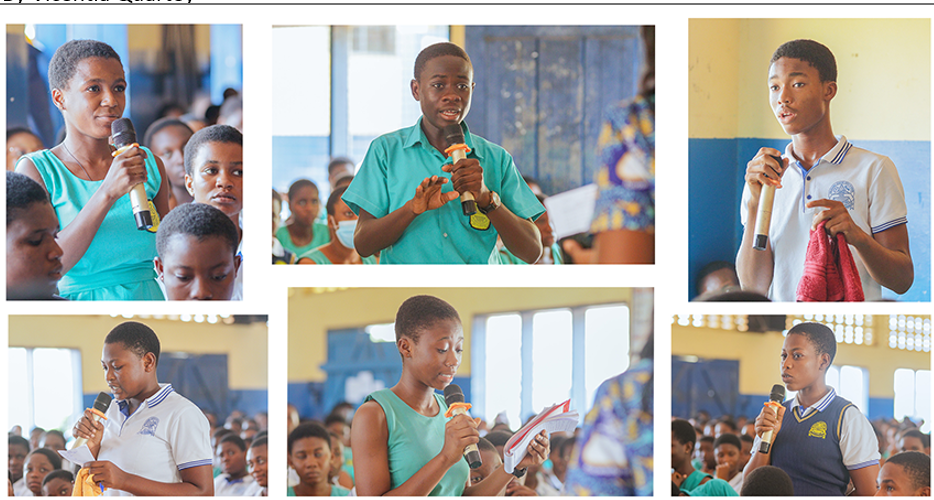
At its heart, the roadshow was about mentorship and inspiration. For the more than 1,200 participants gathered in the school’s dining hall, it was a rare opportunity to interact with researchers and professionals whose journeys made higher education and careers in research feel tangible and attainable. These moments matter: they expand horizons, challenge limiting assumptions, and plant seeds of ambition that classrooms alone may not always nurture.
Held in March 2026, the roadshow featured presentations from ISSER’s Social and Economics Divisions, as well as the Academic Affairs Directorate, offering participants a window into the Institute’s research, policy work, and the University of Ghana’s academic programmes. Speakers translated research into relatable, real-world insights, helping participants connect academic concepts to everyday life and national development challenges. The experience underscored the power of education grounded in context, relevance, and possibility.
Remarkable benefits when engagement efforts are intentional
Impactful engagement requires deliberate effort. Academic content had to be carefully adapted into accessible and engaging formats for a diverse audience, demanding time, creativity, and the expertise of communication specialists. How knowledge is communicated is just as important as the knowledge itself.
There were also significant demands on time and resources. A full-day trip to the Volta Region and back is a substantial commitment for academics balancing research, teaching, and administrative duties. Organising an event for over 1,200 participants — covering travel, logistics, and refreshments — required dedicated resources. These constraints are real, but the returns make the investment worthwhile.
For participants, the benefits are immediate and tangible: exposure, motivation, clarity, and a stronger sense of direction. For ISSER, the gains are equally significant. The roadshow strengthened institutional visibility, deepened appreciation of the Institute’s work, and provided the fulfilment that comes from engaging directly with communities. Such interactions also create space for new, socially grounded research ideas, rooted not just in theory but in lived experience.


Initiatives like this challenge the perception of academia as an “ivory tower,” disconnected from everyday realities. Through public engagement, institutions signal relevance, openness, and a willingness to listen as much as to share. This builds trust and ensures research remains responsive to society’s needs.
ISSER’s roadshow shows that when institutions engage intentionally, they do more than share knowledge — they inspire, connect, and learn in return. The process demands time, effort, and resources, but the impact far outweighs the cost.
As Ghana continues to invest in education and development, more institutions should embrace outreach and community engagement. Ultimately, when knowledge travels, it does not diminish—it multiplies.
This roadshow forms part of ISSER’s broader engagement strategy, aimed at bringing the Institute’s research and policy work closer to communities beyond Accra—particularly those that may not ordinarily have direct access to such interactions. Beyond outreach, it reflects a deliberate openness to dialogue, where audiences are encouraged to ask candid, probing questions. Engaging at this level requires preparation, confidence, and transparency from the institution, as well as a willingness to be challenged and understood.
The writer is the Head of Communications Office, ISSER
([email protected]; [email protected])
Post Views: 1
Discover more from The Business & Financial Times
Subscribe to get the latest posts sent to your email.