

By Juliet ETEFE
About 100,000 beneficiaries under the Labour-Intensive Public Works (LIPW) and Productive Inclusion (PI/CLASS) components of the Ghana Productive Safety Net Project Phase II are facing prolonged payment delays, a situation civil society actors warn is pushing vulnerable households into deepening hardship.
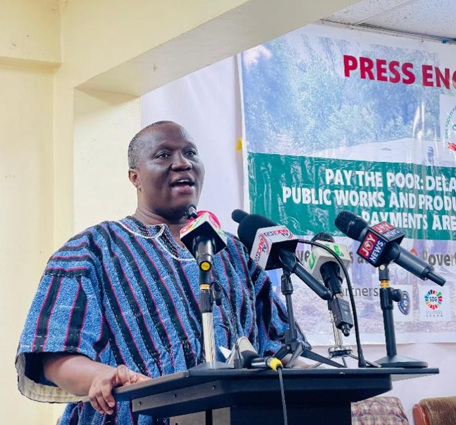
At a press briefing in Accra, the Civil Society Platform for Social Protection (CSO-SPSP) described the delays as a “growing social and economic emergency,” noting that payments have been outstanding since early February 2025.
“Only partial payments have been made to some beneficiaries; payments have been outstanding since February 2025,” it stated.
The platform said the arrears affect approximately 51,000 beneficiaries under the Productive Inclusion programme across 108 Metropolitan, Municipal and District Assemblies (MMDAs), and about 43,000 LIPW beneficiaries across 122 MMDAs.
In the case of LIPW, more than 1,700 payrolls remain unpaid, with total outstanding wages estimated at GH¢42.5million. Works on over 600 community assets have also stalled due to funding bottlenecks, denying beneficiaries both employment opportunities and access to essential infrastructure.
According to Auberon Jeleel Odoom, National Co-ordinator of the CSO-SPSP, the delayed payments are not discretionary benefits but “survival resources, livelihood investments and critical pathways out of poverty.”
He stressed that beneficiaries rely on the funds to secure daily meals, pay school fees, access healthcare and sustain small income-generating activities.
Programme’s impact
Independent assessments cited by the platform underscore the programmes’ impact. A 2021 IPSOS tracer study found that 97 percent of Productive Inclusion beneficiaries remained engaged in income-generating activities three years after completing the programme, with 81 percent reporting improved productivity.
Additionally, a 2024 Beneficiary Satisfaction Survey by the Centre for Social Policy Studies at the University of Ghana showed that 55.6 percent of beneficiaries experienced improved quality of life, while 98.1 percent found programme training highly useful.
The LIPW programme, a key component of GPSNP, provides temporary, off-season employment to poor households while enhancing local infrastructure such as rural roads, small dams and dugouts. Beneficiaries often receive wages for up to 90 days annually, combining livelihood support with community development. Over time, the programme has contributed to the creation of dams in northern communities, feeder roads, plantations and rehabilitated infrastructure, providing both temporary employment and long-term community assets.
Concerns
Despite these gains, the platform warned that the prolonged delays are causing severe livelihood disruptions, including collapsing micro-enterprises, rising household indebtedness, heightened vulnerability, psychological distress and growing erosion of trust in public programmes.
Beyond household-level impacts, the platform raised concerns about broader policy coherence. More than US$16million earmarked for Productive Inclusion and over US$22million for LIPW remain locked within the project financing envelope.
Responding to questions on the partial payments, Mr. Odoom said the organisation has not received a clear explanation from authorities regarding the cause of the arrears.
He suggested, however, that last year’s cap on general government expenditure may have affected the programmes, leading to their deprioritisation.
“It looks as if these programmes were part of those that suffered,” he noted, stressing that social protection interventions targeting the poor should not be sidelined, particularly during fiscal restraint.
The delays are particularly concerning amid the ongoing reassessment of the Livelihood Empowerment Against Poverty (LEAP) programme, which is expected to transition some households toward graduation mechanisms such as Productive Inclusion.
The platform cautioned that unpaid PI grants and LIPW wages could undermine LEAP’s graduation strategy and reverse hard-won gains.
It further warned of potential losses in institutional capacity built over 15 years at the district level, reputational damage to programme credibility, deepening poverty among extremely poor households, and financial distress for master craft persons, contractors and service providers engaged by participating MMDAs who remain unpaid.
Call to action
The Civil Society Platform, therefore, called on government – through the Ministry of Finance and the Ministry of Local Government, Chieftaincy and Religious Affairs – to immediately release all outstanding payments.
It also urged authorities to prioritise funding for programmes serving the extreme poor, ensure transparent public communication on the delays and safeguard the integrity and predictability of Ghana’s social protection system.
The platform maintained that timely payments are essential to upholding Ghana’s social protection guarantees under the 1992 Constitution and the Social Protection Act, 2025, warning that failure to act swiftly could weaken confidence in the country’s poverty reduction agenda.
Post Views: 24
Discover more from The Business & Financial Times
Subscribe to get the latest posts sent to your email.