
…….Optimizing Manageability to scalable performance
In the pursuit for organizational growth and performance scalability, leaders often focus on strategy, systems, technology and capital. While these are essential, they are not sufficient. Many organizations with sound strategies and ample resources still struggle to scale performance sustainably. The missing link is frequently not what the organization does, but how people work together within it.
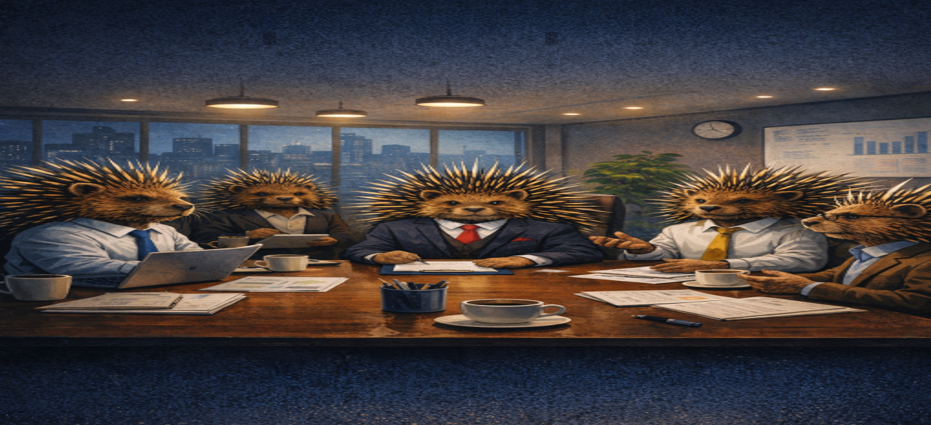
Organizations are modern ecosystems of porcupines. People must collaborate closely to deliver results. Innovation, speed and resilience demand proximity. Yet that same proximity exposes differences in temperament, values, power, ambition, and emotional sensitivity. The very closeness required for performance becomes the source of pain.
As an organization grows, its teams become more diverse, structures more layered and interactions more complex. With this complexity comes friction, interpersonal tensions, misaligned expectations, emotional sensitivities and competing priorities. These human dynamics, if unmanaged, become invisible constraints on performance.
By this understanding, manageability becomes a strategic imperative for the organization. Manageability ensures an organization’s ability to structure, guide and harmonize human interactions in ways that enable consistent execution, adaptability, and growth is critical for its scalability pursuit. Because, at the heart of manageability lies the challenge of navigating what this article refers to as “workplace porcupines.”
Workplace porcupines are individuals or groups whose proximity is necessary for organizational warmth, collaboration, innovation, productivity but whose differences, behaviors, or sensitivities can cause discomfort, conflict, or disengagement if not handled skillfully. By this, optimizing manageability, will be to bring these people close enough to collaborate effectively, while minimizing the “quills” that cause harm.
Having said that, it’s equally important to mention that, organizations rarely fail because of inadequate strategy or insufficient talent. Rather, performance stalls because leaders underestimate the human coordination costs of growth. Drawing on leadership research, organizational theory and practical observation, the article outlines why manageability matters, how unmanaged friction erodes performance, and what leaders must do to scale results without scaling dysfunction. The article further explores how managing workplace porcupines remains central to scaling performance, especially in complex, fast-evolving organizational environments. Let’s talk “Managing Workplace Porcupines”…the hidden key to scalable performance”
Understanding Workplace Porcupines: The Human Reality of Organizations
The metaphor of the porcupine originates from the philosophical dilemma that, porcupines huddle together for warmth in the cold, but when they get too close, they hurt each other with their quills. In organizations, this dilemma plays out daily. We see it in Teams where they are expected to collaborate closely, share ideas freely and align around common goals. Yet individuals bring with them distinct personalities, emotional triggers, values, communication styles, cultural backgrounds, ambitions and insecurities. These differences are not flaws necessarily but are the essence of diversity and creativity. However, unmanaged, they become sources of friction and organizational setback.
Workplace porcupines may include highly skilled individuals with low interpersonal awareness, strong personalities who dominate conversations or decision-making, emotionally sensitive employees who perceive feedback as personal attack, leaders whose authority intimidates open dialogue and Teams competing for recognition, resources or influence.
These porcupines are not inherently problematic as earlier mentioned. In fact, they are often high performers, innovators or critical thinkers. The problem arises when organizations lack the manageability frameworks to harness their strengths while mitigating relational damage.
Why Workplace Porcupines Multiply as Organizations Grow
In small teams, personal goodwill often compensates for poor systems. Relationships are informal, communication is direct and misunderstandings are quickly corrected. As organizations grow, this relational elasticity disappears. The number of interactions increases exponentially with scale. Each additional person introduces not just a new role, but new emotional variables, interpretations, and expectations.
Margaret Heffernan, leadership thinker and former CEO, notes: “For good ideas and true innovation, you need human interaction, conflict, argument, debate.” Yet conflict without manageability becomes destructive. Debate without trust becomes personal. Argument without boundaries becomes political.
As organizations scale, three forces intensify porcupine dynamics: Work becomes more cross-functional as success tend to depend less on individual excellence and more on collective coordination. This forces porcupines closer together. As the organization grows, leaders manage more people, teams interact across distances, and informal correction gives way to formal processes. Misunderstandings linger longer.
In such circumstances, growth brings targets, deadlines, scrutiny and risk. Under pressure, emotional regulation weakens, and quills sharpen. Without intentional manageability, scale magnifies dysfunction faster than performance.
The Cost of Unmanaged Porcupines
The most dangerous aspect of unmanaged porcupines is not open conflict. It is emotional withdrawal. When people feel repeatedly hurt, misunderstood, or unsafe, they rarely explode. They disengage.
Amy Edmondson’s research on psychological safety reveals that, “fear is the enemy of learning and that fear is also the enemy of performance scaling. Disengaged employees do what is required, not what is possible, protect themselves rather than the organization, avoid risk, innovation and accountability and withhold honest feedback.
These behaviors do not show up immediately in performance dashboards. They accumulate quietly until growth stalls. Normally, organizations respond to this by hiring more talent, restructuring, or launching new initiatives without realizing that the real constraint is relational debt.
Ignoring workplace porcupines does not make them disappear; it makes them more dangerous. The cost of unmanaged interpersonal friction is both visible and hidden. Visible costs include declining team productivity, increased conflict and grievances, higher employee turnover, leadership fatigue, burnout, delayed projects and missed targets.
The costs of emotional withdrawal and disengagement, loss of discretionary effort, reduced creativity and innovation, informal silos and “us versus them” dynamics and passive resistance to change are regarded hidden costs.
Besides, many organizations attempt to scale performance by adding more people or introduce new systems, without addressing these underlying relational issues. Left unresolved, the result is complexity without coherence, growth without harmony.
Emotional Intelligence as a Skillset for Managing Porcupines
At the individual level, emotional intelligence (EI) is the most critical competency for managing workplace porcupines. EI enables individuals to recognize emotional triggers, regulate reactions under pressure, empathize with differing perspectives, communicate with clarity and respect and navigate conflict without escalation.
Organizations that invest in EI development equip their people with the skills to self-manage, reducing the burden on leaders and systems.
Psychological Safety as the Antidote to Porcupine Pain
One of the most powerful tools for managing workplace porcupines is psychological safety, the shared belief that the team is safe for interpersonal risk-taking. In psychologically safe environments, people speak up without fear of humiliation, mistakes are treated as learning opportunities, feedback is given and received constructively and differences are explored not suppressed.
Psychological safety does not mean comfort or the absence of challenge. It means challenge without threat and this distinction allows porcupines to coexist without constant emotional injury. Leaders play a critical role in creating this environment by responding calmly to bad news, inviting input from quieter voices, acknowledging their own limitations and separating ideas from personal identity.
Manageability: The Forgotten Strategic Capability
Manageability is the organization’s capacity to coordinate human effort without excessive friction, align behavior without coercion, and sustain performance as complexity increases. It is not a function of authority alone nor is it achieved through policies or systems in isolation. Manageability lives at the intersection of structure, leadership behavior, culture, and emotional intelligence.
Admissibly, differences require management. Without it, they become liabilities rather than assets. Highly manageable organizations are not conflict-free but are conflict-capable. They absorb tension without tearing, debate without damage, and proximity without pain. Poorly manageable organizations, by contrast, experience constant relational strain, political maneuvering, and emotional fatigue even among high performers. This is where the metaphor of workplace porcupines becomes instructive.
The Illusion of Control and the Reality of Coordination
Many leaders respond to porcupine pain by tightening control. That is more rules, more reporting, more oversight. This often worsens the problem because control assumes predictability. Human systems are not predictable; they are adaptive.
Ronald Heifetz, authority on adaptive leadership, argues: “Leadership is not about answers. It is about holding people in a productive zone of disequilibrium.” That “productive zone” is precisely where porcupines must operate close enough to generate heat, tension, and progress, but supported enough to avoid injury.
Manageability, therefore, is not about eliminating disequilibrium but containing it constructively. Here, poorly managed organizations oscillate between chaos and rigidity. That is from too loose confusion, conflict and fragmentation to too tight a condition of compliance, disengagement and silent resistance. Meanwhile, highly manageable organizations achieve dynamic balance between the two extremes.
Manageability: From Control to Coordination
To mention manageability is not about minimizing human differences, but about designing systems, cultures, and leadership behaviors that make those differences workable.
Traditional management models emphasized control in respect of rules, hierarchy, supervision, and compliance. In today’s complex organizations, control alone is ineffective. Instead, distributed teams and dynamic markets demand coordination rather than coercion, influence rather than authority and trust rather than surveillance.
Optimized manageability answers critical questions as to how easily people can collaborate without unnecessary conflict, how quickly teams are able to resolve tension without escalation, how clear are roles, expectations and decision rights, how safe do people feel expressing dissent or new ideas and how aligned are individual behaviors with organizational goals?
When manageability is low, even small issues consume disproportionate energy. Meetings become battlegrounds, decisions stall, morale declines and performance plateaus. When manageability is high, organizations scale not just in size, but in effectiveness too.
Culture as the Long-Term Container of Manageability
Culture determines how people behave when no one is watching. It is the invisible system that either amplifies or neutralizes porcupine dynamics.
Cultures that support manageability emphasize mutual respect, accountability with empathy, learning over blame, transparency over politics and purpose over ego. Culture is shaped not by slogans, but by daily leadership decisions of what is rewarded, tolerated, corrected or ignored.
Scaling Performance and why Manageability matters more as Organizations Grow
When manageability is high energy flows toward execution, not self-protection, differences generate insight, not injury, conflict sharpens decisions rather than eroding trust and Leaders spend less time firefighting and more time leading. Patrick Lencioni captures this dynamic powerfully, emphasizing that “Politics is when people choose their words and actions based on how they want others to react rather than based on what they really think.” By this, it is noticed that Politics flourish where manageability is low. Meaning that authentic collaboration thrives where it is high. Manageability does not remove human complexity; it absorbs it and allows organizations to scale performance without scaling dysfunction.
Meanwhile, scaling performance is not linear because as organizations grow, the number of interactions increases exponentially. Every new hire, team, or layer of leadership multiplies relational complexity. High-performing scalable organizations share a common trait as they are deliberately designed to manage human interaction. They invest as much in leadership capability, culture, and emotional intelligence as they do in technology and strategy.
In small teams for instance, personal relationships can compensate for weak systems. In larger organizations, systems can be made to compensate for the limits of personal relationships. Without intentional manageability, scaling creates noise, confusion, and friction faster than it creates value.
Why Performance Rarely Scales as Planned
Most organizations do not fail because of a lack of strategy. They fail because they underestimate the human cost of growth.
As organizations scale, leaders often assume that performance will scale proportionately as more people, more systems and more output. In reality, performance rarely scales linearly. It plateaus, fragments, or even regresses. What looked like momentum in a smaller structure becomes friction in a larger one.
Peter Drucker warned of this long before the age of complex matrix organizations that, “Management is not about managing people; it is about managing work, yet work is done by people, and people are not mechanical inputs. They are emotional, relational, interpretive, and deeply human. When organizations scale without addressing how human beings interact under pressure, complexity multiplies faster than capability. The result is a familiar organizational paradox of brilliant strategy, poor execution, talented people, disappointing results and growth in size, stagnation in performance.
Leadership Failures that Exacerbate Porcupine Dynamics
Leaders are the chief architects of manageability. Whether intentionally or unintentionally, leadership behavior shapes how safe, clear and collaborative the workplace feels. Avoiding difficult conversations, playing favorites or tolerating toxic behavior, overcentralizing decisions, sending mixed signals about values and confusing performance pressure with emotional pressure are few symptomatic expressions.
Effective leaders understand that how results are achieved matters as much as the results themselves. They do not eliminate friction; they channel it constructively. They set clear expectations and boundaries, modeling emotional regulation, encouraging respectful disagreement, addressing issues early and fairly and valuing both results and relationships as behaviors that optimize manageability.
Designing Systems that Reduce Friction
Manageability is not sustained by goodwill alone but must be embedded in organizational systems. Key systemic enablers of manageability are role clarity where clear responsibilities reduce overlap and conflict, robust decision frameworks with defined decision rights that prevent power struggles, effective communication norms where agreed rules for meetings, feedback and escalation are ensured. Additionally, there must be performance metrics with balanced measures that value collaboration and conflict resolution mechanisms that details structured ways to address tension early.
It is arguably said that, when systems are ambiguous, people fill the gaps with assumptions, politics and emotions that sharpen their quills unintentionally.
Turning Friction into Productive Tension
Not all friction is bad. In fact, some of the highest-performing teams experience healthy tension debates, differing viewpoints and rigorous challenge. The difference lies in intent and management as productive tension focuses on ideas, not personalities and when ideas are anchored on shared goals and occurs within agreed boundaries, it leads to better decisions.
However, unproductive friction becomes personal or emotional, when it is fueled by ego or insecurity, lacks resolution mechanisms will erode trust. Optimized manageability transforms porcupine quills into creative edges sharpening thinking without drawing blood.
The Future of Work and why Managing Porcupines Will Matter Even More
As organizations adopt hybrid work, AI-driven processes, and global collaboration, the human dimension of work becomes even more complex. Physical distance may reduce some friction and may introduces new challenges of miscommunication, isolation, and emotional disconnection.
In this future, manageability will be a defining leadership capability and organizations that fail to manage human dynamics will struggle to scale, no matter how advanced their technology. Optimizing manageability to scale performance is ultimately about designing organizations that work with human nature, not against it. That, workplace porcupines are not obstacles to be removed; they are realities to be managed. And at the heart of that sustainability lies in one enduring truth: Performance scales best where people can work closely without hurting each other and still stay warm together.
A Leadership Wake-Up Call
The central argument of this article is simple but uncomfortable that, most performance problems are people problems in disguise and most people problems are manageability failures. Besides, organizations do not suffer from too many porcupines instead, they suffer from leaders and systems that have not learned how to manage proximity wisely.
As we move deeper into knowledge work, hybrid teams, cultural diversity, and AI-enabled workflows, the human dimension of work becomes more critical, not less. The organizations that will win are those that understand this truth early.
As Drucker famously observed: The most important thing in communication is hearing what isn’t said and that, workplace porcupines rarely announce themselves loudly. Their pain shows up in silence, resistance, and underperformance.
Manageability then is the discipline of hearing those signals and responding with design, leadership and wisdom.
Bottom of Form
Frank Anim is the CEO and Strategic Partner of AQUABEV Investment and Discovery Consulting Group. He is an Executive Director and the Lead Coach in Leadership Development and best Business Management practices for Discovery Leadership Masterclass.
Email: [email protected] or [email protected]
Tel: +233-0241824033/+233-0501324604
Post Views: 22
Discover more from The Business & Financial Times
Subscribe to get the latest posts sent to your email.