

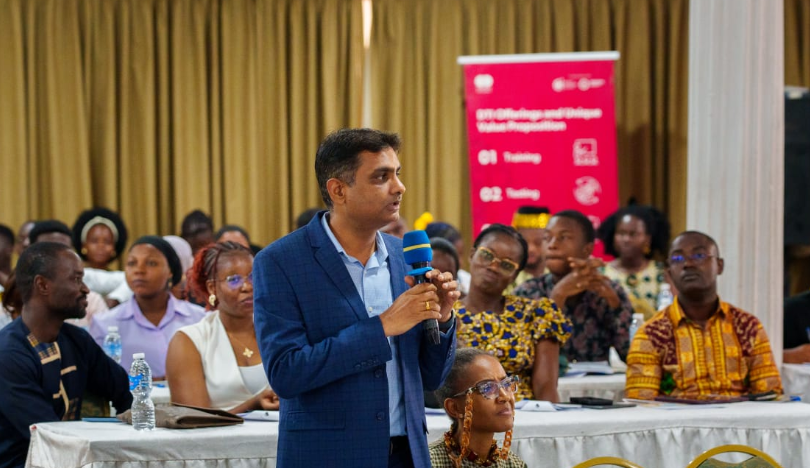
The Design & Technology Institute (DTI) Alumni Convocation 2026 has concluded with a strong call for the continent’s youth to take ownership of its workforce systems, urging a decisive shift from aid dependence to African-led workforce architecture.
Held under the theme “Beyond Aid: Building Africa’s Workforce by Us, For Us,” the convocation brought together industry leaders, policymakers, development partners and DTI alumni to examine how the continent’s growing youth population can be mobilised to drive industrial transformation.

With its population projected to exceed 2.5 billion by 2050- forming one of the world’s largest labour pools- the gathering challenged participants to interrogate a critical question: who is designing the systems that will absorb and empower this workforce?
Delivering the keynote address, seasoned global executive and academic Mr. Kofi Amegashie emphasised the urgent need for the continent to transition from dependence to deliberate system design.
“Dependence is a mindset. It assumes that development comes from outside- that expertise arrives on a plane. Architecture is different. Architecture is design, structure, systems-intentional building,” he said.

He stressed that no country has industrialised without prioritisingtechnical capability. “No nation architects its future without skilled professionals who can execute it. Technicians make strategy real. Engineers make growth possible.”

Drawing from over three decades of leadership experience across Africa, Europe and the UK, Mr. Amegashie noted that production failures in global industries were rarely due to weak strategy presentations. “They happen because technical capability is insufficient,” he said.

He cautioned that industrial ambition would remain aspirational without strong technical ecosystems. “If we are serious about moving from dependence to architecture, we must design and build our own systems. The future will be decided in workshops, studios, production floors and design laboratories.”
He further stated that the government’s role should be enabling rather than controlling. “Government must provide the environment, access to finance, markets, information and scalable regional systems while allowing industry and professionals to execute.”
President of the DTI Alumni Association, Mr. Karl Adu Dankwah, described the convocation as a turning point for the alumni body. “This is not just a reunion; it is a renewal of responsibility. The builders are us. The workforce is us. We cannot speak of building Africa’s workforce while standing on the sidelines,” he said.
He noted that alumni performance directly shapes DTI’s national reputation. “Our competence becomes the institute’s credibility. Our conduct becomes its brand.”

He also announced that DTI would soon break ground for its Pan-African Centre of Excellence for TVET and Workforce Development, describing alumni as “the foundation of the institute’s legacy.”
Project Coordinator at DTI, Mr. Mohit Sharma, representing the Mastercard Foundation partnership, underscored the importance of structured coordination.
“Potential becomes power only when it is organised. The question is not whether you are skilled, but whether you will collectively shape the systems within which your skills operate,” he stated.
He emphasised that the Alumni Association is transitioning from informal engagement to structured coordination. “You are not just participants in systems; you must become co-creators of the systems Africa needs.”
Mr. Sharma noted that Africa’s demographic expansion presents both opportunity and risk, depending on how effectively talent is mobilised, coordinated and aligned to industry demand.
Alumni also shared testimonies on how DTI’s competence-based training model transformed their employability and entrepreneurial journeys.

Ms. Susana Abban, a fashion entrepreneur, described how the programme enabled her to overcome personal barriers and launch a sustainable fashion enterprise.
“I came in as an unemployed graduate with fears. The mindset training helped me break through. I pitched my idea and won $1,000, and today I train others and employ three people.”
Mr. Jesse Agbenyegah, founder of Kraft Urban Fabrications, highlighted the need for young people to create opportunities rather than rely solely on job applications.
“We are changing the narrative, from only seeking jobs to creating jobs with the skills we have,” he said.
Speakers noted that DTI’s competence-based training focused on welding, fabrication, precision manufacturing and entrepreneurship- has significantly strengthened school-to-work transition outcomes for the country’s youth.

Under the Mastercard Foundation’s Transforming Youth TVET Livelihoods Phase II programme, DTI aims to train 50,000 young people over three years, building on 30,000 trained under the first phase.
Participants concluded that coordinated alumni action will be central to preparing the continent’s workforce for the next 25 years, with focus on skills relevance, enterprise creation, industry collaboration and local economic resilience.
Post Views: 25
Discover more from The Business & Financial Times
Subscribe to get the latest posts sent to your email.