
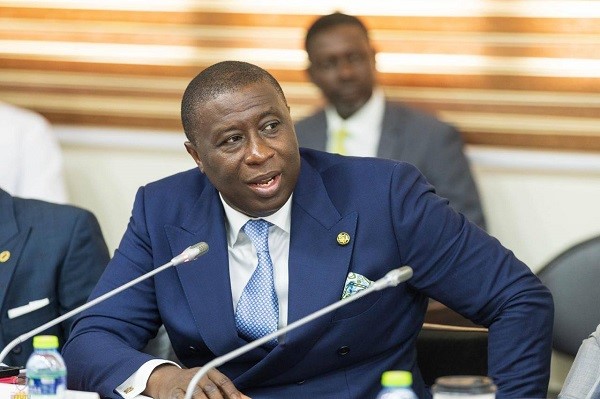

Patrick Yaw Boamah, the Member of Parliament for Okaikor Central has argued that Ghana could have made significantly greater progress in its development journey if successive governments had adopted long-term national programmes protected by law rather than frequently introducing new initiatives that disrupt continuity.
Reflecting on the country’s development trajectory nearly seven decades after independence, the lawmaker said Ghana’s pace of economic and infrastructural transformation has been constrained by political transitions, policy resets and shifting ideological priorities across administrations. “Ghana has turned 69 and I believe our pace of development could have been better,” Mr Boamah said. “We experienced several military interventions, constitutional changes and leaders with different ideas about how the country should develop.”
He argued that the stability provided by the Fourth Republic of Ghana should have been used to design national development programmes that every political party would be required to pursue once in government.
Call for development plans ‘cast in stone’
According to Mr Boamah, major infrastructure and social investment programmes should be supported by legislation and ring-fenced budgetary allocations to ensure that they are implemented consistently regardless of changes in government.
He cited road infrastructure as a clear example of where such an approach could have transformed the country’s economic landscape. “If we had decided under the Fourth Republic that key economic highways such as Accra–Kumasi, Accra–Takoradi–Elubo and Accra–Aflao must be dualised within a defined timeframe, with specific portions of the national budget committed to that programme, those projects would have been completed by now,” he said.
Such legally backed programmes, he suggested, would prevent major national projects from being delayed or abandoned when administrations change. The same principle, he added, could be applied to the health sector by committing governments through legislation to construct a fixed number of district hospitals during each electoral cycle.
Policy resets and political branding
Mr. Boamah said Ghana’s development planning is often disrupted when successive governments introduce new flagship programmes while abandoning or rebranding those initiated by previous administrations. Examples of this pattern can be seen in initiatives such as One District One Factory, Agenda 111 and the proposed 24-Hour Economy Policy.
While each initiative may have its own objectives, frequent policy changes can create implementation gaps and weaken long-term planning. “You start an industrialisation programme and another government comes and gives it a different name. A health programme begins and the next administration replaces it with another flagship initiative,” he said. “What we need is to agree as a country on certain core programmes with clear timelines backed by law. Governments can still introduce their own policies, but those national plans must not be disrupted.”
Development implications
Economists say the issue raised by Mr. Boamah goes beyond politics and touches on one of the most persistent structural challenges facing Ghana’s economy: policy continuity. Large infrastructure projects, industrialisation programmes and national transport systems typically require long-term planning horizons that extend beyond a single electoral cycle. When programmes are discontinued or redesigned every four to eight years, projects often become fragmented, delayed or more expensive.
In Ghana’s case, analysts note that inconsistent implementation has slowed progress in key sectors including transport infrastructure, rail development, industrial expansion and health services. A legally anchored national development framework could help address this problem by ensuring that major economic projects — particularly those with strong multiplier effects — are completed regardless of political changes.
Economic impact
For Ghana’s economy, the stakes are significant. Stable long-term infrastructure planning can improve productivity, reduce transport costs and strengthen regional trade links. Dualising major highways, for instance, could lower logistics costs for agricultural producers, mining companies and manufacturing firms while easing congestion between the country’s main commercial centres.
Similarly, consistent investment in healthcare infrastructure would expand access to services, reduce pressure on urban hospitals and improve labour productivity by strengthening public health outcomes. Policy continuity also plays a critical role in attracting private investment. Investors are generally more willing to commit capital when long-term development strategies are predictable and insulated from political cycles. Frequent policy changes, by contrast, can create uncertainty, discourage large-scale investment and slow industrial growth.
Ghana’s position in the region
Despite these challenges, Mr. Boamah acknowledged Ghana’s relative stability and influence within West Africa. He noted that the country remains widely regarded as a democratic model on the continent, citing the enduring legacy of independence leader Kwame Nkrumah, who was posthumously recognised as Africa’s ‘Millennium Leader’. “Within the sub-region Ghana is still doing better in many respects,” he said.
However, he argued that the country’s democratic reputation should be matched by more disciplined long-term development planning. “We are seen as a beacon of democracy and development in Africa,” Mr Boamah said. “That means we must also demonstrate that our development planning is serious, structured and capable of delivering results.”
For the Okaikoi Central MP, the lesson after nearly seven decades of independence is clear: Ghana’s future growth will depend not only on new policy ideas but on the ability of successive governments to commit to national development plans that endure beyond political cycles.
Patrick Yaw Boamah
Post Views: 22
Discover more from The Business & Financial Times
Subscribe to get the latest posts sent to your email.