

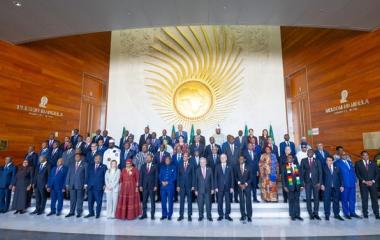

On the sidelines of the 39th African Union Summit, African leaders and institutions threw their weight behind a bold initiative to build a New African Financial Architecture (NAFA) that can mobilise resources at scale to finance the continent’s development priorities.
The African Continental Free Trade Area Secretariat highlights a critical need to unlock African private capital and close trade-related infrastructure gaps, reflecting growing recognition among African policymakers that the continent’s ambitious development agenda – from the AfCFTA to the AU’s Agenda 2063 – cannot be realised within existing financing frameworks which leave Africa chronically under-resourced and dependent on external capital flows that are volatile, conditioned and insufficient to meet the continent’s needs.
President-African Development Bank Dr. Sidi Ould Tah opened the dialogue by underscoring the urgency of strategic, collective action to mobilise resources at scale and build an integrated financial architecture for the continent.
“NAFA is not just a financial plan. It is a blueprint for Africa’s economic transformation. It points to a future where Africa finances its development on its own terms through collaboration, coherence and leadership,” Dr. Ould Tah stated.
His emphasis on urgency reflects a sobering reality: despite decades of development finance initiatives, Africa continues to face massive financing gaps across infrastructure, industrialisation, health, education and climate adaptation.
AfCFTA Secretary-General Wamkele Mene, in his contribution to the dialogue, emphasised need to unlock African private capital as a cornerstone of the new financial architecture. Mene also highlighted the urgency of closing trade-related infrastructure gaps, a challenge that sits at the intersection of trade facilitation, industrial development and financial architecture.
Leaders from AfCFTA institutions, AU-ETTIM and Regional Economic Communities (RECs) welcomed NAFA and reaffirmed the importance of stronger coordination, co-design, effective oversight of regional projects and value chains and complementary regional policies to ensure successful implementation.
Africa faces a massive development financing gap – estimated at nearly US$108billion annually for infrastructure alone, with an additional US$$1.3trillion yearly required to achieve Sustainable Development Goals (SDGs) by 2030
Insufficient domestic resources, rising debt and reliance on costly foreign commercial borrowing have severely constrained the continent’s ability to fund its development, exacerbated by a 20-25% debt-to-GDP ratio and significant illicit financial flows.
Africa has made significant progress in financing its development through domestic resources in recent years. However, this funding is inadequate to close a widening financing gap.
Post Views: 43
Discover more from The Business & Financial Times
Subscribe to get the latest posts sent to your email.