
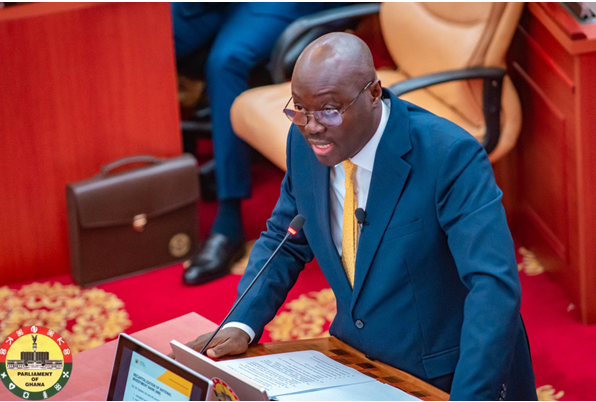

Finance Minister Cassiel Ato Baah Forson last week Thursday announced a raft of measures as part of a broad sector overhaul for one of the country’s main export earners.
The measures come after a sharp drop in global cocoa prices, a failed financing model and what government describes as years of mismanagement at Ghana Cocoa Board.
Cocobod’s long-standing syndicated loan model faltered. For the first time in three decades the annual syndicated loan in 2023 was delayed, with the first tranche arriving four months after the season began. The board later defaulted on part of its obligations and relied on emergency support from the Finance Ministry.
Dr. Forson added that the financing model invented after the syndicated loan failed was entirely dependent on buyers pre-financing cocoa purchases.
“The key motivation for buyers was the rollover contract price of US$2,661 per metric tonne when the market price was around US$2,000. Once that gap closed, the incentive disappeared. That model was not sustainable.”
To address the situation, government will introduce a new financing framework based on domestic cocoa bonds from the 2026-2027 season. The bonds will create a revolving fund to finance purchases within each crop year, reducing reliance on external syndicated loans and buyer pre-financing.
The debt conversion is expected to restore positive equity and strengthen the board’s balance sheet.
Dr. Forson however indicated that road construction accounts for a significant part of the financial difficulties Cocobod is facing. It is therefore gratifying to learn that road-related liabilities of GH¢4.35billion will be transferred to the Ministry of Finance and Ministry of Roads and Highways.
Additionally, the new Cocoa bill will prohibit quasi-fiscal expenditures and impose sanctions where necessary.
Beyond financing and debt restructuring, the reforms include a push to increase domestic processing. Cabinet has directed that the remainder of the 2025-2026 crop be allocated for local processing and from 2026-2027 at least 50 percent of Ghana’s cocoa beans must be processed locally.
To this end, state-owned Produce Buying Company will be revived and the Cocoa Processing Company will be prioritised to lead domestic processing. Dr. Forson said private processors have indicated they have the capacity to handle more than half of Ghana’s output.
Further, Cabinet has instructed the Attorney General to commission a forensic audit and criminal investigation into Cocobod’s activities over the past eight years.
Dr. Cassiel Ato Forson has assured cocoa farmers that government’s ongoing reforms will safeguard their interests and strengthen the cocoa sector. Cocoa has always been a vital part of Ghana’s economy and he emphasised that the new measures are designed to protect both farmers and the industry.
Post Views: 7
Discover more from The Business & Financial Times
Subscribe to get the latest posts sent to your email.