


The Environmental Protection Authority (EPA) has sensitised about 20 manufacturing firms at Ejisu in the Ashanti Region on the newly enacted Environmental Protection Act, 2025 (Act 1124), warning that violations could attract prison terms ranging from five to ten years.
The workshop forms part of efforts by the EPA to strengthen compliance and enhance oversight of environmental practices. It also aims to empower the authority to review and revoke decisions concerning environmentally sensitive areas that may pose risks to public health.
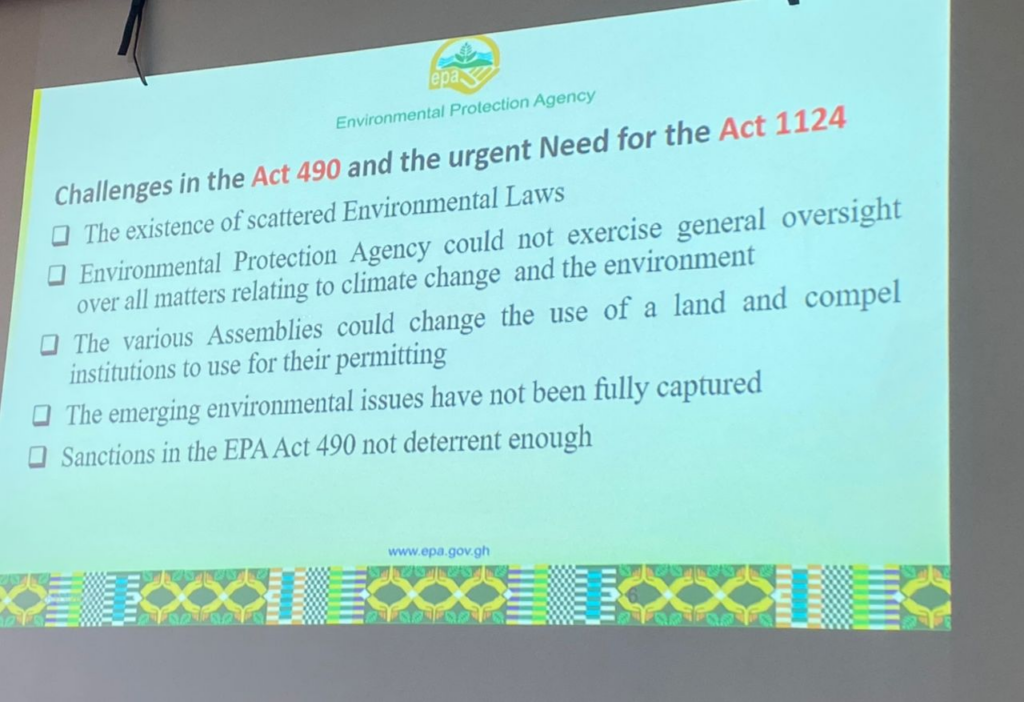
Addressing participants at the opening session, the Ashanti Regional Director of the EPA, Dr. Jackson Adiyiah Nyantakyi, commended the passage of Act 1124, describing it as a major step toward reforming Ghana’s environmental governance framework.
According to him, the previous law, the Environmental Protection Agency Act, 1994 (Act 490), was inadequate in addressing emerging environmental challenges such as waste management, pesticide control, and climate change.
He urged operators in the manufacturing sector to align their operational and planning processes with the provisions of the new law to promote sustainable environmental management.
Dr Nyantakyi further highlighted the penalties under the new act, noting that any person who fails to pay an administrative penalty commits an offence and is liable, upon summary conviction, to a fine of not less than 5,500 penalty units and not more than 15,000 penalty units, or a custodial sentence of between five and ten years, or both.
“Under Section 37 of the Act, any individual who obstructs a public officer in the lawful execution of their duties commits an offence and may face a fine ranging from 500 to 1,000 penalty units, or a prison term of one to two years, or both,” he said
Dr Nyantakyi explained that the sensitisation programme was necessary to educate stakeholders and prevent further violations, noting that several individuals have already fallen foul of the law since its introduction.
The Ejisu EPA Director, Joseph Amoako Addai, educated participants on cleaner production initiatives.
He explained that cleaner production is a proactive and integrated strategy that applies preventive environmental approaches to processes, products, and services.

It is designed to improve efficiency while reducing risks to human health and the environment by preventing waste and pollution at the source rather than managing them after they are created.
DISCLAIMER: The Views, Comments, Opinions, Contributions and Statements made by Readers and Contributors on this platform do not necessarily represent the views or policy of Multimedia Group Limited.
DISCLAIMER: The Views, Comments, Opinions, Contributions and Statements made by Readers and Contributors on this platform do not necessarily represent the views or policy of Multimedia Group Limited.
Source link