
Government is seeking to deepen cooperation with India in fisheries and aquaculture, with the sector primed to be a new driver of food security, employment and value-chain growth as part of an expanding bilateral economic partnership.
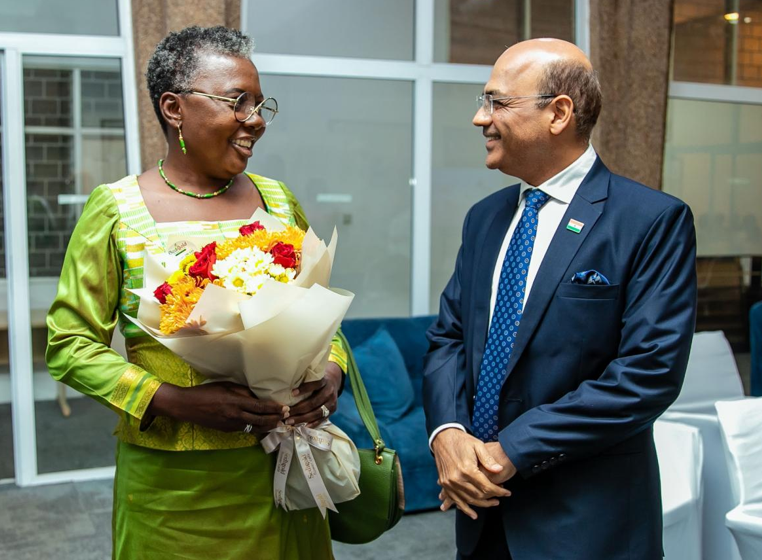
In remarks at the India–Ghana Partnership Day in Accra, the Minister for Fisheries and Aquaculture, Emelia Arthur, said Ghana saw “significant opportunities to deepen collaboration with India” across various aspects of the value chain.
“Ghana sees significant opportunities to deepen collaboration with India in aquaculture development, fisheries research, value chain enhancement, post-harvest management, innovation and institutional capacity building,” she said.
The minister noted that these areas were central to Ghana’s blue economy ambitions and efforts to stabilise domestic fish supply while improving productivity and incomes.
Mrs. Arthur said Ghana’s reform agenda in fisheries governance would depend on stronger institutions, skilled human capital and sustained investment.
She pointed to the need for longer-term planning frameworks and better coordination across agencies as the country seeks to manage aquatic resources more sustainably while expanding aquaculture production.
“Success will depend on strong institutions, skilled human capital, innovation and trusted partnerships,” she noted.
Mrs. Arthur said fisheries and aquaculture remains a practical test of how Ghana intends to convert diplomatic partnerships into sector-level outcomes.
The sector supports an estimated three million livelihoods in coastal and inland communities and remains a key source of protein, yet faces persistent challenges – including overfishing, weak enforcement, limited processing capacity and high post-harvest losses, leading to a 390,000-metric-tonne supply deficit.
Aquaculture, while growing, continues to be constrained by gaps in hatchery systems, feed technology, cold-chain logistics and technical expertise.
While marine stocks face the relentless pressure of overfishing and illegal practices, the sector saw a defiant 16.4 percent growth surge in early 2025, fuelled largely by a booming aquaculture industry that is racing to hit a 177,000-tonne target by next year.
Despite fish accounting for a 60 percent of the national protein intake, the industry continues to bleed value through post-harvest losses of up to 50 percent in inland regions, forcing the government to double down on controversial ‘closed seasons’ and new regulatory frameworks to protect the waters that feed the nation.
“Whether in Accra, New Delhi or Tel Aviv, our conversations increasingly converge around sustainability, resilient food systems and the blue economy,” Mrs. Arthur further said.
India’s High Commissioner to Ghana, H.E. Manish Gupta, said both countries were exploring cooperation in fisheries and aquaculture under a structured framework, drawing on India’s experience in scaling development projects and deploying technical expertise across emerging economies.
He said India’s development cooperation increasingly focused on pairing training with applied solutions that deliver measurable results on the ground.
“Development partnership and capacity building efforts are the cornerstone of our bilateral cooperation,” he said.
“India’s ability to implement large-scale projects with scale and speed has considerably improved during the last decade, and these are very beneficial for the Global South,” he added.
The officials indicated that India’s capacity-building instruments would play a central role in the sectoral push.
The Indian Technical and Economic Cooperation (ITEC) programme and scholarships administered by the Indian Council for Cultural Relations (ICCR) provide training, research exposure and technical assistance that can be tailored to fisheries governance, aquaculture management and value-chain development.
These programmes are expected to support skills development for regulators, researchers and operators across the sector.
Beyond training, cooperation is likely to extend to technology transfer and applied research. Priority areas include improved hatchery management, feed formulation, disease control, quality assurance and cold storage infrastructure.
Reducing post-harvest losses has emerged as a key focus, given its impact on food availability, incomes and export potential. Officials say progress in these areas could help Ghana reduce import dependence and strengthen competitiveness in regional markets.
The sectoral discussions come against the backdrop of a broader recalibration of India–Ghana relations. Following a landmark visit by India’s prime minister – Narendra Modi – last year, the two countries elevated their ties to a comprehensive partnership, opening pathways for collaboration in digital public infrastructure, renewable energy, innovation and climate-smart agriculture.
Fisheries and aquaculture align closely with this agenda through their links to climate resilience, employment creation and inclusive growth.
Economic ties between the two countries have gained momentum. Bilateral trade has risen to about US$5billion, close to a five-year target of US$6billion, reinforcing expectations that deeper sectoral cooperation could further expand commercial engagement. Indian firms already operate in Ghana across manufacturing, pharmaceuticals and services, and officials say agriculture-linked industries could attract increased investment as collaboration deepens.
For Ghana, the challenge will be execution, with Mrs. Arthur saying reforms in fisheries governance were underway; but success would require effective enforcement, investment mobilisation and coordination across ministries and agencies.
Post Views: 6
Discover more from The Business & Financial Times
Subscribe to get the latest posts sent to your email.