

… as reforms restore investor, trader confidence
By Ebenezer Chike Adjei NJOKU ([email protected] )
Ghana is among the few African economies to record an improvement in trade dynamics over the past 18 months, according to the latest Africa Trade Barometer published by Standard Bank Group. The country climbed one place in the survey, moving from seventh to sixth among the ten markets assessed between August 2024 and October 2025.
This improvement, the report said, reflects a gradual recovery in business sentiment as economic reforms and stabilising macroeconomic conditions begin to restore confidence among companies engaged in cross-border trade.
The study tracked trade conditions across Angola, Ghana, Kenya, Mozambique, Namibia, Nigeria, South Africa, Tanzania, Uganda and Zambia, combining macroeconomic indicators with business sentiment surveys to measure the health of trade ecosystems across the continent.
The report states that: “Ghana (7th to 6th position) was among the countries recording gains in the overall barometer ranking, alongside Angola and Mozambique, while South Africa, Namibia, Kenya and Zambia all slipped in the standings”.

The improvement comes as Ghana’s macroeconomic environment stabilises following a period of severe volatility marked by high inflation, currency depreciation and fiscal stress.
Business sentiment in particular has strengthened sharply as Ghana saw its business confidence index score rise to 71 in the current edition of the survey from 59 in August 2024, with abolishing the levy on electronic transfers (e-Levy) cited as a key factor.
“This positive sentiment was particularly strong in Ghana, where the index score surged to 71 following removal of the Electronic Transfer Levy in April 2025,” the report noted.
The rise in confidence was underpinned by improving expectations among businesses about the country’s economic trajectory and trading environment. Lower inflation, a more stable currency and policy reforms aimed at easing the cost of doing business have helped restore predictability for companies involved in international trade.
The report also highlighted Ghana’s improving trade balance, driven by strong export earnings from key commodities.
“Ghana experienced the largest increase. Ghana’s trade surplus increased to US$9.4billion,” the report said.
The surplus reflects higher export revenues from gold and cocoa, Ghana’s two largest export commodities, as well as improved export volumes during the period under review.
Commodity price dynamics played a role in strengthening trade balances across several African markets, but Ghana’s gains were notable because they coincided with policy reforms aimed at improving the country’s trade ecosystem.
The nation’s improved trade ranking is further supported by a significant expansion in export earnings, which rose to US$31.11billion by end-December 2025. This represents a 62 percent increase from the US$19.16billion recorded in 2024. Consequently, the country’s trade surplus reached US$13.66billion in 2025, a 38 percent increase over the US$9.88billion surplus reported for the previous year.
The primary driver of this growth was the gold sector, where earnings increased from US$10.31billion in 2024 to US$20.98billion in 2025. This result was directed by a 35.7% increase in export volumes and a 49.9 percent rise in global gold prices, which averaged US$3,400.35 per fine ounce during the period.
In addition to mining, cocoa revenues reached US$3.86billion in 2025, compared with US$1.94billion in 2024.
Gross International Reserves climbed to US$13.8billion by end-2025 – providing roughly 6 months of import cover, with the state eyeing 15 months of import cover.
Government initiatives designed to expand export markets and deepen regional trade relationships also contributed to the improvement in sentiment.
“Ghana’s government prioritised energy diversification in its Nationally Determined Contributions (NDC) revisions in July 2025 to safeguard industrial productivity,” the report added.
The report pointed to targetted trade missions to East African markets including Kenya, Tanzania and Rwanda, which were intended to create commercial partnerships and open new export opportunities for Ghanaian companies.
These initiatives form part of broader efforts aimed at positioning Ghanaian businesses to take advantage of opportunities under the African Continental Free Trade Area (AfCFTA), which aims to expand intra-African commerce by lowering trade barriers across the continent.
Financial sector reforms and policy adjustments have also supported the recovery in confidence. The Bank of Ghana reduced the Monetary Policy Rate (MPR) by 900 basis points over the course of 2025, bringing it down from 27 percent in January to 15.5 percent by early 2026. With inflation at 3.3 percent for Feb 2026 and the Ghana Reference Rate at 11.71 percent, the MPR is expected to fall further.
The report noted that easing monetary conditions and reforms to banking channels have helped improve liquidity and reduce the cost of transactions for businesses engaged in international trade.
Changes to certain levies and transaction processes have also contributed to lowering the operational burden for firms that rely on foreign exchange for imports or export financing.
Removal of the 1.5 percent withholding tax on unprocessed gold from small-scale miners and the carbon emissions levy has contributed to an estimated annual saving of over GH¢800million for the private sector.
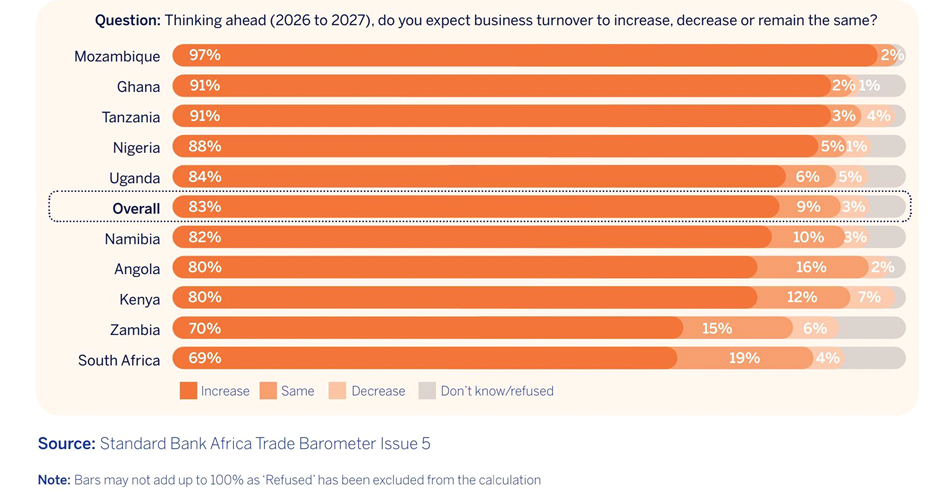
Survey responses from businesses across the ten markets indicate that companies operating in Ghana are increasingly optimistic about future prospects.
A majority of respondents expect turnover to increase over the next three years, reflecting expectations that macroeconomic stabilisation will translate into stronger trade activity and expanding market opportunities.
Broader findings of the Africa Trade Barometer suggest that sentiment across the continent is also improving.
Across the ten surveyed markets, the average barometer score rose from 59 in August 2024 to 65 in the latest survey, indicating strengthening confidence among African businesses despite persistent structural challenges.
These include infrastructure constraints, access to trade finance and regulatory hurdles that continue to limit the pace of intra-African commerce.
For Ghana, however, its improvement in the rankings signals a gradual rebuilding of credibility among investors and traders after a period of economic instability, the report noted.
The country remains outside the top tier of Africa’s trading economies, but the shift in sentiment suggests that recent reforms and stabilisation efforts are beginning to influence perceptions among businesses operating in the market.
Sustaining that momentum, the report indicated, will depend on continued policy consistency, further improvements in trade infrastructure and deeper regional integration as Ghana seeks to strengthen its role within Africa’s evolving trade landscape.
Post Views: 8
Discover more from The Business & Financial Times
Subscribe to get the latest posts sent to your email.