
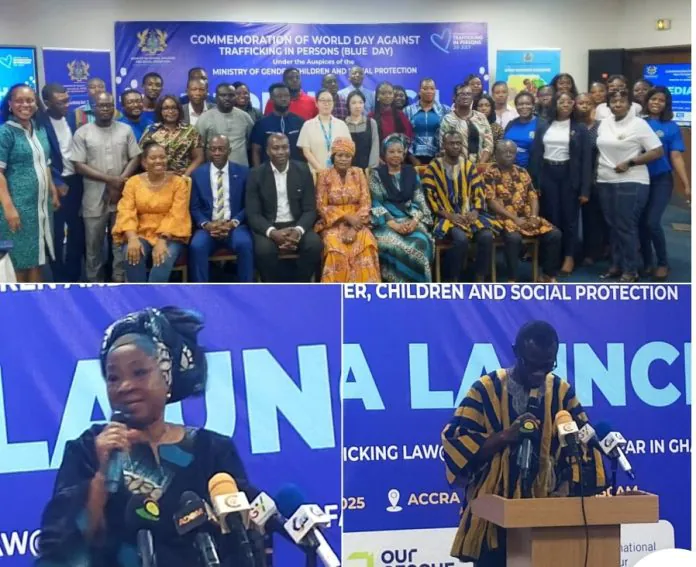


In a powerful address marking the media launch for World Day Against Human Trafficking (“Blue Day”), Ghana’s Minister for Gender, Children and Social Protection, Hon. Dr. Agnes Naa Momo Lartey, declared an urgent, intensified national effort to combat the scourge of human trafficking, vowing to “break the chains” and “leave no one behind.”
Speaking at the Accra City Hotel today, Dr. Lartey painted a stark picture of the crisis, detailing harrowing accounts of Ghanaian citizens lured abroad with false promises, only to face abuse, rape, torture, forced prostitution, and enslavement, particularly in the Middle East. She highlighted the grim reality of irregular migration attempts ending in tragedy in the Mediterranean.
“Human trafficking is real,” the Minister stated emphatically. “Victims are enslaved, their dignity and freedom ripped away. We see them abused, raped, tortured, disgraced, and reduced to nothing. We see them perish in deserts and seas. This ends now.”
Key Announcements & Context:
Theme & Urgency: Ghana aligns with the global theme “Reach every victim of trafficking, leave no one behind,” emphasizing trauma-informed, survivor-led approaches. Domestically, the focus is “The Human Trafficking Law @ 20: The Journey so far in Ghana,” marking two decades since the pivotal Human Trafficking Act (2005, Act 694).
Legal Framework: Dr. Lartey outlined Ghana’s legislative arsenal, including Act 694, its amendments, the 2015 Prohibition Regulations (L.I. 2219), and the current National Plan of Action (NPA 2022-2026) covering Prevention, Protection, Prosecution, and Partnership.
Global Scale: Citing alarming statistics, the Minister noted human trafficking is now
the world’s second-largest criminal enterprise (after firearms, surpassing drugs), generating over **$30 billion USD annually.
Ghana’s Status: While acknowledging Ghana’s maintenance of a Tier 2 ranking in the 2023 US Trafficking in Persons Report, signifying significant efforts, Dr. Lartey stressed “there is a lot more to be done in a decisive way.” Poverty and the quest for “greener pastures” remain key vulnerabilities exploited by traffickers.
Successes & Gaps: She highlighted successes like operational shelters for women and children but underscored the critical need for dedicated shelters providing trauma-informed care for adult male victims.
A Call to Arms:
Dr. Lartey issued a forceful rallying cry to government agencies, law enforcement, civil society, international partners, communities, and the media:
1. Report and Defend the Vulnerable
2. Educate, Legislate, and Activate
3. Strengthen border protection WITHOUT criminalizing victims
4. Work in solidarity, not silos
5. Hold perpetrators accountable
“Today is more than a commemoration,” Dr. Lartey declared. “It is a recommitment. Let us reset and reassess. Together, we can break the chains of trafficking. Together, we can build a world where no one is exploited, no one is invisible, and no one is left behind.”
On his part, Professor Leander Kandilig, the Center for Migration Studies, University of Ghana-Legon, presented a comprehensive assessment of Ghana’s fight against human trafficking over the past two decades. Reflecting on “the journey so far,” Prof. Kandilige highlighted significant milestones but underscored persistent and emerging challenges demanding urgent national attention and renewed commitment.
Unintended Consequences and Systemic Gaps Central to the challenges outlined was the 2017 ban on recruitment of domestic workers to Gulf states.
Characterized initially as a temporary measure, Prof. Kandilige noted it has yielded unintended consequences. “There’s also been an acute shortage of shelters for victims of trafficking,” he stated, “as well as limited resources for the continuous operationalization of the few existing shelters.” This gap severely hampers victim support and recovery.
Furthermore, the Professor identified critical capacity gaps within law enforcement and the justice system. While some specialized training exists, he emphasized it “needs to improve.” He pointed specifically to uneven capacity: “Officers of the Attorney General’s Department and Ministry of Justice officers in the northern part of the country in particular, are not trained to the required standards, and this gap is to be bridged.”
The geographical expansion of Ghana’s administrative regions has also exposed operational deficiencies. “Not all the newly created regions have specialized anti-human trafficking units,” Prof. Kandilige explained, “compared to the traditional regions, the original 10 regions.” While agencies like the Economic and Organized Crime Office (EOCO) have trained officers
in all regions except Oti, the Ghana Police Service’s Anti-Human Trafficking Unit still lacks focal persons in the Ahafo, Savannah, and North East regions. “They need to also finish hard,” he urged, stressing the need for nationwide coverage.
Charting the Way Forward
Moving beyond challenges, Prof. Kandilige proposed a multi-faceted approach for the future. A fundamental step, he argued, is reviewing the 2005 Human Trafficking Act (Act 694). “We need to decide whether the law as it stands now is sufficient or it needs to be reviewed,” he said, highlighting the need to address contemporary challenges, “especially in the area of artificial intelligence (AI) perpetrators, as well as how law enforcement officers could react.”
He called for Ghana to take ownership of its monitoring: “There’s a need for a comprehensive annual trafficking report for Ghana using local context specific criteria, not only always trying to meet requirements by ECOWAS and then the US State Department. Let’s have a local, domesticated kind of criteria for measuring our progress.”
Crucially, Prof. Kandilige stressed the need for sustainable domestic funding: “Once we agree that trafficking is a menace, we need to commit to providing the needed resources, budgetary allocations and release as a country, rather than being overly dependent on donor funding.”
Other key recommendations included:
Strengthening the Human Trafficking Secretariat:To effectively implement the
National Plan of Action with stakeholders.
Comprehensive Victim Care:** “Urgent need for the provision of comprehensive trauma informed care” including rehabilitation, shelters, family tracing, and reintegration.
Enhanced Collaboration & Training: Fostering joint efforts among law enforcement agencies and delivering specialized training on trafficking, migration, victim identification, investigation, and prosecution.
Prevention & Awareness: “Rededicating ourselves to increasingly preventive efforts and intensifying awareness raising programs through participatory community engagement and dialogues.”
Operationalizing the Database: Building capacity to fully utilize the IOM-collaborative human trafficking database for real-time data and intelligence.
A Call for Concerted Action
Concluding his presentation, Prof. Kandilige reiterated the gravity of the issue: “I would like to restate that trafficking in persons is a menace that requires stakeholder collaboration, timely sharing of intelligence, the commitment of resources to effectively fight this canker in our society.”
Marking the 20th anniversary of the landmark legislation, he issued a final challenge: “20 years on, let’s be dispassionate in our evaluation of the 2005 Human Trafficking Act and what it has helped us to achieve so far as a country.” His presentation served as a stark reminder that while progress has been made, the journey towards eradicating human trafficking in Ghana demands significantly greater political will, resource allocation, and systemic strengthening.
The event, attended by diplomats, government officials, law enforcement, NGOs, and media, sets the stage for Ghana’s official commemoration of World Day Against Human Trafficking on July 30th.
By Kingsley Asiedu