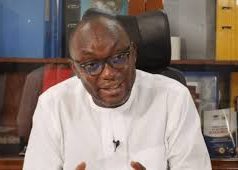


Former National Entrepreneurship and Innovation Programme (NEIP) Chief Executive Kofi Ofosu Nkansah has called for Ghana to establish a unified national framework governing religious activities in senior high schools following ongoing legal battles over religious freedom at Wesley Girls’ High School.
Speaking on Metro TV, Nkansah argued that many schools already have models ensuring peaceful coexistence without undermining mission traditions. He urged the Conference of Heads of Assisted Secondary Schools (CHASS) to coordinate and share these proven approaches across the education system.
The call comes amid a Supreme Court case filed in December 2024 by private legal practitioner Shafic Osman challenging Wesley Girls’ alleged restrictions on Muslim students. Osman alleges that Wesley Girls Senior High School forces Muslim girls to attend Christian services and prevents them from practicing their religion, including wearing the hijab, fasting during Ramadan, and observing other Islamic rites.
Nkansah recommended that headmasters, former school leaders, and faith based stakeholders work together to develop a standardised system balancing compulsory school activities with denominational freedom. He suggested these stakeholders should meet to determine what has worked best over the years so all parties can reach a middle ground.
He proposed that after the court ruling, the Ministry of Education and Ghana Education Service (GES) should create a comprehensive code guiding religious practice across all senior high schools. This framework would regulate how students practice their faith on various campuses, preventing individual administrators from making arbitrary decisions about religious matters.
According to Nkansah, the absence of a unified code leaves school administrations with excessive discretion. He warned that fragmented approaches risk creating misunderstanding and tension, even though Ghana has maintained strong interfaith harmony over decades.
The former NEIP boss pointed to Ghana’s long history of peaceful coexistence in schools and society as evidence that workable solutions already exist. He described Ghana as a model for peaceful interreligious coexistence and called for safeguards preserving this national strength.
However, Nkansah stressed that mission schools retain a legitimate claim to their historical identity despite receiving public funding. He warned that stripping these institutions of their longstanding practices could weaken the ethos that has produced strong academic and disciplinary results over decades.
He insisted that Methodist, Presbyterian, and Catholic institutions continue contributing infrastructure and maintaining standards that shape discipline and academic excellence. Government funding should not become grounds for removing the doctrines and moral standards that define these schools, according to Nkansah.
He maintained that mission aligned practices such as compulsory monthly services must remain intact for all students choosing to attend such schools. Once students agree to attend a Methodist school, they should align themselves with attending all compulsory services, he stated.
Nkansah emphasized that mission identity must not suppress students’ constitutional liberties. Schools should not deny the rights of students practicing their faith, he added, striking a balance between institutional character and individual freedoms.
Commenting on the legal challenge brought by Shafik Osman, Nkansah backed the argument that Muslim students should not be prevented from observing their faith during permissible hours. He agreed that blanket prohibitions on prayer, fasting, or wearing hijab are inconsistent with constitutional protections on religious freedom and equality.
On compulsory Methodist worship requirements, Nkansah disagreed with efforts to nullify such obligations, arguing it would bring confusion to campuses and affect discipline. He opposed claims that compulsory worship is discriminatory, insisting students voluntarily opt into mission school structures.
He partially endorsed relief concerning restrictions on fasting, praying, and wearing hijab, provided these activities occur outside statutory school hours. If students have free time and their fasting will not affect compulsory activities, they should be allowed to participate, he explained.
Nkansah welcomed the litigation for its potential to establish national clarity, predicting it will be a landmark case. He expressed hope the outcome will guide consistent policies across second cycle institutions throughout Ghana.
The Supreme Court case was filed on December 24, 2024, invoking the original jurisdiction under Articles 2(1)(b) and 130(1)(a) of the 1992 Constitution. The action challenges what plaintiffs describe as discriminatory religious practices at the Cape Coast school.
Attorney General and Minister for Justice Dominic Ayine has filed a formal response rejecting the assertion that the school’s policies are unlawful, arguing that Wesley Girls SHS, established and operated under the Methodist Church of Ghana, is entitled to maintain rules consistent with its Methodist heritage and doctrines.
The Supreme Court has allowed Democracy Hub to join the case as an interested party. The advocacy group, represented by Oliver Barker Vormawor, will provide information to assist the court in determining the constitutional questions raised.
A seven member panel presided over by Justice Gabriel Pwamang delivered directives on Tuesday, November 25, 2025, ordering the Wesley Girls Board to respond to the allegations. The court has asked all parties to refrain from discussing or analyzing the matter on social media during proceedings.
The Wesley Girls’ case has reignited national debate about balancing religious freedom with institutional identity in Ghana’s education system. A proposed regulatory framework that would clarify individual religious rights and the responsibilities of publicly financed institutions has been under development since 2021, following reports of schools impinging on religious rights of students, but progress slowed after some Christian communities raised concerns.
Education stakeholders await the ruling, which could set precedents affecting hundreds of mission schools across Ghana that serve diverse student populations while maintaining their founding religious traditions.