By Rukayatu Musah
Ghana is calling for stronger regional action against violent extremism and deeper cooperation with Europe, as African and European leaders meet in Luanda, Angola, for the 7th African Union–European Union (AU–EU) Summit.
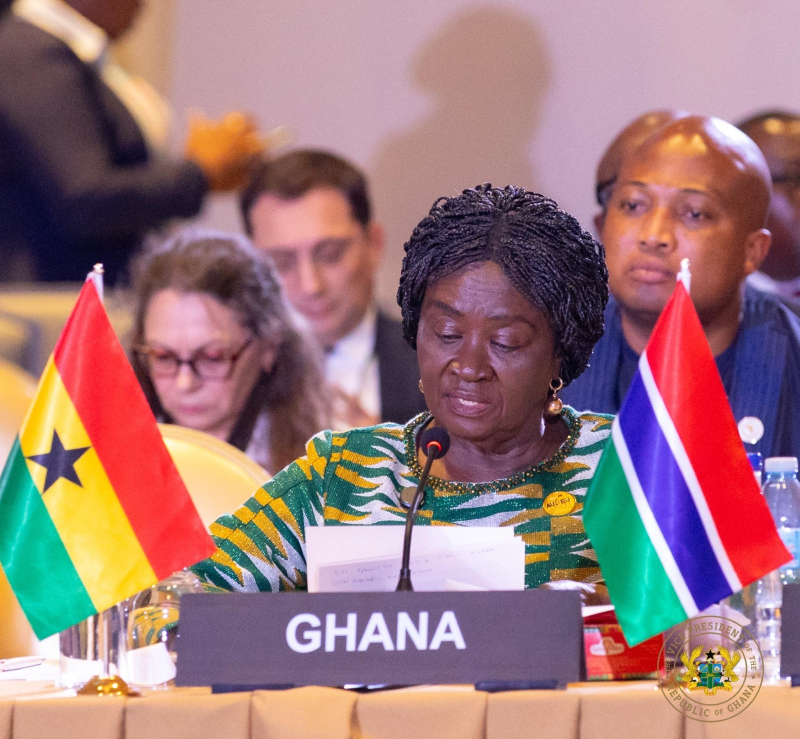
Vice President Professor Naana Jane Opoku-Agyemang, speaking on behalf of President John Mahama, placed security, development and partnership at the centre of Ghana’s agenda at the two-day summit, which marks 25 years of AU–EU partnership under the theme: “Promoting peace and prosperity through effective multilateralism.”
The summit is seeking to turn long-standing promises between the two continents into real projects, jobs and greater security for their people.
Call for Regional Meeting on Violent Extremism
Addressing heads of state, Prof. Opoku-Agyemang praised the African Peace and Security Architecture as “one of the continent’s major achievements” in preventing and managing conflicts. But she warned that emerging and overlapping crises are stretching the system.

She pointed to climate shocks, political tensions and piracy as key drivers of worsening humanitarian emergencies across the continent, and highlighted growing threats from extremist networks in West Africa that exploit poverty and exclusion.
Prof. Opoku-Agyemang announced that Ghana is proposing a focused regional meeting on violent extremism to tackle the problem at its roots through stronger cooperation.
“Ghana is proposing a focused meeting on violent extremism to tackle the root causes of insecurity through regional unity and community-based peacebuilding,” she said.
Strengthening the AU–EU Partnership
The Vice President reaffirmed Ghana’s commitment to a stronger AU–EU partnership, grounded in mutual respect, shared values and shared prosperity. She recalled the joint vision endorsed at previous summits and stressed that Africa and Europe must work as equal partners to address common challenges.
Prof. Opoku-Agyemang welcomed the European Union’s Global Gateway Initiative and its €150 billion pledge for Africa’s sustainable development, especially in green energy and digital services.

She emphasised that targeted investments in infrastructure, connectivity and technology can help shift the relationship towards value addition and long-term growth.
“Investments in infrastructure, clean energy and digital technology will create opportunities for African youths, researchers and businesses,” she noted.
Domestic Stability and Economic Reforms
On the domestic front, the Vice President highlighted Ghana’s progress in restoring macroeconomic stability and rebuilding confidence. She noted that inflation has fallen and the cedi has stabilised, following reforms in fiscal governance and public financial management.
She explained that Ghana’s 2026 agenda is anchored on three core priorities:
Restoring stability and confidence in the economy and public finances

Investing in infrastructure and connectivity to drive growth and integration
Creating jobs and building human capital to secure inclusive and sustainable prosperity
Prof. Opoku-Agyemang underlined that Ghana’s reform efforts are closely linked to its broader vision of partnership with the EU, arguing that credible domestic policies make external cooperation more effective and impactful.
Security, Development and Justice
Beyond violent extremism, Ghana is also seeking support for key national and regional priorities, including an AU waiver on offshore patrols to strengthen maritime security, and backing for strategic infrastructure projects such as a hydro dam and the Wongbo water facility to improve energy access and water security.

On justice and human rights, Prof. Opoku-Agyemang reiterated Ghana’s intention to table a United Nations resolution on reparations, recognising the trans-Atlantic slave trade as one of the gravest crimes against humanity. She invited European partners to join as co-authors in shaping a just, forward-looking outcome.
Quoting former UN Secretary-General Kofi Annan, she reminded leaders that:
“There can be no development without security, no security without development, and neither without respect for human rights.”
Turning Commitments into Action
As the Luanda summit marks a quarter-century of AU–EU engagement, Ghana’s message is that the time has come to move decisively from declarations to delivery.
By calling for regional action on violent extremism, pushing for fair and transformative investments, and linking security with development and justice, Ghana is positioning itself as a key voice for a more equal and results-driven Africa–Europe partnership.
The challenge now, as Prof. Opoku-Agyemang made clear, is to turn the commitments made in Luanda into concrete projects, jobs, peace and long-term prosperity for people on both continents.