
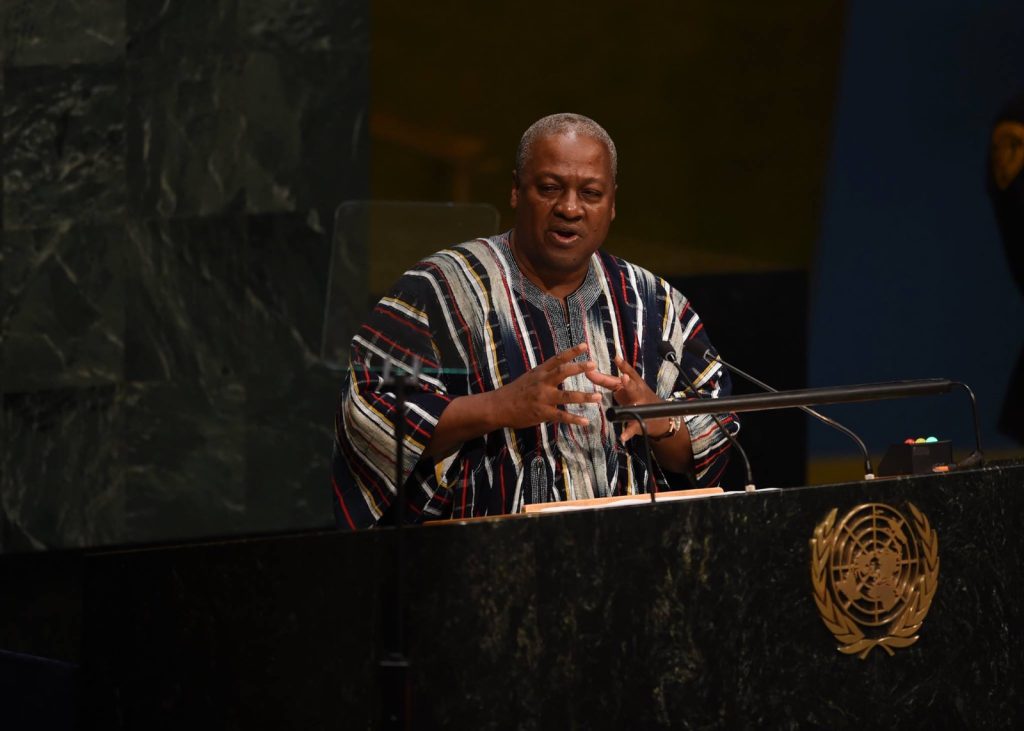
President John Mahama is set to table a landmark United Nations resolution on Wednesday, March 25, 2026, formally declaring the Transatlantic Slave Trade as the gravest crime against humanity, a move Ghana’s Ministry of Foreign Affairs describes as a defining moment in the global push for reparatory justice.
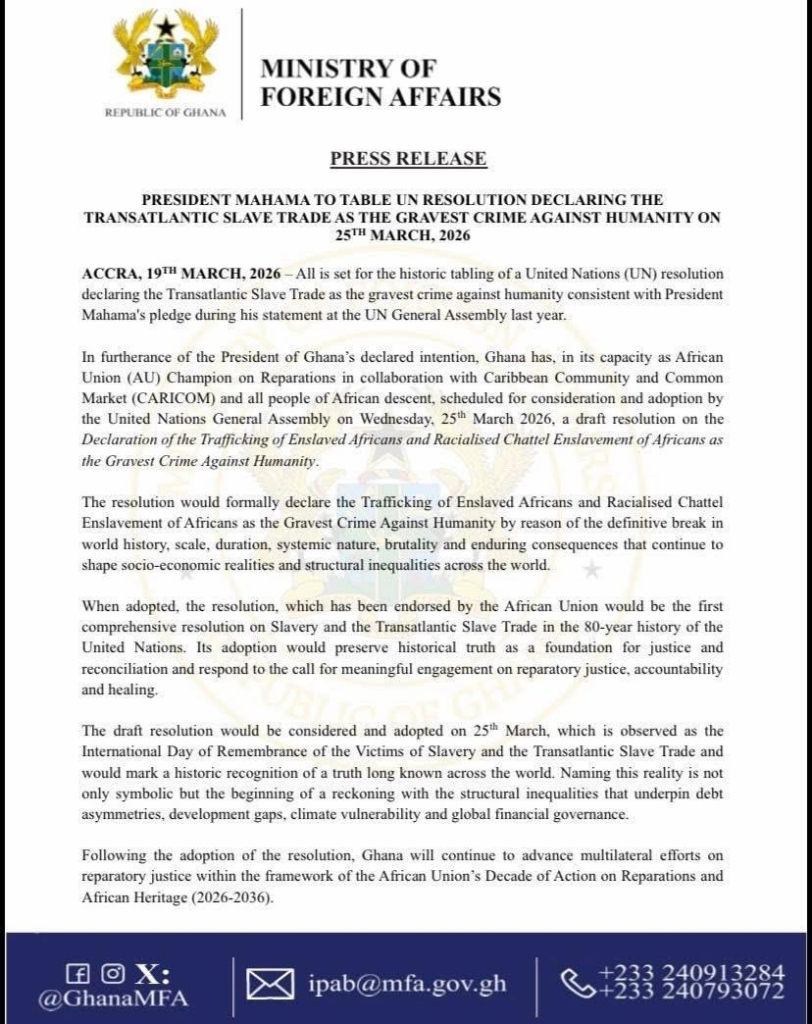
The draft resolution, titled Declaration of the Trafficking of Enslaved Africans and Racialised Chattel Enslavement of Africans as the Gravest Crime Against Humanity, is scheduled for consideration and adoption by the UN General Assembly on a date that coincides with the International Day of Remembrance of the Victims of Slavery and the Transatlantic Slave Trade.
Ghana is spearheading the initiative in its capacity as African Union Champion on Reparations, working in collaboration with CARICOM and all people of African descent.
“All is set for the historic tabling of a United Nations resolution declaring the Transatlantic Slave Trade as the gravest crime against humanity,” the Ministry said in a press release issued on Thursday, March 19, 2026, consistent with President Mahama’s pledge during his address to the UN General Assembly last year.
The resolution would formally recognise the trafficking of enslaved Africans and their racialised chattel enslavement as the Gravest Crime Against Humanity, citing the definitive break the trade caused in world history, its scale, duration, systemic nature, brutality, and the enduring consequences that continue to shape socio-economic realities and structural inequalities across the world.
If adopted, it would be the first comprehensive UN resolution on slavery and the Transatlantic Slave Trade in the organisation’s 80-year history.
The Ministry says its adoption would preserve historical truth as a foundation for justice and reconciliation, while responding to growing global calls for meaningrful engagement on reparatory justice, accountability, and healing.
The resolution has already received endorsement from the African Union.
The Ministry noted that naming this historical reality is “not only symbolic but the beginning of a reckoning with the structural inequalities that underpin debt asymmetries, development gaps, climate vulnerability and global financial governance.”
Following adoption, Ghana intends to continue advancing multilateral reparations efforts within the framework of the African Union’s Decade of Action on Reparations and African Heritage (2026–2036).
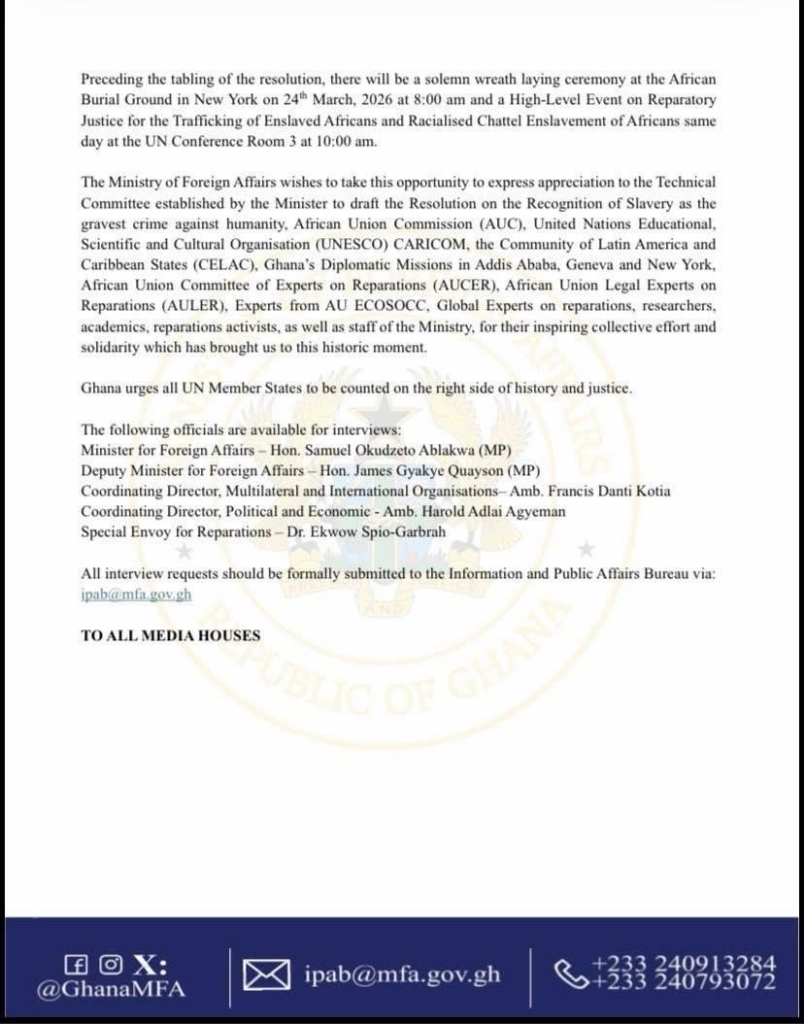
Ahead of the tabling, a solemn wreath-laying ceremony will be held at the African Burial Ground in New York on Tuesday, March 24, 2026, at 8:00 am.
A High-Level Event on Reparatory Justice for the Trafficking of Enslaved Africans and Racialised Chattel Enslavement will follow at UN Conference Room 3 at 10:00 am the same day.
The Ministry expressed appreciation to the Technical Committee established to draft the resolution, as well as the African Union Commission, UNESCO, CARICOM, CELAC, Ghana’s Diplomatic Missions in Addis Ababa, Geneva, and New York, the AU Committee of Experts on Reparations, AU Legal Experts on Reparations, and global academics and reparations activists for what it called their “inspiring collective effort and solidarity.”
Ghana is urging all UN Member States “to be counted on the right side of history and justice.”
DISCLAIMER: The Views, Comments, Opinions, Contributions and Statements made by Readers and Contributors on this platform do not necessarily represent the views or policy of Multimedia Group Limited.
DISCLAIMER: The Views, Comments, Opinions, Contributions and Statements made by Readers and Contributors on this platform do not necessarily represent the views or policy of Multimedia Group Limited.
Source link