
By Kingsley .K. Asiedu
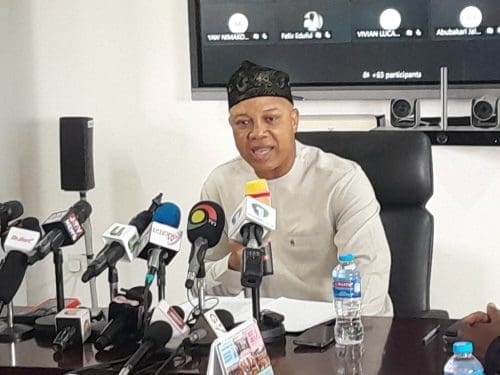
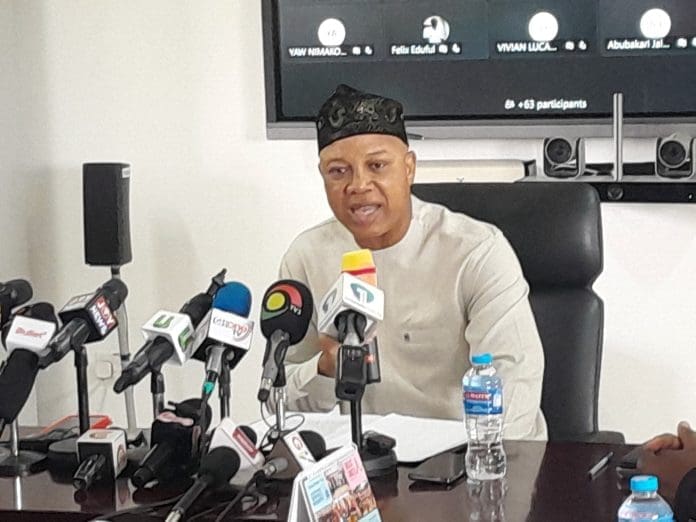
Ghana’s water supply is under increasing threat as river siltation spirals beyond the capacity of treatment plants, Managing Director of Ghana Water Limited (GWL), Adam Mutawakilu, warned at a press conference today in Accra.
Speaking at the Ghana Water Ltd. Conference Room,Mutawakilu made an urgent appeal to Corporate Ghana, development partners, and public-sector stakeholders to rally behind a 24-month Catchment Recovery Plan aimed at stabilising key river systems and cutting rising treatment losses.
“Ghana’s raw-water sources are silting up faster than our plants were built to handle,” Mutawakilu said. “If we don’t act at the source, we will spend more each year to produce less water.”
Crippling Operational and Financial Pressures
According to GWL, rising silt levels—especially after heavy rains—are spiking turbidity at major water intakes, making conventional treatment difficult, costly, and at times impossible. The result? More frequent plant shutdowns, increased sludge removal cycles, higher chemical usage, mechanical breakdowns, and surging energy demands.
Emergency dredging, once rare, is now routine. Mutawakilu cited GHS 64 million spent on dredging at Owabi, and GHS 13.8 million at Mampong, just to keep abstraction channels open. While these measures restored functionality, they also required costly downtime that disrupted supply to communities.
The effects are widespread:
Eastern Region: Anyinam, Kibi, Osino, Akim Oda (Birim River); Nsawam (Densu).
Central and Western Regions: Daboase, Sekyere Hemang (Pra River); Bonsa (Bonsa River); Kwanyako (Ayensu River).
Ashanti Region: Odaso (Oda River); Konongo (Anum River); Barekese (Offin River).
Upper West: Jambusie (Black Volta).
Volta Region: Kpeve, Agordome (Volta Lake).
Northern Region: Dalun (White Volta).
Higher Costs, Lower Reliability
Treatment costs are also ballooning. GWL has shifted from alum to specialised polymers for improved performance at high turbidity levels—but at a steep price.
“Chemical costs at Barekese, Odaso, and Konongo have surged by about 400%,” Mutawakilu revealed. “Polymers are more expensive, require tighter control, and often expose us to foreign-exchange volatility.”
Mechanically, the silt wreaks havoc on pumps and equipment, shortens maintenance intervals, increases spare-part usage, and burns more power to move less water. “We’re a tariff-regulated utility. We cannot and do not wish to pass sudden cost surges to consumers,” Mutawakilu said. “But the gap is stretching us beyond reasonable limits.”
The Catchment Recovery Plan
In response, GWL is proposing a focused 24-month Catchment Recovery Plan targeting eight priority river bodies. The plan includes:
Riverbank stabilisation and re-vegetation at erosion hotspots.
Targeted, survey-led dredging around intake channels.
Coordinated land-use compliance.
Stronger community engagement to protect buffer zones.
“This is not charity—it’s investment,” he said. “Restoring catchments will reduce treatment challenges, lower energy costs, extend asset life, and transform recurring emergencies into planned, cost-effective interventions.”
Economic Ripple Effects
The implications go far beyond GWL. If siltation continues unchecked:
Beverage and bottling firms could face production slowdowns and stock-outs.
Food and consumer-goods companies may experience quality incidents.
Hospitality and events sectors will grapple with unreliable supply and expensive backups.
Hospitals and schools could be forced into unsustainable water carting.
Manufacturers risk process
interruptions.
Real estate and commercial centres will absorb rising utility costs.
“Productivity falls and prices rise when a fundamental input like treated water becomes more expensive and less reliable,” Mutawakilu warned.
A Call for Partnership
GWL is calling on Corporate Ghana, district assemblies, regulatory bodies, and traditional leaders for co-funding and coordinated action. Support could include financial backing, equipment, logistics, and technical expertise assigned to specific river systems.
“Every contribution will be visible, measurable, and auditable,” he assured.
Mutawakilu also commended the Government of Ghana for its ongoing interventions:
The Ministry of Lands and Natural Resources, under Hon. Emmanuel Kofi Buah, for intensifying regulatory enforcement via Blue Water Guard operations to monitor water bodies and prevent illegal mining.
The Ministry of Sanitation and Water Resources, led by Hon. Kenneth Gilbert Adjei, for ongoing collaboration with GWL on both technical and policy levels.
President John Dramani Mahama, for bold leadership through the National Anti-Illegal Mining Operations Secretariat (NAIMOS), which includes
military-led interventions and a nationwide excavator registration and tracking initiative.
“These actions are yielding results,” Mutawakilu noted. “But let us be clear: the riverbeds remain heavily silted. Without sustained desilting, our pumps will continue to struggle.”
Final Appeal: Protect the Source
Mutawakilu concluded with a strong message: “Water security begins at the source. If we protect the source, our plants will do the rest. Let us act with urgency and purpose—together—to keep Ghana’s taps running.”
Ghana Water Limited stands ready to lead this charge—but it cannot do so alone.