


By Ernest Bako WUBONTO
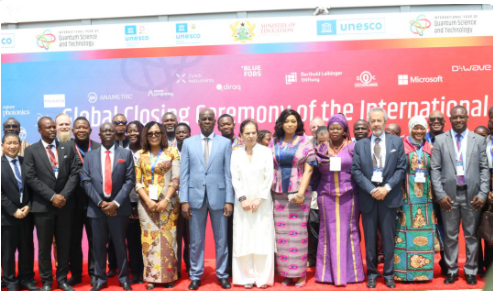
The global scientific community gathered in Accra to mark the official closing of the International Year of Quantum Science and Technology (IYQ2025), with leaders calling for a new era of collaboration to ensure quantum advances benefit all humanity.
The closing ceremony, hosted by UNESCO in collaboration with the Ministry of Education and the Ministry of Environment, Science, Technology and Innovation (MESTI), became a platform for a decisive vision, as stakeholders stressed that quantum technology must be a unifying force rather than a source of further division that sidelines the Global South.
Speakers urged sustained investment in diverse talent and stronger international cooperation to ensure the gains of quantum science are shared equitably.
President of the Institute of Physics (UK), Michele Dougherty, in her keynote address, celebrated a century of quantum discovery while outlining a clear mandate for the future.
She highlighted Ghana’s pivotal role in IYQ2025, noting its May 2024 submission of the UN resolution on the observance.
“Ghana has proven that the Global South is not just a consumer of quantum science, but a key player,” Prof. Dougherty said, emphasising the significance of hosting the closing ceremony in Accra.
“I am glad to emphasise that a new generation from diverse backgrounds is realising its potential in the global space, irrespective of location. This is a step in the right direction,” she added.
She noted that the future of quantum science is no longer a distant prospect but a present reality that must help bridge the global divide. While acknowledging that the UK has established itself as an international hub for quantum science and technology through significant government investment, she cautioned that the quantum frontier must not become the preserve of a select few.

“International cooperation is not optional; it is a necessity. We must not allow new technologies to deepen existing divides, but rather use them to close the gap,” she stressed.
Past President of the American Physical Society (APS), John Doyle, also called for the momentum generated by IYQ2025 to be harnessed to create jobs and deliver meaningful societal impact.
He emphasised education, innovation and sustainable development as foundational requirements for scientific progress to have universal impact.
“If we want science to be valued, we must ensure it meets people where they are, with relevance and trust. Quantum science is not about the distant future; it is about developments already shaping our world,” he said.
Prof. Doyle added that talent exists everywhere but requires the right pathways, resources and opportunities to flourish.
Minister of Education, Haruna Iddrisu, urged countries to invest more in science education, particularly quantum science, describing it as critical to Ghana’s development.
“I understand that interest in science is declining and, globally, the number of engineers is also falling. This should remind us to wake up and invest more in science, especially quantum sciences,” he said.
He emphasised that knowledge, science and innovation remain central to human progress, adding that UNESCO’s declaration of 2025 as the International Year of Quantum Science and Technology signals the growing importance of the field.
Mr Iddrisu noted that attention must now shift beyond discovery to the responsibilities that accompany scientific advancement.

With about 140 countries yet to develop national quantum strategies, he called for intensified awareness and engagement, stressing that quantum science has applications in agriculture, including soil and water monitoring and climate forecasting.
“For a country like Ghana, where agriculture is the backbone of our economy, quantum science is relevant for soil and water monitoring and climate forecasting. It therefore remains paramount,” he said.
A call for unified innovation
Speakers underscored the need for a triple-pronged collaboration among governments, academia and industry to unlock the full potential of quantum technology.
They concluded that the true power of quantum science lies in its ability to unify, but this can only be achieved by investing in people as much as in infrastructure.
As IYQ2025 draws to a close, the message to world leaders was clear: set a well-defined vision, ensure institutional alignment and build trust through sustained investment. With these foundations in place, speakers said, scientific progress can accelerate in ways that are both inclusive and transformative.
The President of the Institute of Physics declared that quantum technology is not merely shaping the future — it is defining the present.
Post Views: 1
Discover more from The Business & Financial Times
Subscribe to get the latest posts sent to your email.