

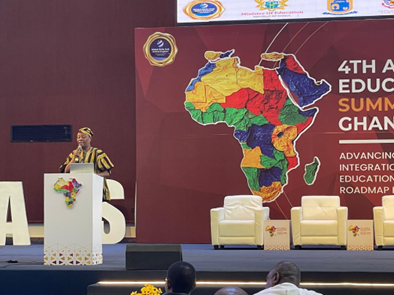
The government is scaling up the use of education technology, including artificial intelligence applications in senior high schools, as part of a broader strategy to align skills development with a digitalising economy, government officials said at the Africa Education Summit in Accra.
The policy direction, outlined on behalf of Education Minister Haruna Iddrisu, positions technology integration as central to education reform and long-term economic transformation. Authorities are prioritising digital tools to improve teaching delivery, expand access to learning, and equip students with competencies suited to a knowledge-driven global economy.
A key component of the strategy is the rollout of subject-specific AI applications across senior high schools. Developed using Ghana’s national curriculum in partnership with institutions such as the Transforming Teaching Education and Learning programme and the Mastercard Foundation, the tools are designed to support lesson preparation, assessment design and classroom delivery while improving student engagement.
The government has also operationalised a national Transcript Portal to digitise continuous assessment records. The platform enables electronic data submission by schools and strengthens central verification, while providing authorities with the ability to track attendance patterns and identify anomalies in student performance.

These initiatives are being complemented by a curriculum microsite, which provides standardised teaching and learning materials for educators nationwide, and a Professional Learning Community framework aimed at improving teachers’ digital competencies.
Officials say the reforms are intended to build an “innovative, inclusive and responsive” education system, with agencies including the Ghana Education Service, the National Council for Curriculum and Assessment, and the National Teaching Council playing implementation roles.
The strategy reflects a broader recognition that education systems must adapt to rapid technological change affecting multiple sectors, including commerce, healthcare and governance. Authorities argue that failure to integrate technology risks limiting Africa’s ability to compete in the global economy.
However, policymakers acknowledged structural constraints that could affect execution. Limited digital infrastructure, uneven internet connectivity, gaps in teacher training and restricted access to locally relevant digital content remain key challenges across Ghana and the wider continent.
“Educational technology must not become the privilege of a few institutions or urban communities,” the minister said, stressing the need for equitable access regardless of geography or income levels.
The summit, which brings together policymakers, academic institutions, development partners and private sector actors, is expected to focus on developing a coordinated roadmap for technology adoption across African education systems.
Government officials emphasised that partnerships will be critical to implementation, particularly in mobilising resources and technical expertise. The emphasis on collaboration reflects the scale of investment required to close infrastructure gaps and standardise digital learning tools.
Post Views: 24
Discover more from The Business & Financial Times
Subscribe to get the latest posts sent to your email.