

By Kizito CUDJOE
Government is pushing to reinvest part of the Ghana Petroleum Funds (GPFs) in domestic energy and industrial projects, a plan that has split civil society groups and drawn caution from the Public Interest and Accountability Committee (PIAC).
Some civil society organisations support using a portion of the funds to finance commercially viable infrastructure that could boost power supply and industrial output. Others, however, warn that domestic investment could expose the savings to political risk and weaken their stabilisation role.
Government maintains that investing a share of the country’s petroleum funds locally will unlock capital for power, gas and industrial projects while improving energy reliability.
Technical Advisor-Ministry of Finance Dr. Theo Acheampong said the proposed investments will include safeguards such as escrow arrangements and political-risk guarantees.
He added that the investments are expected to create jobs and strengthen both domestic and regional energy security.
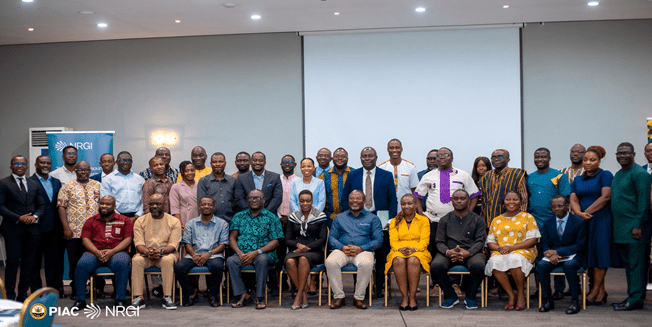
Speaking on the side-lines of a roundtable in Accra organised by the Natural Resource Governance Institute (NRGI) and PIAC, Dr. Acheampong said government also seeks to ensure that petroleum revenues allocated to the budget and stabilisation fund deliver more tangible benefits for the economy.
He noted that under the Petroleum Revenue Management Act (PRMA), part of petroleum receipts already supports the budget through the Annual Budget Funding Amount (ABFA) and a stabilisation fund, while amendments to the law allow for building sinking funds to retire public debt.
It will be recalled Finance Minister Dr. Cassiel Ato Forson said in the 2026 Budget Statement that the current legal framework restricts investments from the petroleum funds to low-risk foreign securities issued by institutions such as the International Monetary Fund (IMF), the World Bank and other highly rated sovereigns.
He said the funds have accumulated about US$1.46billion since 2011 and earned roughly US$194.9million – or about 1 percent annually on average. Government is now considering designating additional qualifying instruments that allow part of the funds to be invested in commercially viable domestic energy projects.
According to the minister, investments in projects such as thermal power plants and gas processing facilities could diversify the funds’ portfolio, improve long-term returns and support initiatives such as government’s 24-Hour Economy programme by lowering energy costs and improving supply.
But PIAC and some civil society groups have cautioned that domestic investment could weaken fiscal discipline and expose the funds to political interference. They are calling for stronger transparency rules, parliamentary oversight and clear safeguards before any changes are implemented.
Following parliament’s amendment of the PRMA in December 2025, PIAC has urged broader stakeholder engagement on investment of the funds.
The Committee has also called for measures to safeguard the interests of future generations in line with objectives of the Ghana Heritage Fund (GHF) and proposed a comprehensive review of the Act rather than piecemeal changes.
PIAC Chair Richard Kojo Ellimah, speaking at the roundtable, noted the divided stance among civil society groups and called for collective monitoring of government’s plans.
The Africa Director of NRGI, Nafi Quarshie, said the latest government decision represents a major policy shift with implications for how the country balances risk and long-term savings.
“This is not a trivial adjustment. It is a consequential policy shift that changes the balance between risk and security, immediate returns and long-term insurance and political discretion and rule-based governance,” she said.
Miss Quarshie added that NRGI’s work across resource-rich countries shows that sovereign funds tend to falter not because governments spend, but because spending occurs without clear rules, credible oversight and public trust.
“Investing petroleum savings domestically may promise higher returns,” she said, “but it also concentrates economic and political risks at a time when diversification is critical.”
She warned that using savings to finance energy infrastructure could support development goals, but risks blurring the Heritage Fund’s purpose – turning it from a savings instrument into a quasi-development fund.
Repeated use of stabilisation buffers, she said, could weaken the country’s ability to respond to future shocks.
On the other hand, the Policy Lead for Petroleum and Conventional Energy at the Africa Centre for Energy Policy (ACEP), Kodzo Yaotse, said this is not the first time policymakers have considered tapping the GPFs for domestic spending.
Previous proposals, he noted, included using the Heritage Fund to support the Free Senior High School (FSHS) policy and Covid-19 mitigation expenditures.
He however said this is the first time the funds are being considered as a source of commercial capital for large-scale infrastructure.
ACEP has proposed merging the Ghana Stabilisation Fund (GSF) and Heritage Fund into a consolidated fund with a dual mandate: financing priority infrastructure such as energy, transport and road networks to yield strong economic multipliers, while maintaining a portion of the fund in diversified offshore assets.
“The initial domestic allocation will be 40 percent of the merged fund. An additional 20 percent may be committed to domestic projects in three years if returns exceed traditional foreign asset benchmarks. If the strategy for 40 percent fails, the fund will revert to 100 percent low-risk foreign asset investment,” he said.
Post Views: 54
Discover more from The Business & Financial Times
Subscribe to get the latest posts sent to your email.