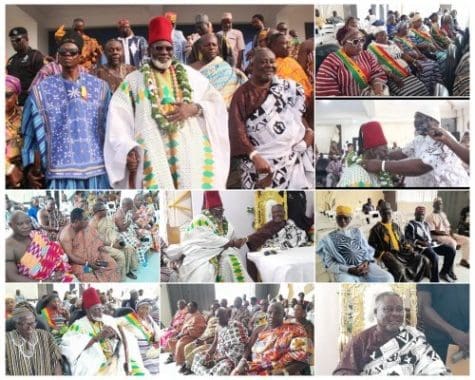
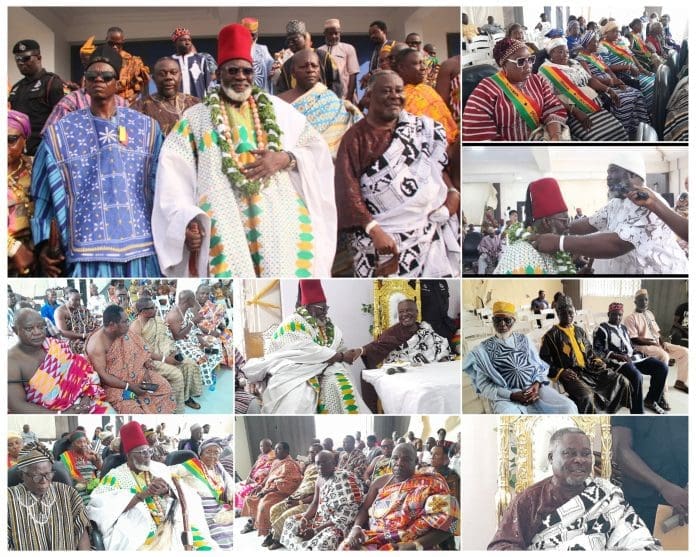

In a landmark moment for traditional governance and interethnic cooperation in Ghana’s capital, Naba Alhaji Abass Baba Nyaaba Akeyezia, the Greater Accra Frafra chief, on Wednesday paid a historic courtesy visit to Oboade Nortse Prof. King Odaifio Welentsi III, president of the Greater Accra Regional House of Chiefs and paramount chief of the Nungua Traditional Area.
The visit, held Jan. 14 at the Nungua Traditional Council, marked the first official engagement between the two traditional leaders and was widely described by elders and observers as a milestone in strengthening unity, dialogue and cooperation among traditional authorities in the Greater Accra Region.
Clad in regal attire befitting their high offices, the two chiefs exchanged warm pleasantries before engaging in wide-ranging discussions on peacebuilding, cultural preservation, internal migration and the evolving role of traditional leadership in regional and national development. The meeting was attended by elders of the Nungua Traditional Council and members of the Frafra community, underscoring its significance beyond ceremonial symbolism.
In his welcome address, Oboade Nortse Prof. King Odaifio Welentsi III extended New Year greetings to the Frafra chief and his delegation, describing their presence as both timely and meaningful.
“On behalf of the Nungua Traditional Council, the elders and the people of the Ga-Dangme region, I extend warm greetings to His Royal Eminence, Naba Alhaji Abass Baba Nyaaba Akeyezia, the Greater Accra Frafra chief, and your esteemed community,” the Nungua Mantse said. “You are most welcome to my palace.”
He noted that while there is no direct, well-documented historical bond between the Frafra people of Ghana’s Upper East Region and the Ga-Dangme people of southern Ghana, both groups share deeper West African ancestral roots shaped by ancient migration patterns.
“Historically, the Frafra are linked to Mamprusi and Burkina Faso, while the Ga-Dangme trace their lineage through Nigeria and Benin,” he said. “Nevertheless, this royal meeting marks the beginning of a strong bond between the Frafra tribe and the Ga-Dangme nation. As the saying goes, it is better late than never.”
Prof. Welentsi emphasized that the gathering symbolized genuine respect and goodwill, and he called for deliberate efforts to strengthen the emerging bond through conflict resolution, intermarriage, business partnerships, cultural exchanges and joint celebration of festivals.
As a gesture of openness, the Nungua Mantse extended an advance invitation to the Frafra chief and his community to participate in this year’s Homowo Festival in Nungua, scheduled for July. The Homowo festival, one of the most significant cultural events of the Ga-Dangme people, commemorates resilience and triumph over famine.
He also acknowledged the long-standing presence of Frafra people in Accra, particularly in areas such as Gamashie, Ngleshie Alata, Jamestown, Osu, Nungua and Tema, where many have migrated in search of livelihood opportunities.
“The Frafra people are known for their artistic crafts and agriculture, and your presence in Accra is a testament to internal Ghanaian migration and cultural integration,” he said. “You add your unique northern traditions to the diverse mix of people in the Ga-Dangme region. All Frafra individuals have every right to share in the development of the Greater Accra Region.”
In a paternal appeal, the Nungua Mantse urged the Frafra community to maintain unity, support one another and avoid behaviours that could tarnish their collective reputation. “Consider the Ga-Dangme region your second home, and my palace a place where you can always find shelter,” he said.
At the sidelines of the meeting, Jimmy Atamah, secretary to the Greater Accra Frafra chief, described the visit as a defining moment for the community.
“Our coming to Nungua today marks a milestone,” Atamah said. “When you are selected as the head of a community, you must open up your wings to explore, to know the people you are living with — even your neighbors.”
He explained that the decision to visit the Nungua Mantse was inspired by an earlier encounter between the two chiefs at a public event, where they engaged in extensive conversation.
“If you speak with somebody at a program, you must make a follow-up,” Atamah said. “That is why we decided to undertake this historic visit.”
Atamah praised Prof. Welentsi for what he described as exemplary leadership and professionalism, particularly his prompt response to the Frafra chief’s request for a meeting.
“I was very happy when my chief told me that he responded to our letter within 72 hours,” he said. “Procrastination cripples us as a society, but this shows the good work of a leader.”
He added that the visit provided an opportunity for mutual learning and exchange of ideas, which he said was essential for national progress and peaceful coexistence. “If other leaders treat and handle people the way he has done to us, then we as a people will enjoy living in Ghana in harmony,” Atamah said, offering prayers for the Nungua Mantse’s long life and guidance.
Beyond pleasantries, the meeting also addressed sensitive issues surrounding chieftaincy recognition in the Greater Accra Region. Prof. Welentsi cautioned the Frafra chief and other ethnic leaders from outside the region on the use of the title “chief” within Greater Accra.
According to him, substantive recognition as a traditional chief in the region must come from the Greater Accra Regional House of Chiefs and not from individual traditional councils unless the individual is a recognized branch of one of the region’s 13 traditional councils.
“Your recognition must come from the region and no other traditional council,” he said. “The Nungua Traditional Council alone cannot offer such recognition unless you are a branch of Nungua.”
He further urged ethnic groups from other regions to adopt the title “leader” rather than “chief” for their community heads in Greater Accra, citing the need to curb chieftaincy disputes and protracted litigations.
Prof. Welentsi also advised against double installations for a single title, warning that such practices often fuel division and legal battles.
In response, the Greater Accra Frafra Chief, expressed gratitude for the guidance and the warm reception, noting that the council of Frafra elders in Greater Accra would be responsible for selecting individuals to represent the community at the local level and formally presenting them to the Nungua Traditional Council.
The visit ended on a hopeful note, with both sides reaffirming their commitment to peaceful coexistence, mutual respect and collaboration — a step many believe could serve as a model for interethnic relations in Ghana’s increasingly diverse capital.
By Kingsley Asiedu