

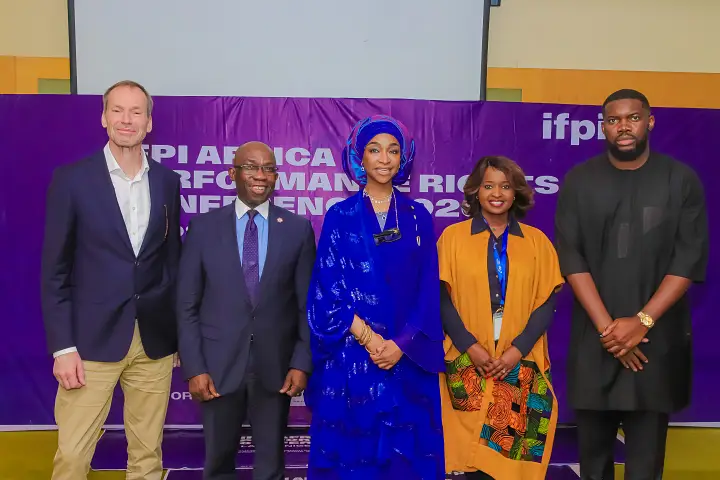
The International Federation of the Phonographic Industry’s (IFPI) Africa Performance Rights Conference (PRC) 2026 officially kicked off in Lagos, Nigeria, on Tuesday 31st March 2026 attracting participation of Africa’s top recording industry executives including record label chief executives, sound recording Music Licensing Companies/Collective Management Organisations (MLCs/CMOs) and heads of recording industry bodies.
The meeting was officially opened by the Minister of Art, Culture, Tourism and the Creative Economy in the Federal Republic of Nigeria, Honourable Hannatu Musawa. “Africa is no longer at the margins of the global music industry — we are its fastest-growing frontier,” said Hon. Musawa, adding that “IFPI’s own data confirms this. In 2025, Sub-Saharan Africa’s recorded music revenues grew by 15.2% to USD 120 million, placing our region joint second-fastest growing in the world. Digital revenues surged by over 20%. Subscription streaming alone added USD 12.5 million in new value. These are not abstract numbers — they represent the creative labour and artistic brilliance of African musicians reaching audiences they have never reached before.”
Themed ‘Addressing Challenges and Leveraging Opportunities to Drive the Sustainable Growth of Recorded Music in Africa’, the meeting built on discussions and deliberations from the 2025 PRC held in Cape Town, South Africa, and where the industry prioritised action points critical to addressing sound recording collective management gaps in the region.
IFPI’s Chief Legal Officer, Lauri Rechardt said, “Collective management organisations play an important role in the recorded music value chain and have the vital duty to effectively and efficiently license broadcasters and public performance users of recorded music as well as distributing the royalties in line with standard practice.”
The conference is an important moment for the recording industry to examine progress and key developments in performance rights licensing in the region, including reviewing the level of implementation of the commitments from the 2025 Cape Town meeting.
The opening ceremony of the conference saw high-level panel discussions involving the Honourable Minister Hannatu Musawa and record label executives including Sean Watson, Managing Director Sony Music Entertainment Africa; Manusha Sarawan, Managing Director Universal Music Group Southern and East Africa; Marc Latilla, Managing Director Warner Music Group South Africa; Aibee Abidoye, Executive Vice-President, Chocolate City; and Elvis Adidiema, Director General Sony Music Francophone Africa.
Moderated by IFPI Sub-Saharan Africa Regional Director Angela Ndambuki, the panel meticulously interrogated salient issues that continue to slow down the desired industry growth while at the same time presenting proven solutions that have worked elsewhere to ensure Africa’s recording industry secures its rightful seat at the global table.
Critical to the discussion was the need for governments in the region to prioritise review of copyright laws to enhance protection of recorded music against any form of piracy and set in place anti-piracy enforcement actions targeting piracy sites.
“The gap between cultural influence and economic return is the defining challenge for this generation of African music leaders,” noted Hon. Musawa. “Closing that gap requires action on three fronts: a robust intellectual property framework, transparent and effective collective management, and the physical and digital infrastructure to support a modern music ecosystem,”
While acknowledging the recent anti-piracy enforcement actions by the Nigerian Internet Registration Authority (NIRA), Ms Ndambuki called on the Honourable Minister to ensure that the federal government continues to work with the Nigerian recording industry to execute site blockings against all piracy sites.
Speaking during the event, Dr. John O. Asein, Director-General of the Nigerian Copyright Commission said; “The music industry is fast becoming a critical pillar of Africa’s creative economy, creating jobs, attracting investment, driving digital innovation, and contributing meaningfully to GDP. For countries like Nigeria, the recording industry represents not only a cultural asset but a strategic economic resource. However, as we celebrate this growth, we must also confront the realities that threaten its sustainability. These are not merely industry concerns; they are development challenges that require coordinated and sustained responses.”
Participants also noted that licensing of AI Companies that use copyrighted works to train their AI models is bound to become standard practice, highlighting the recent AI licensing deals. It was however noted that there is need for clear policies to guide on the use of AI in enhancing creativity without undermining or disrupting the human creativity and the revenues arising from such creativity. At the heart of it, was the unanimous view that governments in the region should incentivise investors in the recorded music business to enhance the growth of Africa’s recorded music business.
From the two-day deliberations, it was clear that while Africa’s recording industry’s potential market is still enormous, there is need to ensure that the region’s licensing companies prioritise long-term strategic actions towards improving performance rights licensing, which accounts for a small percentage of the region’s recorded music revenues.
The conference concluded today with MLCs committing to key resolutions to strengthen licensing and revenue growth across the region. MLCs will review and enhance broadcast licence agreements while developing long-term licensing strategies aligned with IFPI guidance. A strong focus will be placed on expanding public performance markets and driving measurable revenue growth.