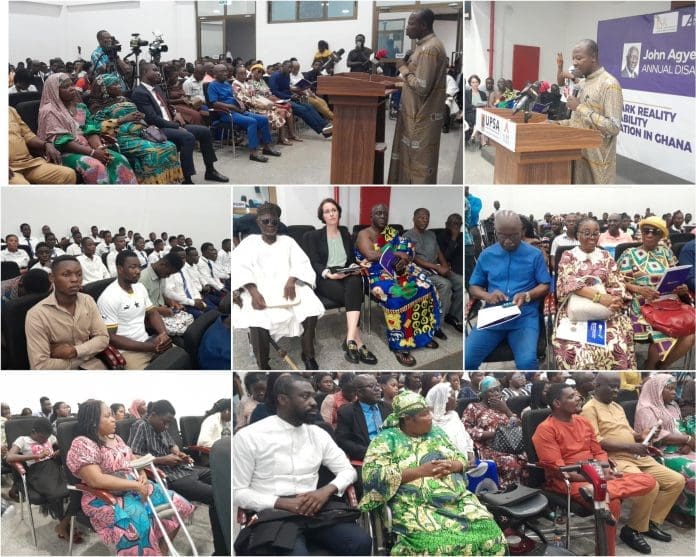

The inaugural John Agyekum Kufuor Annual Disability (JAKAD) Lecture was held Tuesday at the University of Professional Studies, Accra (UPSA), casting a spotlight on the persistent gaps between Ghana’s disability legislation and the lived realities of persons with disabilities (PWDs).
The lecture, a joint initiative by the Konrad Adenauer Stiftung (KAS), University of Professional Studies, Accra (UPSA), the John Agyekum Kufuor Foundation, and Rights of Youth and Disability (RYD) International, was themed “The Stark Reality of Disability Legislation in Ghana.”
Dr. James Kwabena Bomfeh Jnr., who delivered the 40-minute keynote, laid bare the contradictions between Ghana’s progressive disability law—Act 715, passed in 2006—and its inadequate implementation nearly two decades on.
“Inclusion is not a favour. It is a constitutional mandate. Justice must be accessible to all—physically, socially and legally,” Dr. Bomfeh declared to a packed auditorium. “Act 715 was a landmark, but it was not a destination.”
The event was chaired by Nana Kobina Nketsia V, Omanhene of Essikado, who paid tribute to former President John Agyekum Kufuor, noting that “to name this lecture after him while he is still among us is to affirm that legacy is not only to be remembered, but sustained and continued.”
Under President Kufuor’s leadership, Ghana began to redefine disability as a matter of human rights rather than pity. However, Dr. Bomfeh highlighted sobering truths: public infrastructure remains largely inaccessible, employment discrimination persists, and policies often exclude PWDs from decision-making processes.
“A person with a disability was invited to a public building to discuss disability policy—yet every wheelchair user had to be physically carried up the stairs,” he recounted. “That is the stark contradiction between legislation and reality.”
According to the Ghana Statistical Service, the number of persons with disabilities in Ghana surged from 737,743 in 2010 to 2,098,138 in 2021, representing about 8% of the population. Globally, 1.3 billion people—or 16% of the population—live with a form of disability (UNICEF, 2025).
Disability and poverty remain deeply linked, with the World Bank estimating that unemployment among PWDs may cost low- and middle-income economies up to 7% of GDP.
A Call for Reform
Dr. Bomfeh outlined 11 key recommendations to move Ghana from legislative intent to tangible change:
Introduce disability awareness education in basic school curricula.
Domesticate the UN Convention on the Rights of Persons with Disabilities (UNCRPD).
Strengthen legal definitions to cover political rights, housing, and digital access.
Empower the National Council on Persons with Disability (NCPD) with quasi-judicial authority.
Mandate accessibility audits of public infrastructure.
Institutionalise disability impact assessments in national policies.
Operationalise district-level disability assessment centres.
Make Act 715 accessible in Braille, audio, and simplified formats.
Integrate the Act into training manuals of the Ghana Police, Judicial Service, and DVLA.
Train and recruit PWD journalists through support from the GJA and NMC.
Support GHALII to make disability-related laws freely available online.
He urged the audience to see the struggle for disability inclusion not just as policy work but as a “moral reckoning,” a “national test,” and a call to shared humanity.
“Disability is not the preserve of those living with it today,” he said. “The development of a country cannot be sustainable unless it includes all segments of society.”
A Shared Conviction
In her remarks, Anna Wasserfall, Country Director of the Konrad Adenauer Stiftung (KAS) Ghana, emphasized that inclusion is central to democratic strength.
“A society’s strength is measured not just by the prosperity of its economy or the
soundness of its institutions, but by how it values and includes every individual citizen,” she said.
Wasserfall praised the collaborative efforts behind the event, adding that inclusion is the fulfilment of constitutional promise, not a distant ideal.
“When citizens living with disabilities can participate fully in public life, democracy truly thrives,” she said. “Let us act so that equal access becomes a lived reality for all.”
The lecture closed with a powerful civic call: to transform this annual event into a national moment of reflection, accountability, and renewed commitment.
“Let this annual lecture become a civic ritual… a platform of renewal and the audacity to walk the lofty dreams of those who have gone before us,” Dr. Bomfeh urged.
The JAKAD Lecture now promises to be a vital space for honest dialogue, remembrance, and action—a living tribute to a former president’s vision and a nation’s collective conscience.
By Kingsley Asiedu