

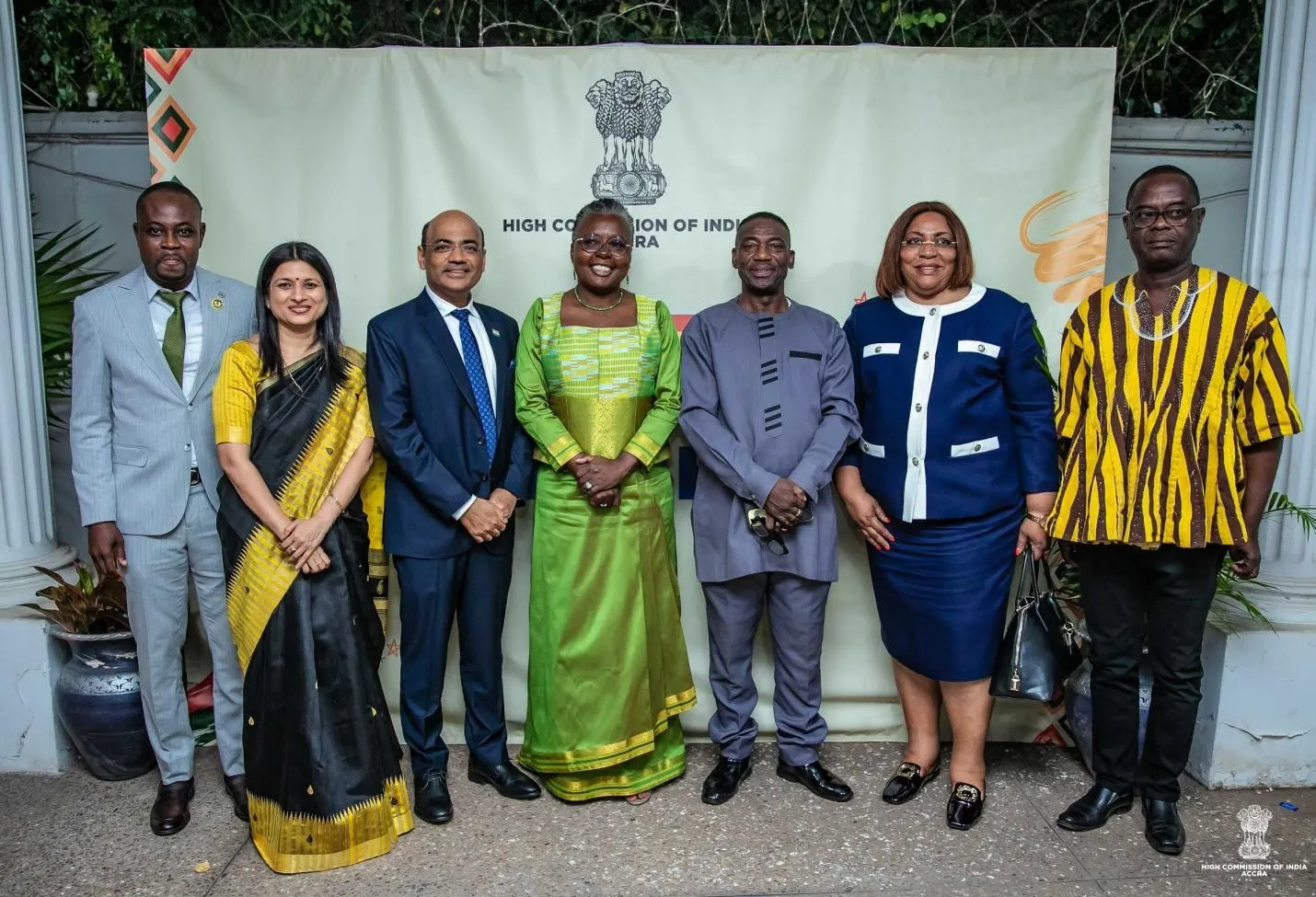
… with 500 annual fully funded training, scholarship slots
India has doubled its commitment to capacity building for Ghana, announcing the offer of 500 fully-funded training and higher education slots annually under the Indian Technical and Economic Cooperation (ITEC) programme and the Indian Council for Cultural Relations (ICCR) scholarship schemes, in a move aimed at strengthening human capital and institutional capacity in the country
This announcement was one of the key points during the India–Ghana Partnership Day in Accra, where senior government officials, diplomats, educators and members of the Indian diaspora gathered to reflect on the evolution of bilateral relations and future areas of cooperation.
The expanded commitment builds on a long-standing development partnership centred on skills transfer and professional training, with officials noting that the opportunities are open to persons across the country.
India’s High Commissioner to Ghana, H.E. Manish Gupta, said capacity building had remained the cornerstone of India’s South–South cooperation framework since independence.
“Institutional capacity building has always been the cornerstone of India’s South–South cooperation framework. We are not just sharing knowledge; we are building our future together,” Mr. Gupta said.
He noted that the ITEC programme, established in 1964, had trained more than 200,000 officials across 160 countries, making it one of the oldest and most extensive institutionalised international training initiatives globally. Ghana has so far recorded about 5,000 beneficiaries under the scheme, he said.
Under the expanded arrangement, Ghanaian professionals will continue to access training across more than 400 courses at over 100 institutions in India, covering areas such as public administration, information technology, finance, engineering, health, agriculture and emerging digital skills.
The ICCR scholarships complement this by supporting undergraduate, postgraduate and doctoral studies, alongside cultural exchanges and specialised training in the arts and traditional knowledge systems.
Speaking at the event, the Minister for Fisheries and Aquaculture, Hon. Emelia Arthur, highlighted the practical value of the programme, drawing on her own experience as a former beneficiary of Indian training institutions.
She disclosed that she had participated in the ITEC programme at the Indian Institute of Applied Manpower Research, an experience she said shaped her understanding of long-term development planning and institutional coordination.
She also benefitted from professional exposure at the Indian Social Institute, where she developed a deeper grounding in policy analysis and development models.
Mrs. Arthur said the training she received in India went beyond technical instruction to instil discipline, systems thinking and an appreciation of how education, skills and planning intersect to deliver sustainable development outcomes.
She noted that such capacity-building initiatives had had a lasting influence on leadership approaches within Ghana’s public service.
“My ITEC experience in India was transformative. It went beyond technical instruction to instil discipline, systems thinking and a deep appreciation of how institutions, technology and people must work together if development is to be sustainable,” she explained.
India has placed particular emphasis on Africa within its capacity-building agenda. According to the High Commissioner, a significant share of ITEC resources is dedicated to the continent, alongside complementary initiatives – including the deputation of experts, customised training programmes, grant-funded projects and humanitarian assistance.
The expanded training offer comes at a time when Ghana and India have elevated their bilateral relations to a comprehensive partnership, opening new avenues for cooperation in digital public infrastructure, innovation, renewable energy and climate-smart agriculture.
Officials said sustained investment in human capital would be critical to ensuring that these new areas of cooperation translate into tangible economic and institutional gains.
The event also featured testimonies from Ghanaian beneficiaries who shared their experiences of training in India
Edward Fiifi Acquah, Greater Accra Regional Commander of the Ghana Prisons Service, said the programme had strengthened his professional outlook. “The exposure broadened my leadership perspective and enhanced my ability to manage institutions more effectively,” he said.
Similarly, Anuwa Sadat Amadu, President of Future Leaders Models United Ghana, described the training as impactful.
“The programme sharpened my leadership skills and reinforced the importance of structured planning and innovation in youth development,” he noted.
Post Views: 53
Discover more from The Business & Financial Times
Subscribe to get the latest posts sent to your email.