
The Indian government has launched a significant immigration reprieve for Ghanaian nationals currently residing in the country with expired visas.
In a strategic move to regularise migration flows, authorities have opened a three-month window allowing eligible individuals to leave India without facing the heavy financial penalties usually associated with overstaying.
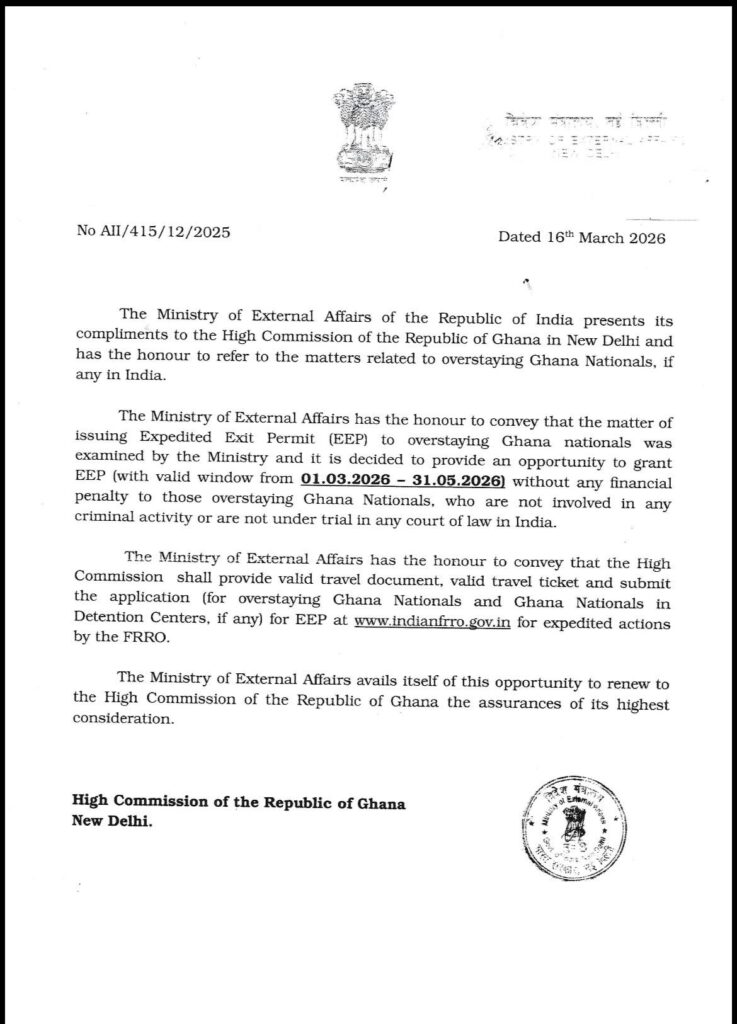
The initiative was formalised in a diplomatic communication dispatched to the Ghana High Commission in India on March 16, 2026. Under the new arrangement, the Indian government will issue an Expedited Exit Permit (EEP) to those who meet the criteria, facilitating a lawful and frictionless departure process.
The amnesty is specifically designed for law-abiding individuals who have found themselves in an undocumented status due to visa expirations.
To qualify for the penalty-free exit, applicants must satisfy the following conditions:
- No Criminal Record: The offer is strictly prohibited for individuals involved in any criminal activity.
- Legal Standing: Applicants must not be currently standing trial or subject to any ongoing court proceedings in India.
- Valid Documentation: Eligible persons must possess a valid travel document (passport or emergency travel certificate) and a confirmed outbound flight ticket.
The application window
The relief measure is time-bound, having retroactively commenced on March 1 and scheduled to conclude on May 31, 2026. Ghanaian nationals falling within this category are urged to initiate their applications via the Foreigners Regional Registration Office (FRRO) online portal.
By utilising the EEP system, the Indian government aims to provide a smooth, lawful, and penalty-free exit process for affected individuals, thereby reducing the administrative burden on immigration detention centres and legal systems.
The Ghana High Commission is actively encouraging Ghanaians in India to take advantage of this rare administrative window.
Officials warned that those who fail to regularise their departure before the May 31 deadline risk facing severe future immigration consequences, including hefty fines, potential deportation, and permanent bans from re-entering India.
The initiative reflects a growing trend in international diplomacy, as both nations seek to manage their diaspora populations more effectively while maintaining robust bilateral relations.
DISCLAIMER: The Views, Comments, Opinions, Contributions and Statements made by Readers and Contributors on this platform do not necessarily represent the views or policy of Multimedia Group Limited.
DISCLAIMER: The Views, Comments, Opinions, Contributions and Statements made by Readers and Contributors on this platform do not necessarily represent the views or policy of Multimedia Group Limited.
Source link