

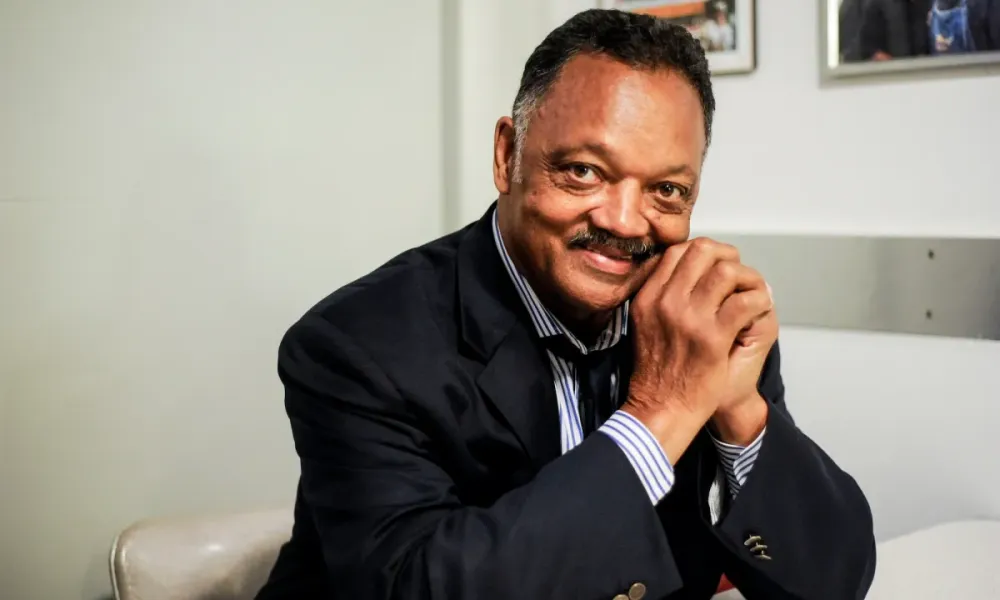
Rev. Jesse Jackson, a civil rights icon, Baptist minister, and two-time Democratic presidential candidate, has d!ed at the age of 84.
The Jackson family confirmed his passing in a statement on Tuesday morning, Febuary 17.
“His unwavering commitment to justice, equality, and human rights helped shape a global movement for freedom and dignity. A tireless change agent, he elevated the voices of the voiceless – from his Presidential campaigns in the 1980s to mobilizing millions to register to vote – leaving an indelible mark on history,” the statement read.
Jackson had been hospitalized in recent months and was under observation for progressive supranuclear palsy (PSP), the Rainbow PUSH Coalition has said.
His tireless dedication to racial equality spanned more than six decades and helped shape the modern Civil Rights Movement.
READ ALSO: Reggae legend and drummer, Sly Dunbar, dead at 73
A protégé of Martin Luther King Jr., Jackson fought on the front lines of the battle against Jim Crow segregation laws as a college student. He stood out for his rousing speeches, radical ideas, and passion for racial equality. Jackson would become a key figure in the civil rights movement that pressed for broader economic opportunities for Black people through the Southern Christian Leadership Conference, or SCLC, and more recently, his organization, the Rainbow PUSH coalition.
Jackson profoundly shaped American politics, inspiring a generation of minority leaders and moving the Democratic Party’s platform toward social and economic progressivism as it entered the 21st century.
He was born Jesse Louis Burns October 8, 1941, in Greenville, South Carolina, to Helen Burns, 16, and Noah Louis Robinson, a 33-year-old married neighbor. However Jackson would not learn the identity of his biological father until he was 7 years-old.
Later in his childhood, Jackson took the last name of his stepfather, Charles Jackson, whom his mother married when he was an infant. Jackson considered both men to be his fathers.
Growing up in poverty in the Jim Crow era, facing societal judgment for being born out of wedlock and personal challenges with his biological father, Jackson learned to channel his fears into excellence.
“I was afraid to fail,” Jackson told the Chicago Tribune in 1996. “An all-around excellence in sports and academics, being a first-string athlete and an honor student, could protect you from feeling a certain form of rejection. People don’t laugh at you when you get A’s.”
From his early adolescence, Jackson was defined by his charisma and intelligence, being elected class president of Sterling High School and graduating with honors.
Jackson rejected an offer from a minor league baseball team and instead took a football scholarship at the University of Illinois. He later transferred to North Carolina A&T State University.
While attending A&T, Jackson became active in the civil rights movement, joining his local Congress of Racial Equality chapter and taking a leadership role in organizing sit-ins.
Among those was a sit-in Jackson organized on July 16, 1960, at the “whites only” Greenville County Public Library, which would later land Jackson and seven other Black students with the nickname the “Greenville Eight.”
After Jackson was turned away from the library while attempting to acquire a book for a school report, he and the other Black students entered the library and read quietly. When they refused to leave, they were arrested.
As a result of the Greenville Eight’s sit-in, the library closed down its segregated branches and later opened a single integrated one.
It was then that Jackson attracted the attention of King.
Jackson began studying theology at the Chicago Theological Seminary, but deferred to work full-time with King during the Civil Rights Movement. He was ordained a minister in 1968 and was later given a Master of Divinity from the school in 2000.
King recruited Jackson to be an organizer with the Southern Christian Leadership Conference and soon appointed him director of the Operation Breadbasket program, dedicated to improving the economic conditions of Black communities.
Using his political momentum from PUSH, Jackson launched what many perceived as a long-shot bid for the Democratic presidential nomination in 1984.
Campaigning on liberal policies, many of which were considered radical for the time, Jackson was largely thought of as a “fringe” candidate.
Although Jackson lost the Democratic primary, he outperformed expectations, earning 18 percent of the primary vote and winning two states.
He ran for president again in 1988, this time earning 29 percent of Democratic primary votes and winning 13 states. Despite his overall loss, his campaigns were historic, becoming the first Black candidate to win the nationwide Democratic youth vote.
“So many leaders of the African-American community have come from that campaign. He was the one,” Tina Flournoy, the ex-chief of staff to former Vice President Kamala Harris, told Politico in 2007.
Jackson maintained a powerful political figure throughout the 1990s and 2000s, albeit not in an official capacity.
From 1991 until 1997, Jackson served as D.C.’s “shadow senator” an unofficial, unpaid position with no voting power in Congress that is primarily focused on advocating for D.C.’s statehood.