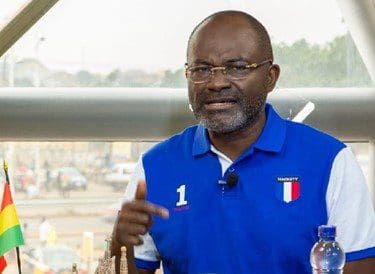
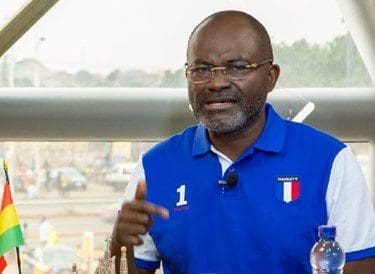

New Patriotic Party (NPP) flagbearer hopeful Kennedy Agyapong has defined true party unity as inseparable from fairness, declaring that harmony cannot exist when some members operate freely while others face silencing.
In a social media post that quickly gained traction among party supporters, the businessman-turned-politician outlined his vision for unity ahead of the NPP’s presidential primaries scheduled for January 31, 2026.
“What does true unity in our party look like? For me, it’s built on one simple, powerful idea: FAIRNESS,” Agyapong wrote. “It means we can’t have harmony when some are allowed to do as they please while others are told to be quiet.”
The statement comes just days after Agyapong addressed supporters at the Team Ken USA Annual Gala 2025 in New York, where he warned against what he described as rising intimidation within party circles. At that event, he vowed to “resist every individual who intimidates us,” sending a clear message that he wouldn’t be cowed by internal party pressure.
His latest post adds philosophical depth to those earlier combative remarks, framing his resistance not as defiance but as pursuit of foundational party values. By linking unity to fairness, Agyapong appears to be arguing that calls for unity ring hollow when they merely ask aggrieved members to stay quiet rather than addressing underlying grievances.
“It means that an apology shouldn’t be a sign of weakness, but a mark of strength, for everyone,” he continued, suggesting that accountability should apply uniformly across party ranks regardless of position or influence.
The timing is significant. Agyapong picked up nomination forms in early August to contest the January primaries, setting up what many anticipate will be a rematch against Vice President Dr. Mahamudu Bawumia, who defeated him in the party’s 2023 flagbearer race. That earlier contest left lingering tensions, with some Agyapong supporters feeling the process favored the establishment candidate.
Since then, Agyapong has embarked on what he calls a “Unity Tour,” visiting constituencies nationwide to rally support. But his speeches have frequently touched on themes of fairness and equal treatment, suggesting he sees these issues as central to his campaign rather than peripheral talking points.
Recent events have added fuel to these concerns. Last month, Agyapong disclosed that the NPP leadership imposed a GH₵4 million development levy on flagbearer hopefuls, in addition to GH₵60,000 filing fees. While framed as party fundraising, such substantial requirements inevitably favor well-funded candidates over those with smaller war chests.
His statements about intimidation and silencing also find context in his history with party leadership. Agyapong has faced disciplinary action previously for comments deemed out of line, creating what some supporters view as a pattern of selective enforcement against outspoken members.
In his latest post, Agyapong sought to elevate the discussion beyond personal grievances. “The New Patriotic Party is a great family and families thrive on respect and justice,” he wrote. “Let’s put aside our differences and focus on our shared mission: building a prosperous Ghana for our children. That’s the unity I believe in. That’s the way forward.”
That framing attempts to position him as the candidate calling for reconciliation based on principle rather than simply demanding accommodation for his own ambitions. Whether party delegates accept that narrative or see it as strategic positioning ahead of the primaries remains to be seen.
The NPP faces genuine unity challenges beyond the Agyapong-Bawumia rivalry. The party lost the 2024 general elections to the National Democratic Congress (NDC), returning to opposition after eight years in power. Rebuilding for 2028 requires not just selecting a flagbearer but healing divisions that may have contributed to that electoral defeat.
Agyapong has repeatedly warned that the NPP “stands no chance of winning the 2028 presidential election without unity,” as he stated in an April address to supporters. His latest comments suggest he sees procedural fairness and equal treatment as prerequisites for achieving that unity.
Some political observers note that Agyapong’s fairness messaging could resonate with grassroots party members who feel excluded from decision-making by what they perceive as an entrenched establishment. His willingness to challenge party hierarchy has long been part of his political brand, appealing to those frustrated with conventional politics.
However, the same approach risks alienating party elders and institutional power brokers whose support typically proves crucial in winning internal elections. The NPP’s delegate system gives significant influence to party officials and established figures, meaning Agyapong’s confrontational stance could work against him even as it energizes certain supporter bases.
The reference to apologies deserves attention. Agyapong has faced calls to apologize for various statements throughout his political career but has typically resisted such demands, arguing that selective demands for apologies demonstrate exactly the double standards he criticizes. His post suggests he views calls for apologies as power plays rather than legitimate accountability measures.
Looking ahead to January’s primaries, Agyapong’s fairness narrative provides a framework for understanding his campaign strategy. Rather than simply attacking opponents, he’s attempting to define the terms of debate—arguing that whoever wins must do so through fair processes that all candidates can respect.
Whether this approach succeeds depends partly on how party delegates interpret recent events. If they see legitimacy in Agyapong’s complaints about unequal treatment, his fairness message could gain traction. If they view his concerns as sour grapes from the 2023 loss, the strategy may backfire.
For now, the social media post has at least ensured that fairness and equal treatment will be part of the conversation leading to January’s vote. Agyapong has made clear he won’t simply call for unity without addressing what he sees as underlying inequities that make genuine unity impossible.
The NPP must decide whether it agrees with his diagnosis—and whether the party’s path forward requires the kind of procedural fairness and equal accountability Agyapong demands, or whether unity requires something else entirely.