
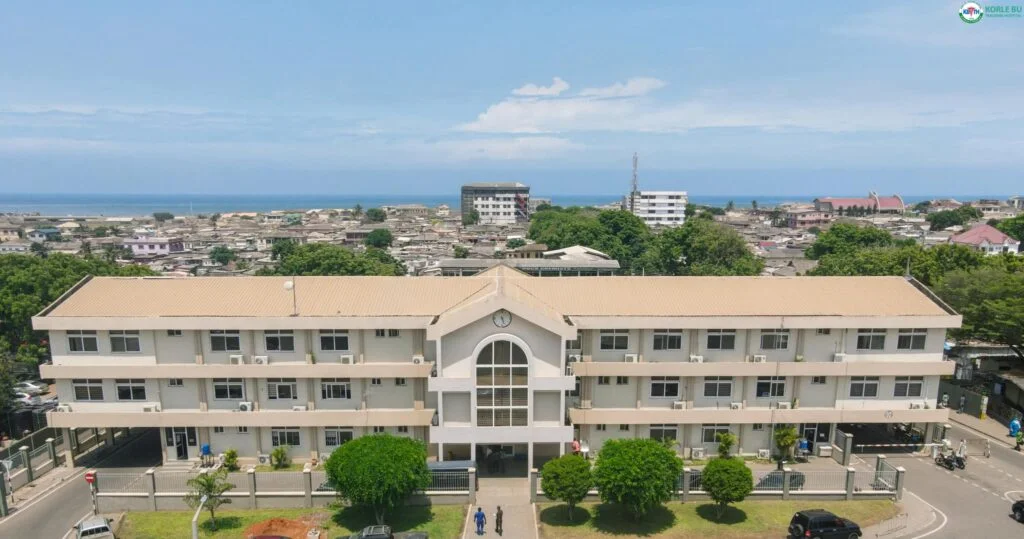
The Korle Bu Doctors Association (KODA) has confirmed the authenticity of a viral video originally published by The1957News depicting patients receiving emergency care on the floor and in chairs at the Accident and Emergency (A&E) Centre of the Korle Bu Teaching Hospital (KBTH).
The association described the footage as accurately representing the persistent and severe overcrowding caused by the “no bed syndrome” at the facility.
In a press statement issued on Monday, March 23, 2026, KODA expressed grave concern over the escalating challenges in emergency care, stating that “recent administrative directives have led to a surge in patient admissions that far exceed the physical and human resource capacity of the Accident and Emergency Centre.”
The doctors reiterated their commitment to the “No Bed” policy, affirming that they will not turn away any patient brought to the emergency room. However, KODA warned that the resulting overcrowding has compelled healthcare workers to provide care in “non-ideal and improvised settings,” rendering the situation unsustainable and posing “significant risks to both patient recovery and professional integrity.”
KODA highlighted several critical consequences of the overcrowding. According to the association, packed conditions compromise infection control, cause delays in critical interventions, and increase the likelihood of medical errors.
The association also pointed to heightened medicolegal vulnerability, explaining that delivering care on the floor, in chairs, or in hallways exposes doctors to “immense legal risk should adverse events occur.”
KODA noted that staff are experiencing rapid burnout and physical exhaustion, further jeopardizing care quality. Additionally, KODA noted long-term occupational hazards, stating that “squatting or bending to take care of a patient on the floor poses significant trauma to the spine of healthcare professionals, the effect of which would be appreciated in the near future.”
The video, originally published by The1957News around March 20, 2026, showed frail patients lying on the floor in the emergency ward, igniting widespread public outrage and renewed scrutiny of conditions in Ghana’s premier public health facility.
In response, the Minister of Health, Kwabena Mintah Akandoh, accompanied by KBTH management, visited the A&E Centre on Saturday, March 21, 2026. During the visit, the Minister observed what appeared to be a near-normal environment and indicated that the social media publication did not align with what he witnessed.
KODA countered this perspective, asserting that the conditions during the ministerial visit were not representative of daily operations.
The association explained that “it is normal practice to prepare prior to a visit by a minister or state official,” with measures such as providing new bedsheets for all beds—including those previously without—and rearranging the ward to present a flawless appearance. KODA stressed that “accepting the actual situation on the ground is an important step towards the solutions.”
The association also addressed efforts by hospital management to question the video’s credibility. Specifically, the Chief Executive Officer of Korle Bu Teaching Hospital, Dr. Yakubu Seidu Adam, sought to undermine the footage by suggesting it may have been AI-generated.
In statements made during and following the Minister’s visit on March 21, 2026, Dr. Adam indicated that the hospital was reviewing the images to determine authenticity, with remarks such as “We are still reviewing the images to ascertain whether it is AI-generated” and that management was conducting a technical assessment amid claims that no patients were placed on the floor and that the video did not reflect the ground reality.
KODA rejected such characterizations and affirmed that the video accurately captured the routine challenges confronting staff and patients at the A&E Centre.
KODA further argued that resolving the “no bed syndrome” extends beyond simply adding beds, noting that “the provision of 1000 extra beds would not immediately translate into enough health personnel to take care of these patients.”
The core issue, according to the association, lies in the limited capacity of referring hospitals nationwide and inadequate coordination within the referral system, which continually overwhelms Korle Bu as the primary destination for complex cases.
Against this backdrop of systemic failures, KODA urged the Ministry of Health and KBTH management to cease making “scape-goats out of a problem they are responsible as leaders of healthcare.” The association directed its members to adhere to protective protocols, including rigorous documentation of sub-optimal care environments including explicitly noting when a patient is managed on a floor mattress due to lack of bed space, formal written escalation of shortages, and avoidance of procedures that violate safety or ethical standards under pressure.
KODA demanded that KBTH management review referral linkages to foster a true networked system, provide immediate adequate logistics, consumables, and temporary holding spaces meeting clinical standards, and issue clear written legal indemnity to safeguard staff operating under these dictated conditions.
While appreciating temporary interventions by management and the Minister, KODA called for a shift from crisis management to systemic correction, urging political will to implement longstanding recommendations from the Ghana Medical Association and other stakeholders. The association expressed openness to dialogue to prevent avoidable mortalities and resolve the crisis.
The statement was signed by Dr. Asare K. Offei (Chairman), Dr. Joojo Nyamekye-Baldoo (Secretary), and Dr. Naa Martekuor Vanderpuye (Treasurer).