
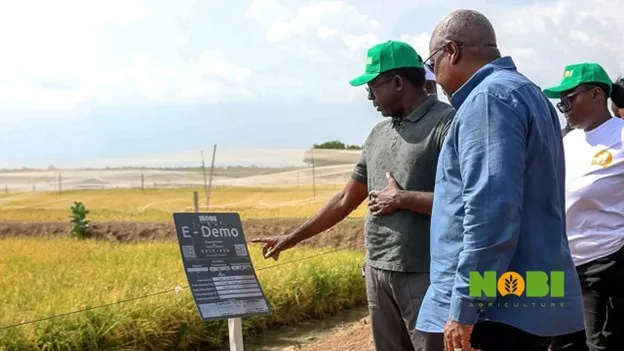

President John Dramani Mahama has visited the Sikasu facility of Nobi Agriculture in the Afram Plains, commending the project’s founder, Kwame Awuah-Darko, for the scale and ambition of an agricultural development that is emerging as one of Ghana’s most significant private farming ventures.
Accompanied by Minister for Agriculture, Eric Opoku, the President toured key sections of the 21,000-acre development, including its rice research institute, irrigation infrastructure, rice fields, warehouse complex, silos and processing plant; facilities that together represent one of the most vertically integrated private agricultural operations currently active in the country.
“This is the kind of private-sector leadership we want to encourage, bold, integrated, and forward-looking. Government’s role is to create the enabling environment, but it is entrepreneurs like this who will drive the transformation of our agricultural sector at scale,” he added.

The visit drew attention to the project’s alignment with the administration’s broader economic agenda, including the Volta Economic Corridor initiative and the 24-Hour Economy framework, both of which identify productive sector investment, particularly agriculture, as a driver of regional development and employment creation.
“This project demonstrates clearly that Ghana can produce a significant share of what we consume if we commit to scale, technology and long-term investment. What I have seen here aligns directly with our vision for a 24-hour economy and the Volta Economic Corridor, where agriculture is not subsistence, but a modern, productive and commercially viable sector driving jobs and national food security,” President Mahama added.
On a similar tangent, Agriculture Minister, Eric Opoku used the visit to highlight the importance of a stable and supportive policy environment in attracting long-term private capital into Ghana’s agricultural sector.

He noted that large-scale, integrated projects such as Nobi Agriculture reflect growing investor confidence but also require sustained government backing in areas such as land access, irrigation infrastructure, input systems and market development.
According to him, the ministry is prioritising policies that de-risk commercial farming, encourage value chain integration and create pathways for collaboration between large agribusinesses and smallholder farmers.
“This is the direction we must move as a country, creating the conditions for serious private investment in agriculture to thrive. When investors are confident in policy consistency and have access to the right infrastructure, we will see more projects of this scale, which is exactly what Ghana needs to achieve food security and build a competitive agricultural economy,” he noted.
Infrastructure and Output
With 7,000 acres in active development in its first phase, Nobi Agriculture has prioritised the foundational infrastructure needed to sustain commercial-scale production.
At the heart of its water management system is a 23-acre reservoir with a storage capacity of 1.2 million cubic metres, designed to stabilise cultivation cycles in a region where rainfall variability has historically constrained traditional farming.
Post-harvest infrastructure includes a rice mill with a processing capacity of three tonnes per hour, supported by a dryer and silo storage holding up to 1,300 metric tonnes of paddy rice. The farm is currently recording yields of 3.5 tonnes per acre, a figure that reflects the measurable benefits of improved seed varieties, irrigation support and modern cultivation methods applied consistently across the operation.

Employment
It currently provides direct employment to more than 150 people, and is increasingly emerging as both a production and livelihood anchor in the Afram Plains.
A dedicated rice research institute within the facility is focused on developing indigenous seed varieties suited to Ghana’s soil and climate conditions. The project currently provides direct employment to more than 150 young people and has attracted interest from Development Bank Ghana, which has taken note of the project’s integrated production model.
Mr Awuah-Darko described the President’s visit as a strong validation of the project’s long-term vision, noting that it reinforces confidence in the role of disciplined private investment in transforming Ghana’s agricultural sector.
“This visit is not just about Nobi Agriculture; it is about demonstrating what is possible when agriculture is approached with scale, structure and commitment. We believe this model can contribute meaningfully to Ghana’s food security and inspire similar investments across the sector,” he said.
This comes as the domestic rice import bill remains a persistent pressure on the current account, as domestic production consistently falls short of demand. In 2025/2026, Ghana is projected to import 1 million metric tonnes, nearly 60 percent of the 1.8 million metric tonnes consumed annually.
While local milled production grew 18 percent to 900,000 metric tonnes, the annual financial drain is estimated at US$600 million. To alleviate this foreign exchange burden, the 2026 Budget intensified the ‘Feed Ghana’ initiative, mandating that public institutions prioritise locally grown rice.
The initiative mirrors Awuah-Darko’s broader belief that Ghana’s agricultural transformation will depend not only on land and labor, but also on science, infrastructure and patient capita.
As Ghana continues to explore pathways toward greater food security and agricultural industrialisation, projects like Nobi Agriculture illustrate the growing role of private enterprise in shaping the sector’s future. Across the thousands of acres now under cultivation, the work unfolding under Awuah-Darko’s leadership suggests that the next chapter of Ghanaian agriculture may well be written at scale.
Post Views: 1
Discover more from The Business & Financial Times
Subscribe to get the latest posts sent to your email.