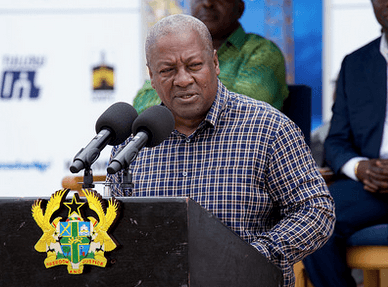

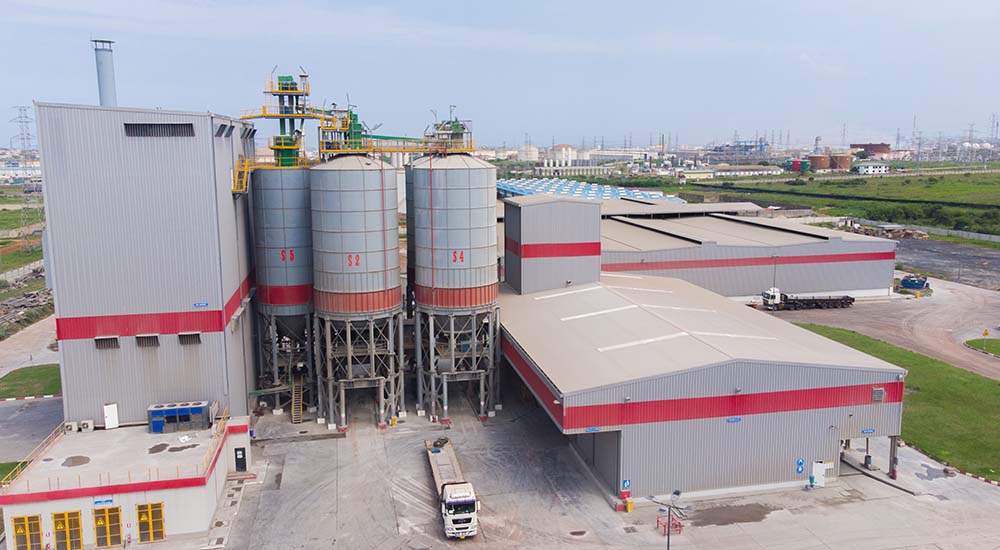
President John Dramani Mahama has commissioned the world’s largest Calcined Clay Plant at the Free Zones Enclave of the industrial city of Tema.
The $110 million facility is a joint venture partnership between Heidelberg Materials and CBI Ghana Ltd.
Calcined Clay is a pozzolanic material produced by heating natural, kaolinite-rich clay to high temperatures, which transforms it into a highly reactive, cement-compatible powder.
It is used as a sustainable, low-carbon alternative to reduce cement clinkers in concrete, enhancing durability, strength, and reducing carbon dioxide emissions.
The President in his remarks commended the Board, Management, Chairman and CEO of CBI and investors for their confidence in choosing Ghana for this investment.
“You’ve demonstrated vision, courage, and commitment by investing in a facility of global scale and technological sophistication,” he said.
“By constructing the world’s largest Carlson clay plant here in Tema, Ghana’s historic industrial center, envisioned by Dr. Kwame Nkrumah, you have a firm Ghana’s position as a leader in Africa’s industrial future.”
He noted that their investment demonstrated that economic growth and environmental sustainability could co-exist together.
President Mahama said the facility they were commissioning was historically significant in many respects; declaring that Ghana now hosts the world’s largest calcined clay cement plant, a significant industrial achievement that places their country at the forefront of sustainable cement production.
He said: “This investment sends a strong signal to the international business community that Ghana was open to serious industrial investment.”
He noted that it demonstrated clearly that when the policy environment was transparent, stable, and supportive of enterprise, the private sector would respond and would have the confidence to mobilise capital and undertake projects of global significance.
The President said the Government of Ghana would continue to maintain such an environment, which was his pledge to the Ghanaian private sector.
“I will make sure that the environment is conducive for you to continue investing and make a handsome return on your investment,” he said.
President Mahama said the cement industry had attracted notable policy focus over the past year due to its key role in construction, housing, and infrastructure development.
He said at the end of 2024, cement prices had risen sharply, reaching approximately GH¢120 per bag for 42.5 grade cement and GH¢113 per bag for 32.5 grade cement.
He said through a mix of macroeconomic stabilization, fiscal discipline, and constructive engagement with industry stakeholders, they started to see positive results in the cement space.
The President said by July 2025, cement prices had fallen by about 20 per cent, providing relief to builders, contractors, and the housing construction industry, adding that, recent data from the Ghana Surgical Service shows that construction inflation decreased to 3.9 per cent year-on-year in January 2026.
He said these developments demonstrated the effect of prudent economic management and strengthening domestic currency.
President Mahama lauded the Chamber of Cement Manufacturers Ghana (COCMAC) for its ongoing engagement with the Government.
He reiterated that dialogue between the Government and the industry remained essential for ensuring stability and growth in this all-important sector.
“The facility we are commissioning today is a $110 million investment with an annual capacity of 1.5 million tons of environmentally friendly calcined clay cement,” he said.
“This innovation marks a significant advancement for both industrial growth and environmental responsibility.”
President Mahama said traditional clay-based cement production accounts for about eight per cent of global carbon dioxide emissions, making it one of the most carbon-intensive industrial processes.
He said by introducing limestone calcined clay cement technology, this facility would significantly reduce carbon emissions while maintaining the strength and quality required for modern construction.
The President said even more importantly, this innovation enables them to replace large amounts of imported clinker with locally sourced Ghanaian clay processed and refined right here in Ghana.
He said this means that they had lower production costs, reduced import dependency, and they had more value retained within the Ghanaian economy.
“Indeed, replacing clinker is expected to cut our import reliance by more than 10 per cent, keeping hundreds of millions of Cedis circulating within the domestic economy. “And even more unique is that our local clay is being processed at this factory using our own liquid natural gas from our oil and gas fields in the western region.”
He said this a collaboration with the nation’s own Ghana Gas and Atuabo Gas Processing Plant, which was bringing gas to this facility to process the clay for cement production.
“I wish to assure CBI and our partners in the industrial enclave that our interaction with the upstream oil and gas companies has been very positive,” he said.
The President said they had recently signed two new memorandum of understanding (MoU) with the Jubilee Partners to invest another $2 billion in the nation’s upstream gas, oil and gas industry to increase the volumes of gas that they were able to produce.
Mrs Elizabeth Ofosu-Adjare, the Minister of Trade, Industry and Agribusiness, said the Ministry was determined to make Ghana the most competitive manufacturing destination in West Africa.
Mr Fredrick Albrecht, CBI Ghana Ltd Managing Director, said in siting the factory in Ghana, they believed that resilience, creativity, and the drive for excellence defined the Ghanaian spirit.
Source: GNA