


By Juliet ETEFE
Year-on-year inflation eased slightly to 3.2 percent in March 2026, down from 3.3 percent in February – marking the 15th consecutive decline and lowest level since the Consumer Price Index (CPI) was rebased in 2021.
Data from Ghana Statistical Service (GSS) show the CPI rose to 264.8 in March 2026 from 256.5 in March 2025, indicating that prices were on average 3.2 percent higher compared to the same period last year.

On a month-on-month basis, inflation slowed sharply to 0.1 percent from 0.8 percent – reflecting easing short-term price pressures.
Compiled from a basket of 307 items across 57 markets and 8,337 outlets nationwide, CPI data point to a sustained disinflation trend with inflation down by 19.2 percentage points from 22.4 percent recorded in March 2025.

The Bank of Ghana (BoG) Monetary Policy Committee (MPC) noted that sustained disinflation, strong external reserves and robust domestic activity supported a measured reduction in the Monetary Policy Rate (MPR) by 150 basis points to 14.0 percent.
Members indicated headline inflation remains below the medium-term target band of 8 ± 2 percent and the real policy rate continues to be restrictive, while cautioning that global risks including the US-Israel-Iran conflict, rising crude oil prices and supply chain disruptions pose potential upside pressures.
A key feature of the latest data is a shift in the drivers of inflation. While goods prices – accounting for about 73 percent of the CPI basket – declined by 1.0 percent month-on-month and slowed to 1.7 percent year-on-year, services inflation rose sharply to 7.2 percent from 3.7 percent, emerging as a growing source of price pressures.

Food and non-food
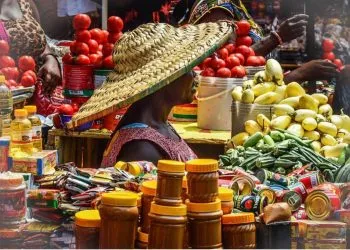
Food inflation eased slightly to 2.3 percent from 2.4 percent, with prices declining by 0.3 percent over the month. Prices of key staples, including maize and rice, dropped by 8.6 percent year-on-year while vegetables and plantain recorded deflation of 1.3 percent. However, fish (8.3%), ready-made food (8.9%) and meat (5.7%) continued to register moderate price increases.
Non-food inflation also edged down to 3.9 percent from 4.0 percent, reflecting relatively stable price movements outside the food basket.
Further disaggregation shows inflation is increasingly domestically driven. Inflation for locally produced goods rose to 4.9 percent from 4.5 percent, while imported inflation fell to negative 0.6 percent, indicating a decline in prices of imported items.
Price pressures also remain highly concentrated. Five items – charcoal, green plantain, smoked herrings, senior secondary school fees and onions – accounted for about 61.5 percent of total inflation while three divisions, housing & utilities, food & non-alcoholic beverages and education, together contributed 87.5 percent.
Housing and utilities recorded the highest inflation at 12.4 percent, contributing 40.6 percent of overall inflation, followed by food & non-alcoholic beverages (31.3%) and education services (15.6%).
Transport helped offset overall price pressures, recording negative inflation of 7.3 percent.
Regional dynamics
Inflation remained uneven across the country, with North East Region recording the highest rate at 8.6 percent while Savannah Region posted the lowest at -4.6 percent.
The data show that several regions remain in deflation, including Bono East, Upper East, Oti, Western and Northern – reflecting persistent regional disparities in price movements.
Notably, inflation is highly concentrated, with the top five regions – Greater Accra, Ashanti, Eastern, Central and Volta – accounting for about 66.7 percent of overall inflation, underscoring the dominance of a few regions in driving national price trends.
Despite the overall easing, emerging month-on-month increases in key items such as petrol and tomatoes, alongside rising services costs, point to potential upside risks in the near term; particularly amid global oil price volatility and regional supply disruptions.
Recommendations
GSS recommended that government sustain fiscal discipline, stabilise food prices and invest in infrastructure such as storage, irrigation, transport and market access to reduce regional disparities.
Households are advised to track spending on food, rent and school fees, avoid non-essential expenses and save where possible, while businesses are encouraged to invest in efficiency, strengthen supply chains and reduce costs.
The March 2026 data reflect continued price stability, but both domestic and external developments underscore a need for continued vigilance to sustain disinflation and support economic recovery.
Post Views: 1
Discover more from The Business & Financial Times
Subscribe to get the latest posts sent to your email.