
Commissioner of Police (COP) Mr Osman Abdul‑Razak, National Security Coordinator, has welcomed stakeholder recommendations to strengthen Ghana’s National Framework for Preventing and Countering Violent Extremism and Terrorism.
He said contributions made during the engagement would be taken seriously and incorporated into the ongoing review process to enhance preventive and response mechanisms.
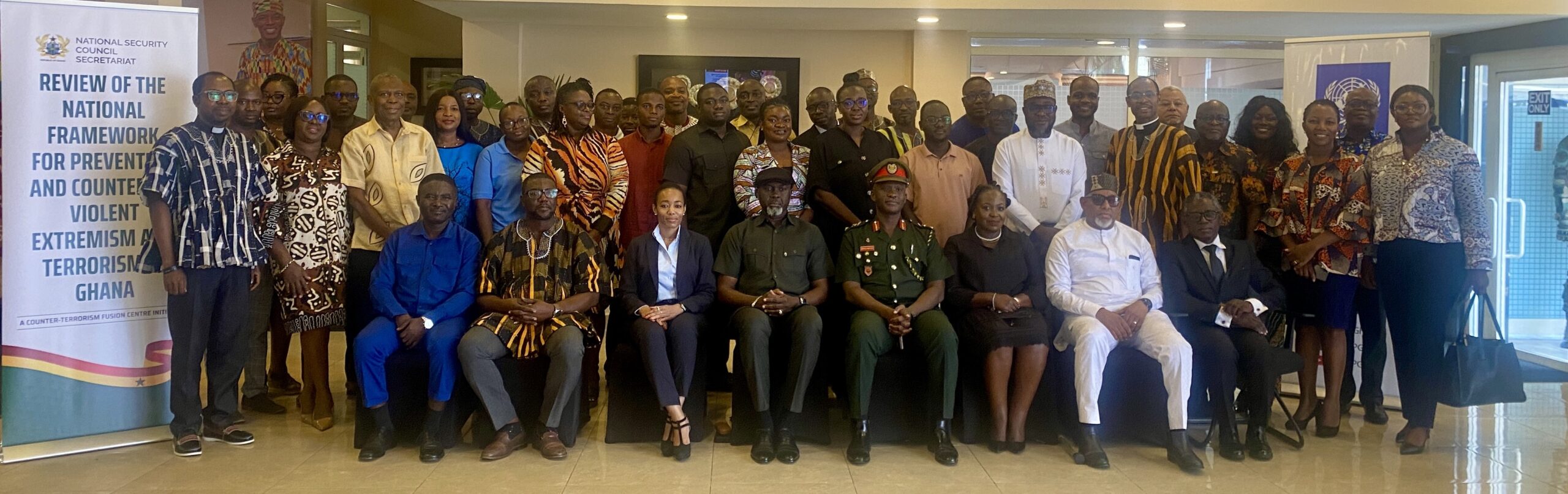
COP Abdul‑Razak was speaking at the closing of a three‑day stakeholder forum in Accra, organised by the Government of Ghana through the National Counter Terrorism Fusion Centre with support from the United Nations Development Programme (UNDP).
The forum brought together representatives from government institutions, security agencies, civil society organisations, religious bodies and youth groups to provide inputs aimed at making the framework more responsive to emerging threats.
COP Abdul‑Razak noted that while Ghana’s counter‑terrorism framework had been recognised as a strong policy document, the challenge remained its practical implementation.
He stressed the need for regular testing, simulations and improved coordination among security agencies.
Stakeholder recommendations focused on strengthening Ghana’s capacity to prevent, protect, respond to and recover from threats.
Key proposals included enhancing institutional coordination, improving early warning systems, building community resilience and safeguarding critical infrastructure.
Participants also called for increased public awareness through education, radio discussions, community durbars and social media campaigns, alongside stronger counter‑narratives to extremist ideologies.
They advocated the adoption of the “See Something, Say Something” approach to encourage vigilance and timely reporting of suspicious activities.
Recommendations highlighted the deployment of advanced intelligence technologies, including CCTV cameras, motion sensors and integrated surveillance systems, particularly in high‑risk areas.
They also called for a comprehensive cybersecurity framework to safeguard critical national infrastructure.
Stakeholders underscored the importance of inclusive engagement, trust‑building between communities and security agencies, and timely information sharing to support early warning systems.
They proposed regular security audits, coordinated nationwide response strategies, evacuation plans, and enhanced capacity for frontline responders.
Participants emphasised the need for a gender‑sensitive approach, advocating the active involvement of women in education campaigns, intelligence gathering and community‑level interventions.
COP Abdul‑Razak reiterated that preventing violent extremism required a whole‑of‑society approach.
He warned that instability in the Sahel region continued to pose a threat to Ghana, particularly in the northern parts, where vulnerabilities such as limited access to education and social amenities could be exploited for radicalisation.
Mr Edward Ampratwum, Head of Transformative Governance at UNDP Ghana, reaffirmed the organisation’s commitment to supporting Ghana’s efforts to prevent violent extremism.
He assured continued technical and financial support, noting UNDP’s dedication to fostering dialogue and strengthening community resilience.
Dr George Amoh, Executive Secretary of the National Peace Council, said the framework had been a useful tool for public education and sensitisation but noted gaps in implementation and coordination.
He highlighted the need to focus on marketplaces and schools as critical spaces for awareness creation and prevention.
Dr. Amoh mentioned ongoing initiatives by the Peace Council, including a conflict mapping project and plans to develop a National Peace Index, which he said would support early warning systems and enhance the effectiveness of the revised framework.
Source: GNA