

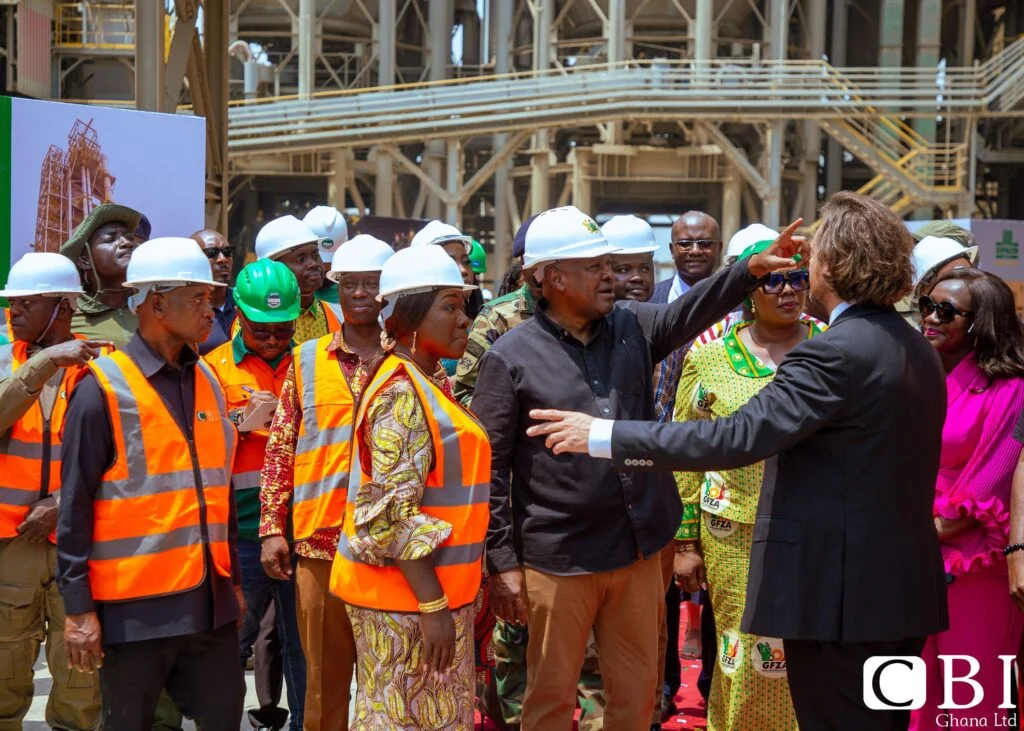
President John Dramani Mahama has commissioned the world’s largest calcined clay plant in the Tema Free Zones Enclave, marking a major milestone for Ghana’s industrial growth and sustainable construction agenda.
The US$110 million facility, developed by CBI Ghana Ltd, utilises groundbreaking Limestone Calcined Clay Cement (LC3) technology. With an annual production capacity of 400,000 tonnes of calcined clay, the plant supports the manufacture of up to 1.5 million tonnes of cement per year and stands as the largest LC3 plant globally.
The official commissioning took place on March 5, 2026. The project is set to significantly reduce Ghana’s dependence on imported clinker as the country currently ranks as Africa’s largest importer by substituting it with locally sourced and processed clay. This shift is expected to ease pressure on foreign exchange reserves and strengthen the Ghana Cedi.
During the ceremony, President Mahama described the development as a powerful symbol of Ghanaian capability and responsible industrialisation.
“What CBI Ghana has built here is a statement about Ghanaian potential. For decades, our industrial growth has faced a punishing import bill that grew on a culture of exporting raw materials and importing finished goods. Today, we are proving that responsible African industrialisation is possible,” he said.
He particularly commended the Ghanaian engineers, technicians, and laboratory staff, stating that the nation’s industrial future would be shaped by their hands.
Frédéric Albrecht, Managing Director of CBI Ghana Ltd, emphasised the plant’s global importance. He noted that Ghana currently spends nearly half a billion US dollars annually on clinker imports, funds that could help stabilise the local currency.
“The eyes of the cement world are on Ghana as we set a new global standard for sustainable construction,” he declared.
By replacing imported clinker with locally produced calcined clay, the facility achieves up to 40% reduction in CO₂ emissions, an environmental gain equivalent to taking approximately 80,000 cars off the road each year.
The plant incorporates state-of-the-art equipment, including advanced packing systems that fill up to 10 bags simultaneously and load a 40-ton truck in just 25 minutes.
By cutting clinker imports by around 400,000 tonnes annually, roughly equivalent to 10 vessels per year, the initiative supports local value chains, generates high-skilled employment in laboratories and on the factory floor, and helps retain vital foreign exchange.
LC3 technology delivers several key benefits as it reduces carbon emissions by up to 40% compared to traditional Portland cement production which requires significantly less thermal energy, and produces a more durable product especially suited to Ghana’s tropical and coastal environments.
The resulting cement offers enhanced resistance to sulphate and chloride attack, making it ideal for marine structures, high-density projects, and long-lasting infrastructure. All products according to CBI Ghana meet and exceed the performance standards set by the Ghana Standards Authority.
The facility is said to align closely with Ghana’s national climate commitments and the construction sector’s sustainability objectives, while operating within the framework of the government’s 24-Hour Economy policy.