
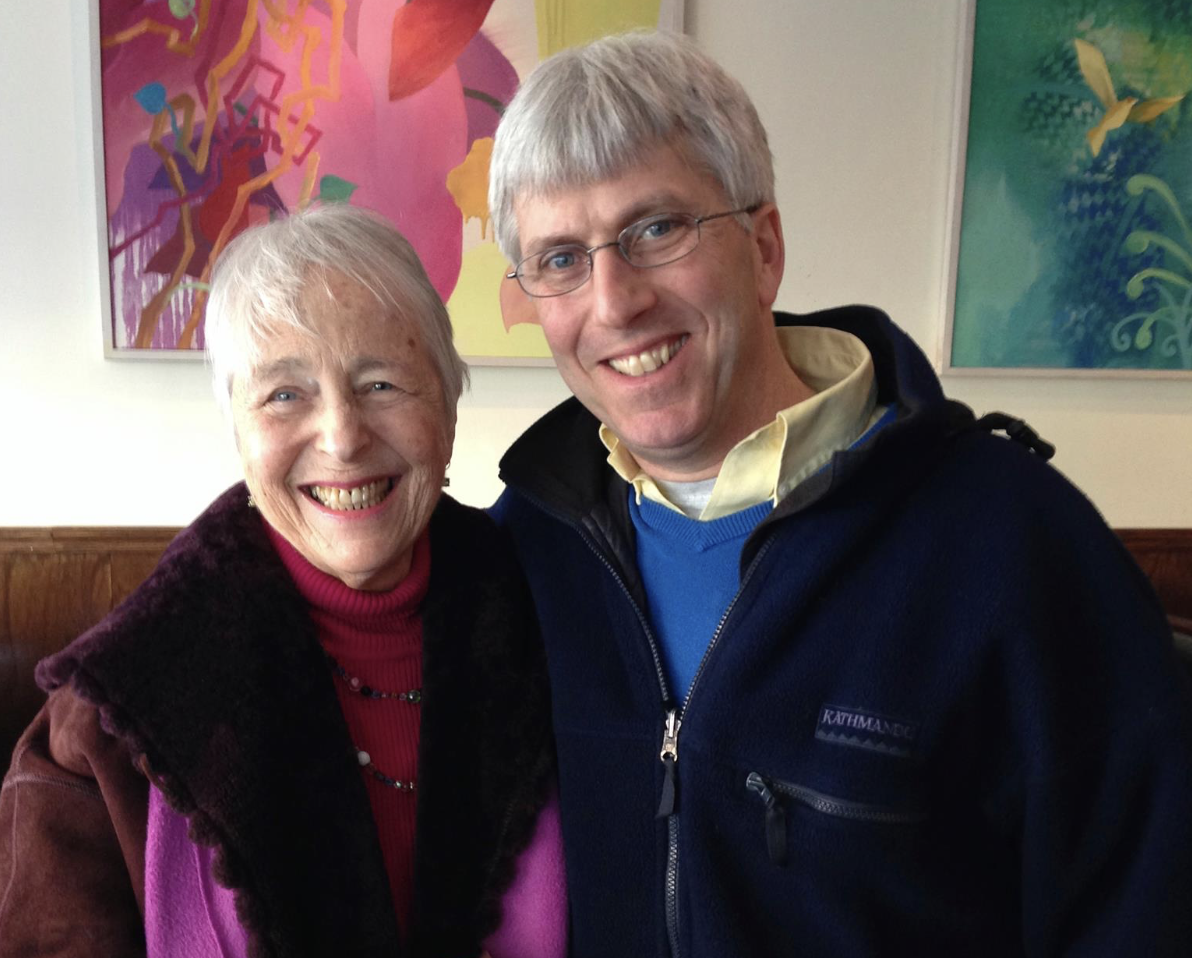
My mother searches for words.
Daily.
After starting a sentence or idea full of hope and energy, she will falter and trail off, eventually losing the thread of what she wanted to communicate. Aware of her diminished capacity, she offers an apology for not being able to retrieve her words.
We’ve been here before.
On President’s Day 1986, the rental car my father was driving on a snowy New Hampshire road skidded into the path of a car with a snowplough on the front. Mom’s door bore the impact. Her seatbelt saved her life, but she broke her collarbone and multiple ribs and lost a lot of blood. The only reason the paramedics gave her even a 1 percent chance of survival was that they were already out on the road, heard the collision and arrived immediately.
Just 20 years old at the time, I was unable to face her mortality, to fully entertain the very real possibility that she would no longer live. Steeling myself to be there for my family, I didn’t shed a tear until close to the first anniversary of the crash. After hovering between life and death in a coma for two days, she began an achingly slow, gradually forward-moving recovery. At 48 years old, she was thrust back to the beginning of life, having to relearn how to stand, walk and control her bladder.
The massive closed-head injury she sustained meant she also had to learn how to talk again. A burden for anyone, this was particularly hard for Mom, who had found her voice in the 70s after feeling silenced for more than 20 years and used it to become an accomplished poet. Her brand of brain scrambling meant that she spoke in smatterings of the five different languages she had known to varying degrees before her accident. When I asked her, “Comme ca va,” in French, she replied without hesitation, “Tres bien, merci. Et vous?” She could still provide the Latin name of the tree outside her room at Spaulding Rehabilitation Hospital and her Brooklyn accent returned with a vengeance.
But she also had the type of aphasia whereby she used language in a way that often made sense only to her. That is, she used the most particular sense of a word with little, if any, connection to its larger meaning. In the hospital, then, G-d was brillo. Pain was in the negative. And when she said “Corazon” in a scratchy voice, she meant heart and hope. The television at the end of Mom’s bed showed images of thousands of Phillipinos standing up against the oppressive, decades long rule of Ferdinand Marcos.
Corazon Aquino, the widow of slain opposition leader Benigno Aquino, led the peaceful protests against the corrupt Marcos regime. Although Mom did not speak Spanish, she somehow grasped the seismic cultural and political shifts that were happening thousands of miles away and connected deeply to the leader of the people power revolution that toppled the corrupt dica and the first lady against the dictator and his wife Imelda who had a collection of close to 3,000 while much of the country’s population lived in poverty
Mom has lived with heart and hope in the 40 years since then.
Due to her tenacious will, extensive medical treatment and willingness to try alternative therapies, she regained strength and language as she moved through developmental stages and resumed life as a functioning adult. She reached out to others who had endured trauma, too, traveling to Washington, DC, to testify before Congress. She started a non-profit organisation, Vital Active Life After Trauma, to help build a world where those who had suffered similar injuries could live dignified and fulfilled lives. An accomplished poet before the accident, she resumed writing, using more plain and soulful language than before the crash.
Mom lived fully and well for more than three decades, encountering more physical challenges as she became a mother-in-law and grandmother of four and meeting them with her customary grit. After contracting adult-onset diabetes in the 1990s, she shed close to 100 pounds and maintained a healthier diet and lifestyle in the years afterward. Her failing heart led to the installation of a pacemaker in 2010, the same year she had her right hip replaced. She kept moving, even as she used a walker more and more regularly each year. When she turned 80 years old in 2017, our families gave her a book we had assembled and I had edited of her poetry and writing. My brother Jon’s picture of a grave rubbing adorned the cover. We divided her work into the time before and after the accident to illustrate its seismic change.
Nearly four years ago, after recognizing her social isolation imposed by COVID, she made another brave decision to leave the city where she had lived her entire adult life and move to San Francisco to be near family. Although she has been well cared for and derived great pleasure and meaning from my brother Mike’s weekly visits with his family, gone well, over time her cognitive decline has advanced.
This time, though, there will be no miraculous recovery.
Once again in a familiar place of caring for our ailing mother, my brothers and I are no longer young men, but middle-aged husbands and fathers. The corners of our eyes, hair color and posture all bear the imprint of our years on earth. More attuned to the mixture of emotions that make up everyday life, we are working to face the inevitable end of the woman who gave us life with the same courage and strength she has exhibited throughout her 88 years.
My wife Dunreith and I call Mom almost every night. Even though her word retrieval and comprehension have diminished, she tells us daily that she has had a good day. And when her language starts to fail, I tell her how glad I am to be able to talk with her and that her struggles are similar to the period after the accident.
I say that we’ll continue the search for the words together tomorrow.
And I tell her that the most important words are, “I love you very much.”
So on the day that we mark the birthday of one president whom we label the father of our country and another who gave his life after holding our nation together during its more searing conflict, I am grateful for Mom’s survival, recovery and continued presence 40 years after her devastating crash. Also filled with sadness at what she’s enduring, I hope that she doesn’t linger too long in her diminished state while anticipating the grief, gratitude and relief I expect we’ll experience when she’s gone.
By Jeff Kelly Lowenstein