

By Juliet ETEFE
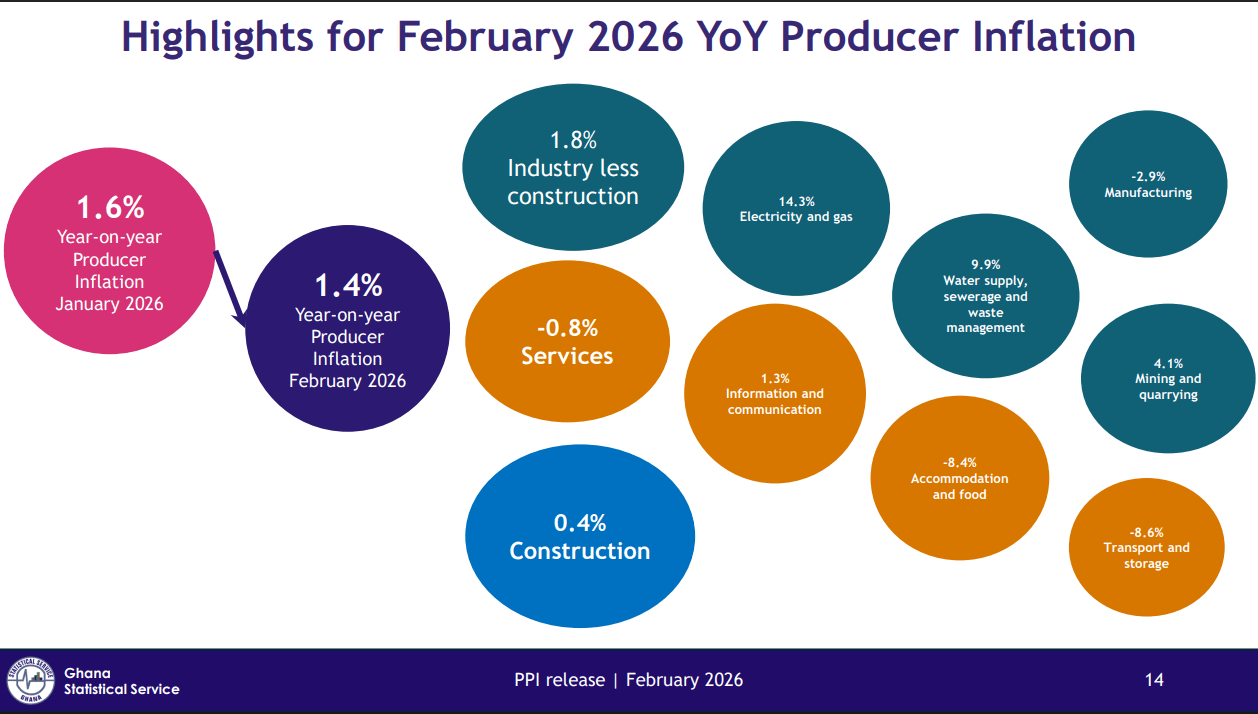
Producer price inflation slowed to 1.4 percent in February 2026, down from 1.6 percent in January, as easing annual price pressures were offset by divergent trends across key sectors.
According to data released by Ghana Statistical Service, the decline reflects a moderation in producer price inflation over the past year – although short-term price pressures remain evident.
Producer price inflation is the rate at which prices received by domestic producers for their goods and services increase or decrease.

On a year-on-year basis, the 1.4 percent rate indicates a modest increase in prices received by domestic producers between February 2025 and February 2026 – representing a 0.2 percentage point drop from the previous month. The figure also marks a slowdown compared to the same period last year, reinforcing a sustained disinflation trend in producer prices.
However, on a month-on-month basis producer inflation rose by 1.3 percent in February, signalling continued upward adjustments in producer prices. This compares with a 3.3 percent increase recorded in January, indicating slower monthly momentum but persistent short-term price pressures.
Sectoral breakdowns show that mining and quarrying – largest component of the Producer Price Index (PPI) with a weight of 43.7 percent – recorded an increase of inflation to 4.1 percent from 3.7 percent in January, making it the biggest contributor to overall producer inflation.
In contrast, the manufacturing sector which accounts for 35 percent of the index remained in deflation, with inflation declining further to -2.9 percent from -2.3 percent.

The sustained contraction reflects weak price conditions in industrial production, particularly in subsectors such as refined petroleum products and basic metals.
Inflation in the electricity and gas sector remained elevated at 14.3 percent – although slightly lower than the 14.8 percent recorded in January – while water supply, sewerage and waste management held steady at 9.9 percent, continuing to exert upward pressure on producer prices.
The construction sector recorded a notable slowdown with inflation easing to 0.4 percent from 1.1 percent, pointing to subdued price growth in building and civil engineering activities.
The services sector meanwhile remained in deflation at -0.8 percent, deepening from -0.3 percent in January. Within the sector, transport and storage declined further to -8.6 percent while accommodation and food services dropped to -8.4 percent. In contrast, information and communication stood at 1.3 percent… making it the only services sub-sector to record positive inflation.
Month-on-month data showed mixed movements across sectors. Mining and quarrying inflation slowed sharply to 2.4 percent from 7.0 percent while electricity and gas dropped significantly to 0.3 percent from 8.6 percent, contributing to the overall moderation in monthly inflation.
Manufacturing however rebounded to 0.6 percent while transport and storage rose by 0.7 percent, indicating some recovery in short-term price levels.
The Industrial Producer Price Index – which excludes construction – recorded an annual inflation rate of 1.8 percent, slightly down from 1.9 percent in January, while rising by 1.5 percent on a month-on-month basis.
The latest data point to a divergence between easing annual inflation and emerging short-term price pressures, with the mining sector continuing to shape overall trends.
Post Views: 1
Discover more from The Business & Financial Times
Subscribe to get the latest posts sent to your email.