

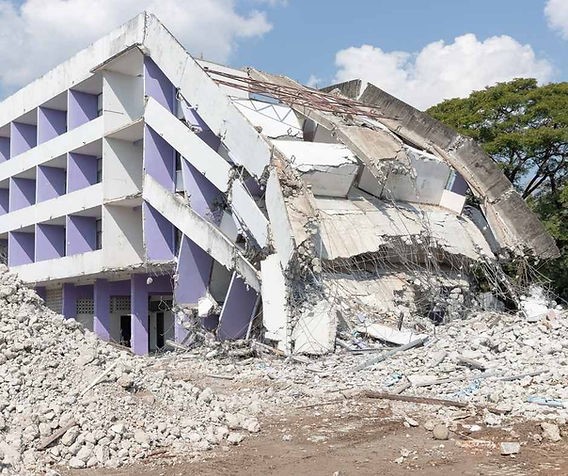
I get particularly annoyed when I see headlines and quotes from supposed responsible citizens in the aftermath of a national disaster. A few days ago, we woke up to the umpteenth building collapse in the Accra New Town neighborhood.
An uncompleted building near a school used as a makeshift church building during a church service, trapping worshippers beneath rubble and triggering a frantic rescue effort. Municipal officers were then outed as having “plans” to raze such buildings down or that “God knows” best.
Well, this is what God will have been telling us and we have been refusing to listen. We as a group of people like to cut corners and not use the right professionals in design and construction of our buildings. From incomplete structures giving way during construction to occupied buildings suddenly crumbling, the pattern is deeply troubling.
The real tragedy, however, is that many of these incidents are preventable. Between 2012 and 2014, at least 22 lives were lost due to building collapses in Ghana. All avoidable, if we listen to God. God will not come down to hold your hand but this piece is another instrument that can educate and guide you, if only you will listen. Will you?
While there are quite a mix of causes of buildings caving in, from poor structural design, weak or inappropriate foundations, use of substandard materials, lack of proper supervision, non-compliance with building regulations and engagement of unqualified artisans instead of professionals, the real gap is the absence of a structural engineer on such projects. Let’s have a critical look at who a structural engineer is and how they can play a critical role in ensuring the integrity of building and thus preventing their future collapse.
The structural engineer: a non-negotiable
A structural engineer is a trained professional within the field of Civil Engineering who specializes in designing and analyzing structures to ensure they are safe, stable, and capable of withstanding loads and environmental forces.
In simple terms, while an architect answers the question “What will the building look like?”, the structural engineer answers the far more critical question: “Will this building stand safely—today, tomorrow, and 30 years from now?”
While architects design how a building looks, structural engineers determine whether it will stand—or collapse. They calculate loads, assess soil conditions, design reinforcements, and ensure the building can withstand weight (dead and live loads), wind and environmental forces, soil movement and settlement, future modifications. Without these calculations, a building is essentially a gamble.
In fact, studies on collapsed buildings in Accra highlight that failure to undergo proper structural design and approval processes is a major contributor to collapse. In many of Ghana’s building collapse cases, investigations consistently point to structural failure—not architectural failure. This distinction matters.
A building may look complete and attractive, but if the internal load paths are poorly designed or improperly executed, collapse becomes a matter of time.
A structural engineer ensures:
- Load Stability
Every building carries weight, its own weight (dead load), people and furniture (live load), and environmental forces. A structural engineer calculates these precisely to prevent overstressing. - Foundation Integrity
Our soil conditions vary widely, from coastal sands in Accra to clayey soils inland. A structural engineer ensures the foundation type matches the soil capacity, preventing settlement or sinking. - Material Suitability
Not all cement, steel, or aggregates are equal. Structural engineers specify the right grades and ensure proper usage. - Construction Compliance
Design alone is not enough. Structural engineers supervise to ensure builders follow drawings accurately, because even a small deviation can have catastrophic consequences.
The cost of cutting corners
Many developers in Ghana, particularly in informal construction, avoid hiring structural engineers to “save costs.” Ironically, this decision often leads to far greater losses in the loss of lives, destruction of investment, legal liability as well as reputational damage. In some cases, buildings collapse before completion, wasting millions of cedis. In others, they fail years later, turning homes, churches, and offices into death traps.
Beyond individual decisions, we as a society general face a systemic challenge in terms of weak enforcement of building codes, informal construction practices, over-reliance on “experienced masons” instead of certified professionals and poor inspection regimes. The situation is such that even when regulations exist, they are often ignored or bypassed yet, the science is clear. A building only performs as well as the integrity of its design and supervision.
The way forward: safety is non-negotiable
If Ghana is truly committed to ending the recurring tragedy of building collapses, then we must move beyond discussion into decisive, enforceable action. The solutions are not abstract, they are practical, proven, and urgently needed. What is required now is the discipline to treat safety not as an option, but as a national standard.
- Mandatory Structural Engineering Sign-Off
No building, particularly multi-storey developments should commence without certified structural drawings, calculations, and documented supervision by a qualified engineer.
Institutions such as the Ghana Institution of Engineering and the Engineering Council of Ghana already provide frameworks for professional accreditation and standards. However, these must be fully integrated into the building approval process and strictly enforced.
A stamped drawing should not be treated as a formality; it is a legal and technical guarantee of safety.
Developers must also ensure that the same engineer who signs off on the design is engaged during construction. Too often, drawings are approved, but execution is left entirely in the hands of artisans, creating a dangerous disconnect between design and reality.
- Stronger Enforcement
Regulation without enforcement is ineffective. Metropolitan, Municipal and District Assemblies (MMDAs) must move from passive approval bodies to active compliance enforcers. These include routine site inspections at critical construction stages, immediate stop-work orders for non-compliant projects, sanctions for developers and contractors who bypass due process as well as digital tracking systems for building approvals and inspections.
The Accra Metropolitan Assembly and other local authorities must be adequately resourced and empowered to carry out these responsibilities without compromise. Enforcement must also be consistent and impartial. Selective enforcement undermines credibility and encourages a culture of shortcuts.
- Public Awareness and Cultural Shift
Perhaps the most overlooked solution is changing public perception. Many developers and homeowners still see hiring a structural engineer as an added cost, something to consider only for “big projects.” This mindset must change. Engaging a structural engineer is not a luxury. It is basic safety, just like using a qualified doctor for medical care.
Industry bodies like the Ghana Real Estate Developers Association, alongside media and professional institutions, must intensify public education campaigns to emphasize the risks of building without professional input, the long-term financial savings of doing it right and the human cost of cutting corners
When the average Ghanaian begins to ask, “Who is the structural engineer on this project?”, the industry will begin to self-correct. Every collapsed building represents more than a technical failure—it is a failure of systems, enforcement, and decision-making. Let us build right and ensure that every structure stands as a symbol of safety, trust, and professional integrity.
The writer is the Executive Director of Yecham Property Consult
& Founder of Green Building Alliance, Ghana, convenor of Ghana Green Building Summit
Email: [email protected]
Linkedin: Cyril Nii Ayitey Tetteh
Post Views: 71
Discover more from The Business & Financial Times
Subscribe to get the latest posts sent to your email.