
Hello Ghana, if you haven’t been burdened with irregular supply of electricity and water in the last couple of weeks, you definitely don’t live in Ghana.
What a sweet life it will be to go off grid. That remains a dream yet for many people, but there’s hope yet for low hanging practical measures to go green at home or the office. Come with me as I rehash a few pointers.
Install Indoor Air Quality (IAQ) Monitoring Device
The established benchmark test for indoor air quality is to assess Carbon Dioxide (CO2) levels, as they are a good general indicator of air freshness. CO2 is released into the air when we exhale.
So, CO2 concentration is determined by how many people are in a building, as well as, how much fresh air is being brought in. In general, the higher the concentration of CO2 in the building in comparison with outdoors, the lower the amount of fresh air exchange.
Without adequate indoor ventilation, CO2 levels naturally build up over time and compromise that particular space, leaving occupants susceptible to allergies and viral infections etc.
Understanding and controlling building ventilation can improve the quality of the air we breathe and reduce the risk of indoor health concerns including prevention of the virus from spreading indoors. One way you can control ventilation is to measure the concentration and there are modern monitoring devices and sensors that measure indoor air quality (IAQ).
When CO2 level of a well-managed space at 350- 1,000ppm for instance goes beyond this average level, then it will require further ventilation intervention to minimize concentration of pollutants and aerosols that contribute to respiratory diseases, including COVID-19. The technology used to measure indoor air quality is available in the form of sensors and monitoring devices including a dashboard.
For those of you in offices in particular, when you have this in place you prevent a Sick Building Syndrome i.e reduced C02s concentration prevent fatigue, headaches, sinus troubles, allergies and other respiratory diseases. You also get to attract new customer/client base as this measure can be a great selling point
Pot Plants
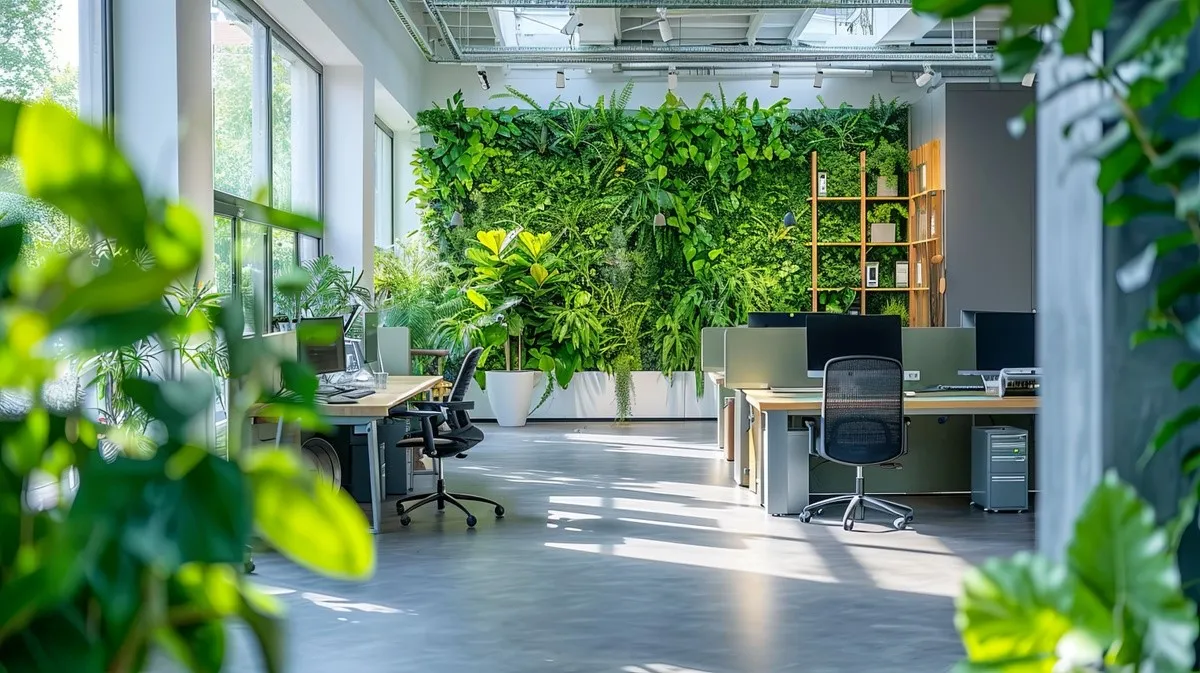
Bring the outside in with indoor plants which are great natural purifiers and also eat up CO2s. Aloe Vera and Snake plant etc. remove toxins from the air in your office, whilst providing oxygen in return. Prevent a Sick Building Syndrome i.e plants reduce C02s concentration while increasing oxygen levels thus preventing fatigue, headaches and other respiratory diseases.
Recycle
Make sure to have a recycling bin in the office for maximum green points, or start a recycling initiative where everyone has a recycling box on their desk and only one rubbish bin placed in a communal area (as opposed to rubbish bins at every station) to encourage mindfulness around how we discard waste.
Demarcate wellness / relaxation spaces
There is a saying that goes, if employees are happy, healthy and comfortable, they are more likely to be productive at work. One of the new trends is to purposely dedicate a wellness or relaxation space within the office or even better the immediate outdoors to offer a place where stressed employees can retreat to, regroup, refocus and just keep still, meditate or collect their thoughts. Adding a great view with plants and greenery is even better.
Get your AC management right
It will surprise you that a few changes in how you use your Air Conditioner (AC) goes a long way to conserving energy and making your home more energy efficient. The default mode for anyone who wants to cool their rooms on a hot day is to set the AC temperature to as low as say 18 degrees celsius right?
What this is actually does is to put more pressure on the AC to draw out the hot air and invariably use more energy. A simple hack which on the face of it might not look like saving on energy however is the go-to solution. Set your AC temperature to about 23 degrees celsius and turn on a fan which not only augments the ACs cooling effort but reduces the pressure on the AC in drawing out hot air.
This simple hack thus saves cost and makes your AC unit more energy efficient. In addition to the above, the outdoor unit also needs to breathe and shouldn’t be placed in a super airless spot or with overhangs that block free passage of air that make the outdoor unit over heat and work overtime.
Consider replacing your windows
These days, most people in this side of town use Air Conditioners (AC) to cool their homes and offices. In trying to make your home more comfortable however you may end up spending too much money on electricity if your home does not have windows that are airtight and have cool air escaping through the gaps.
You may need to consider retrofitting or more specifically changing your louvre blades windows for double panel windows that are a bit more secure. Now, if you can’t afford ACs you may rather consider replacing your windows in a way that allow in natural air or cross ventilation.
Get your lighting right
An effective way of reducing the energy consumption of a building is by replacing energy-related assets with their energy-efficient counterparts. LED light bulbs (LEDs), for example, use at least 75% less energy than traditional incandescent bulbs.
In addition to LEDs you can ensure that enough daylighting is allowed into the building which not only saves you costs but also ensures higher concentration levels for your staff. So, LED bulbs are popular these days and for some people it’s all about picking a pack off the rack in the believe that their energy usage will be efficient.
There is however more to optimizing the benefits of LED bulbs then making a simple purchase. In picking the bulb off the rack, please pay attention to the wattage and the lumens.
The lumens indicate level of brightness while wattage measures energy used hence a 9-watt LED bulb may actually be brighter than the traditional 45-watt incandescent bulb. So, focus on lumens rather than wattage.
Engage and educate employees
The old rule rings true, you can make systematic changes all you want, if you don’t have the buy in of people, the system will fail. So, in addition to implementing the green measures, ensure that you get experts to educate the staff on benefits of going green for personal wellness and environmental protection. Create a team of employees to monitor, patrol and educate other workers on environmentally friendly behaviors.
See that won’t be so hard? Would it ?
The writer is the Executive Director of Yecham Property Consult
& Founder of Green Building Alliance, Ghana, convenor of Ghana Green Building Summit
Email: [email protected]
Linkedin: Cyril Nii Ayitey Tetteh
Post Views: 21
Discover more from The Business & Financial Times
Subscribe to get the latest posts sent to your email.