
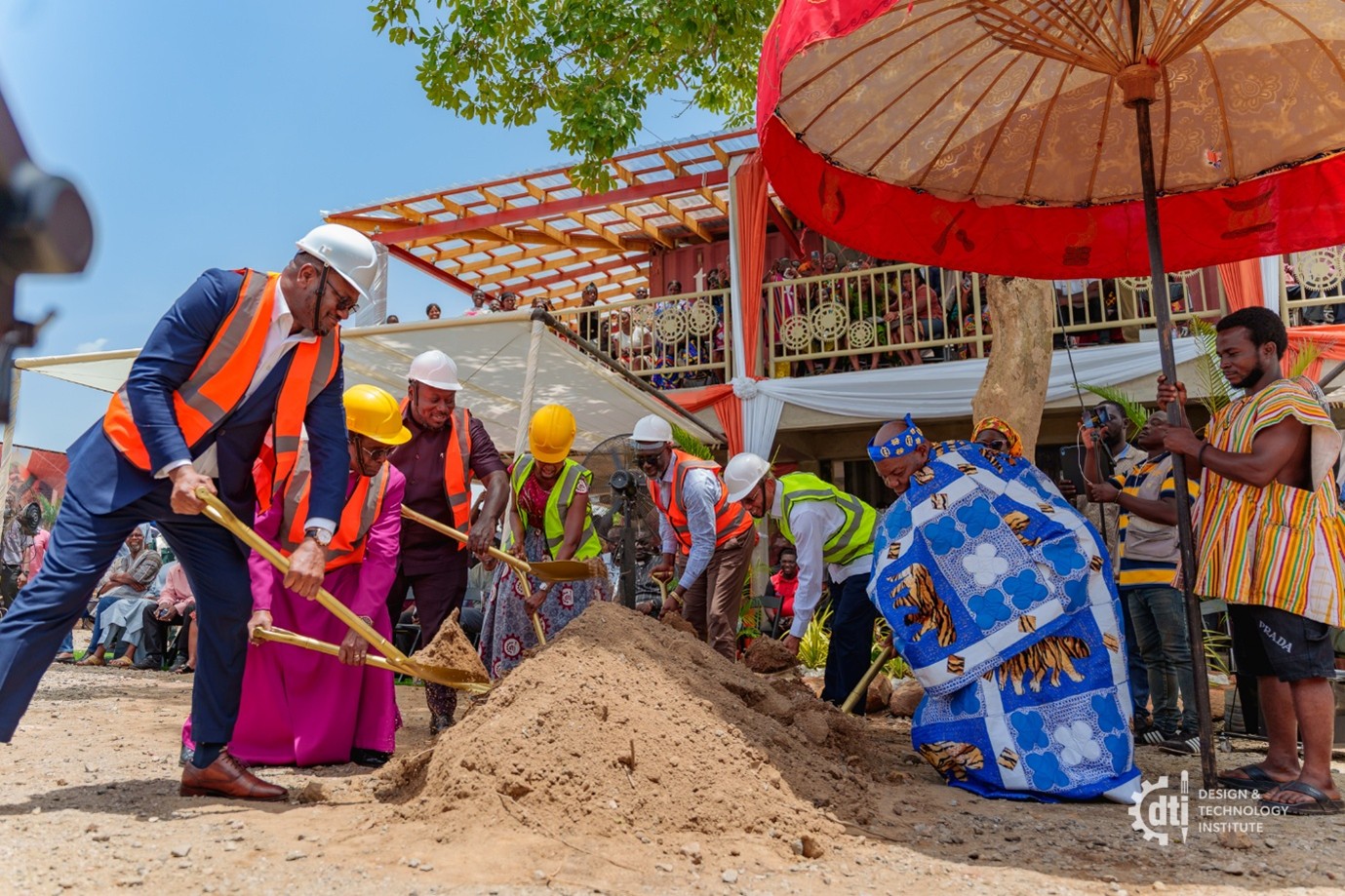

On a quiet stretch of red earth in Berekuso, a town nestled in the Eastern Region hills about 40 kilometres north-east of Accra, something quietly extraordinary took place on Tuesday morning.
There were no fanfares from the capital, no sweeping ministerial motorcades. But gathered on that site — among traditional rulers, government officials, industry leaders, and young people with calloused hands and clear eyes — was the beginning of something that may outlast them all.
The Design and Technology Institute (DTI) officially broke ground for a $28 million Multi-Skills Campus: a facility that, when completed, will train thousands of young Ghanaians each year in the practical, precise, and purposeful skills that modern industry demands. It is as much a statement of philosophy as it is a construction project.
For those who have watched Ghana’s skills deficit widen for decades — and for the young people who have felt that gap most acutely — Tuesday’s ceremony carried a weight that no press release could fully capture.
“This is not just a project. It is a movement.” — Constance Elizabeth Swaniker, Founder, DTI
From Workshop to National Movement
To understand what is being built in Berekuso, one must first understand who is building it — and why.
Constance Elizabeth Swaniker did not arrive at her mission through a policy paper or an academic hypothesis. She arrived through work. Nearly three decades ago, she founded Accents & Art, a metal fabrication company that would become one of Ghana’s most respected in its field. Day after day, she interviewed graduates — young men and women who had completed years of formal education, who had passed their exams and collected their certificates — and found them unable to perform the basic tasks her workshop required.
It was not a matter of intelligence. It was a matter of preparation. The classrooms had taught them to think in abstractions; the factory floor demanded precision.
“I saw brilliance, but not readiness,” she has often said. “And I knew something had to change.”
That observation — simple, stubborn, and urgent — became the seed of DTI. What began as a practical response to an industrial problem has grown, over the years, into something far larger: a national institution dedicated to the proposition that skills are not a consolation prize for those who could not secure degrees, but a foundation upon which entire economies are built.
Today, DTI operates across multiple campuses and disciplines, and its alumni can be found across Ghana — on construction sites and in design studios, in fabrication workshops and in entrepreneurial ventures of their own making. The numbers are striking: over 48,000 people trained directly, with employment outcomes linked to more than 81,000 individuals across the value chain. But Swaniker is quick to insist that the numbers, impressive as they are, are not the point.
“Every figure,” she says, “is a person who went home and changed something.”
Faces Behind the Numbers
Behind every statistic is a story that the statistic cannot tell.
There is the young woman from Kumasi who enrolled in DTI’s welding programme after two years of searching fruitlessly for clerical work, and who now runs a small fabrication business of her own, employing four other young people. There is the young man from the Northern Region who had never touched industrial machinery before DTI, and who is now a qualified technician working with a construction firm on one of Accra’s major infrastructure projects.
These are not exceptional cases. They are, increasingly, the norm — and that is the point.
Female participation at DTI has risen from just 21 per cent at the institution’s inception to over 50 per cent today. In a sector long dominated by men — where the very language of craftsmanship has historically skewed masculine — this is no small thing. It represents a deliberate and sustained effort to dismantle the assumption that technical education is not for women.
The women who graduate from DTI do not enter the workforce as an afterthought. They enter as qualified professionals. Many go on to become trainers, supervisors, and entrepreneurs in their own right, quietly rewriting the story of who gets to build things in Ghana.
Swaniker calls it a quiet revolution. From the inside, it does not feel quiet at all.
A Campus with a Purpose
The Berekuso Multi-Skills Campus is not, in the conventional sense, a school. It is something more deliberate, more intentional, and — its architects hope — more durable.
Designed around DTI’s core “Precision Quality” philosophy, the campus is conceived as a living ecosystem: a place where the boundaries between learning and doing are deliberately blurred. Students will not sit in rows and absorb knowledge in the abstract. They will work with their hands in spaces designed to replicate — and in some cases surpass — the conditions of real industry.
When completed, the 11:29-acre campus will house advanced laboratories and research spaces, industrial training workshops, and Ghana’s largest welding and fabrication centre. New programmes will be introduced across disciplines that rarely feature in conversations about technical education: industrial plumbing and water systems, electrical installation and solar technology, agricultural mechanisation, and even cleaning science — a field often dismissed as menial, yet which underpins the functioning of hospitals, airports, hotels, and every modern institution.
The inclusion of these programmes is itself a statement. It says: we take seriously the work that keeps the world running, even when the world takes it for granted.
The $28 million investment — drawn from a combination of institutional funds, development finance, and partnerships with the private sector — reflects a confidence that this model works. It is not a pilot. It is a commitment.
The Land and Its People
For the people of Berekuso, the groundbreaking carries a meaning that transcends the economic.
Berekuso is a town that has, for much of its recent history, been defined by what it is near — Aburi, the Akuapem Ridge, the Eastern Region’s green hills — more than by what it is. The arrival of DTI’s campus changes that. It makes Berekuso a destination: a place people will come to, train in, and carry forward into the world.
Odeɛfoɔ Oteng Korankye II, the traditional ruler of Berekuso, spoke at the ceremony with the measured weight of a man who has seen promises made and broken, and who is choosing, this time, to believe. He described the project as an investment not merely in infrastructure, but in the young people of his community — those who would otherwise leave in search of opportunity, and might now find reason to stay, or to return.
The land itself, he noted, had been set aside with intention. It was not donated reluctantly. It was offered in the spirit of a community saying: we are ready.
The Bigger African Story
The DTI groundbreaking is a Ghanaian story. But it points to a continental one.
Africa is the youngest region on earth. By 2030, more than 375 million young Africans will be of working age — a demographic dividend of extraordinary potential, provided the systems exist to channel it. At present, those systems are failing. Youth unemployment across Sub-Saharan Africa hovers in double digits in most economies. Even among those who are employed, the quality and sustainability of that employment is often precarious.
The skills mismatch — the gulf between what young people are trained to do and what employers actually need — is a thread running through nearly every economic conversation on the continent. Employers report difficulty finding qualified workers. Young people report finding it impossible to compete for jobs for which they are, by every formal measure, qualified. Both are telling the truth.
At the groundbreaking ceremony, George Opare Addo articulated the paradox with the bluntness it deserves: a nation — a continent — full of talented people, short of skills. Not because the people lack capacity, but because the systems around them have not been built to develop it.
DTI’s model is a direct challenge to that failure. Its “Precision Quality” philosophy does not merely seek to close the gap between education and employment; it seeks to redefine what education is for. The measure of a successful graduate is not a transcript. It is a set of demonstrable competencies — the ability to do something, reliably, to a standard that industry recognises and rewards.
It is a simple idea. It is also, in much of Africa, a revolutionary one.
A Call to Build — Together
The ceremony in Berekuso was well-attended, well-organised, and — as these events go — relatively brief. There were speeches, a prayer, the ceremonial turning of earth. There was applause.
But the moment that lingered longest, for many who were present, was not any single speech or gesture. It was the cumulative effect of the gathering itself: the sense that this was not one institution’s project, but a collective one.
Government representatives were there, acknowledging that the state cannot solve the skills crisis alone — that it needs partners willing to take risks, to invest, to innovate. Industry representatives were there, acknowledging their own role in defining what skills are needed and in creating pathways for those who develop them. Community leaders were there, acknowledging that development does not come from outside; it begins with the willingness to host it.
And young people were there — some of them DTI alumni, some of them prospective students, some of them simply residents of Berekuso curious about what was being built in their backyard. Their presence was the most important thing.
Swaniker addressed them directly. The movement, she said, belongs to them. DTI can build the campus, train the trainers, develop the curriculum, and forge the partnerships. But in the end, it is the young people who walk through the doors — who pick up the tools, learn the craft, and carry it into the world — who will determine what this project becomes.
“When people are given the right skills, they do not just change their own lives. They build nations.”
Hope in Every Brick
There is a particular kind of hope that is built, rather than wished. Not the passive hope of waiting for circumstances to improve, but the active, constructive hope of people who decide — together — to make something real.
That is what is taking shape in Berekuso.
As the first foundations are laid, they carry the ambition of a founder who saw a problem and refused to accept it; the testimony of tens of thousands of young people who have already been changed by what DTI offers; the expectation of a community that has opened its land and its arms; and the possibility — still unproven, but thoroughly credible — that what works in Berekuso can be scaled, replicated, and adapted across a continent that needs it urgently.
Africa’s future will not be built by abstract policy. It will be built by people with skills: welders and fabricators, electricians and plumbers, agricultural technicians and cleaning scientists, entrepreneurs and craftspeople of every kind.
It will be built, in other words, by the graduates of places like DTI.
For a town long tucked away from the national spotlight, Tuesday morning felt different. With Ashesi University and the Design and Technology Institute (DTI) taking root in the community, Berekuso stands on the threshold of a transformation that few saw coming — but many have long hoped for.
Post Views: 15
Discover more from The Business & Financial Times
Subscribe to get the latest posts sent to your email.